Rosetta Stone
Work of artWikipedia
157
MENTIONS
67
EPISODES
57
PODCASTS
Search complete. 157 mentions across 67 episodes found for "Rosetta Stone".
Oct 7, 2026

speaker_4NARRATOR
The fact that we can read any of them is, honestly, almost miraculous.
speaker_4NARRATOR
The knowledge of how to read hieroglyphics was completely lost for centuries, basically for more than a thousand years, until the Rosetta Stone was discovered.
speaker_4NARRATOR
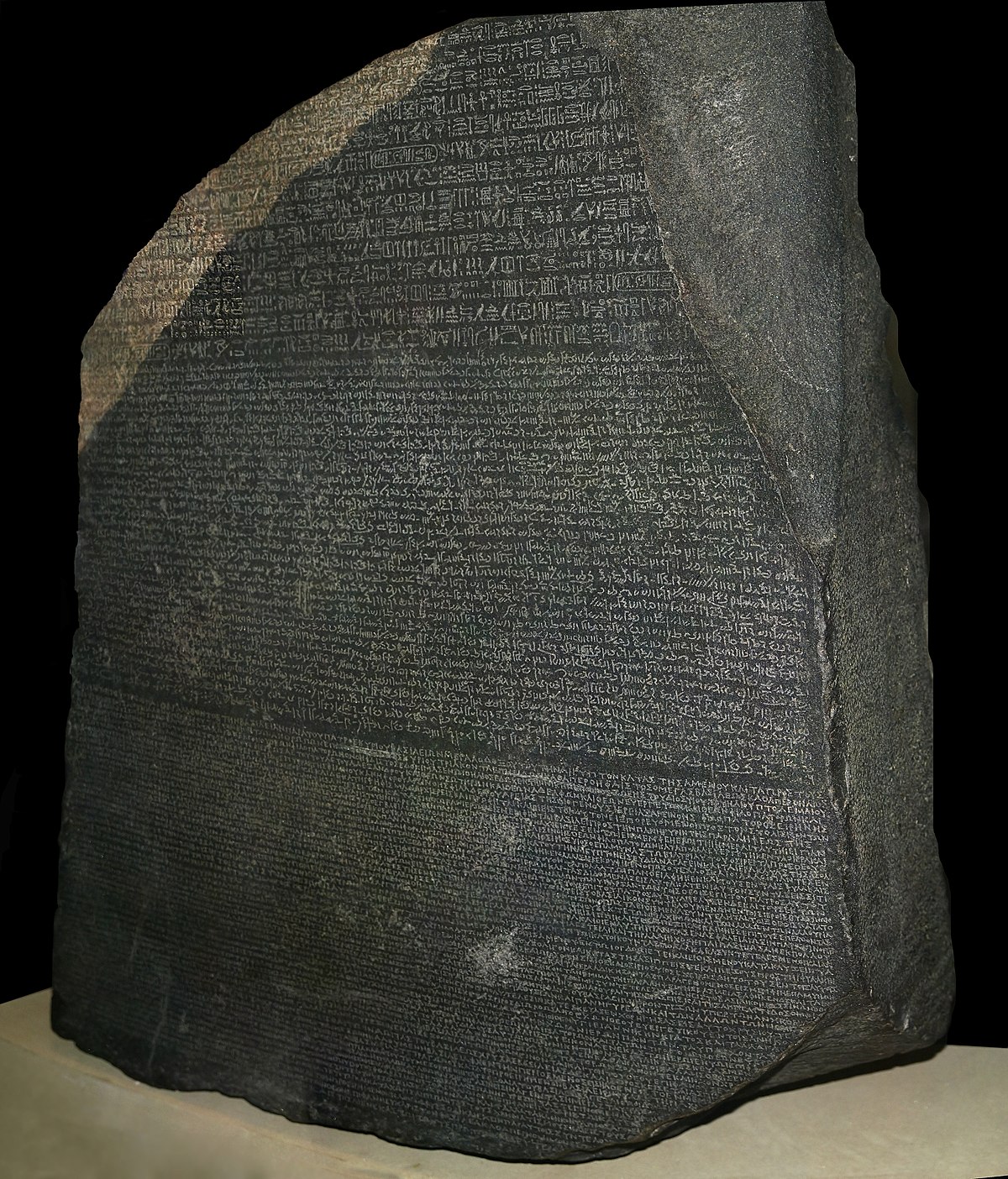
The Rosetta Stone contained the same text written three times: in hieroglyphics; in demotic, which was a later cursive form; and in Greek.
speaker_4NARRATOR
By carefully comparing the Greek version, which scholars could read, linguists figured out the system and cracked the code.
speaker_4NARRATOR
This single discovery suddenly allowed us to read thousands of years of ancient records and documents.

Emma LaramyHOST
The enormous illustrated volumes produced allowed Europeans to study temples and monuments without leaving home.
Emma LaramyHOST
And the Rosetta Stone helped make hieroglyphs readable.
Emma LaramyHOST
So museums began filling with Egyptian objects and bodies.
Emma LaramyHOST
Obelisks rose in Paris, London, and New York.

ToriHOST
The message was a secret troop briefing laying out French and Allied positions just weeks before Austria went to war.
ToriHOST
A European history researcher told the site that AI has the ability to act like a Rosetta Stone for translating all sorts of coded historical messages.
ToriHOST
[upbeat music] A picture is worth a thousand words, and there's a few that might be worth more than that.
ToriHOST
Nikon is on its annual hunt to find the funniest photos from the animal kingdom for its Comedy Wildlife Photography Awards.

Lisa BaileyHOST
That's cool
Kathy DonegiaGUEST
... of the Rosetta Stone, and we all know the story-
Lisa BaileyHOST
Yes
Kathy DonegiaGUEST
... of the Rosetta Stone, that we didn't know how to, how to read Egyptian hieroglyphics-
Lisa BaileyHOST
Right
Kathy DonegiaGUEST
... until the Rosetta Stone had a different language on the same, the same passage In, I think, three languages, and so they were able-
Lisa BaileyHOST
Right
Kathy DonegiaGUEST
... to compare and start to unlock the language.

Lisa BaileyHOST
That's cool
Kathy DonegiaGUEST
... of the Rosetta Stone, and we all know the story-
Lisa BaileyHOST
Yes
Kathy DonegiaGUEST
... of the Rosetta Stone, that we didn't know how to, how to read Egyptian hieroglyphics-
Lisa BaileyHOST
Right
Kathy DonegiaGUEST
... until the Rosetta Stone had a different language on the same, the same passage.
Kathy DonegiaGUEST
In, I think, three languages, and so they were able-
Lisa BaileyHOST
Right

SarahHOST
And we were like, gosh, that's really pretty, but who knows what it is.
SarahHOST
And then somebody found that very famous and very convenient artifact known as the Rosetta Stone.
SarahHOST
And they were like, aha, it's in Greek, which we know what it says.
SarahHOST
And it's in Coptic, which we know what it says.
SarahHOST
Demotic.
SarahHOST
And the Egyptian bit turned out to be also demotic, but in the fancy old-timey religious way of writing it, which was hieroglyphs.
SarahHOST
And because the Rosetta Stone contained a lot of proper nouns, they were able to figure it out because proper nouns almost never change, other than to fit the necessary changes between languages, like, oh, I don't actually have that letter in my alphabet, so I'm going to approximate it.
SarahHOST
And they were like, oh, I can start to match up the names, and now I see that this is the same thing over and over, and I can, you know, whatever.

speaker_1HOST
The murky waters become incredibly clear.
speaker_0HOST
The novel really is the Rosetta Stone for this mystery.
speaker_1HOST
It is where we find the explicit smoking guns that Francis Ford Coppola later decided to imply rather than show.
speaker_0HOST
Because in the book, the Corleones don't undergo a slow, agonizing burn of realization, do they?

Jeff ParkGUEST
It's
ArchieHOST
the Rosetta Stone for you.
ArchieHOST
It's going to be
Jeff ParkGUEST
awful.

Steve StocktonHOST
While some AI models have suggested Hebrew or other ancient languages as potential linguistic bases The translations they produce are often nonsensical or require so many manual adjustments that they lose scientific credibility.
Steve StocktonHOST
So until a Rosetta Stone for the Voynich manuscript is found, it remains a silent witness to a forgotten mind, a 600-year-old secret that refuses to be told.
Steve StocktonHOST
Next, the Tunguska event.
Steve StocktonHOST
Now, the Tunguska event of 1908 is the largest impact event on Earth in recorded history, yet it left behind no crater, no fragments of a meteorite, and no definitive explanation that satisfies every branch of science.
57 more episodes mention Rosetta Stone.
Create an account to see the whole feed, search across every transcript, and follow the entities you care about.