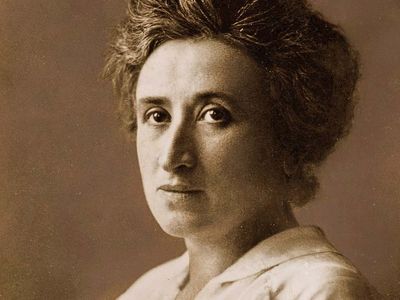
Rosa Luxemburg
Polish-German revolutionaryWikipedia
86
MENTIONS
52
EPISODES
43
PODCASTS
Search complete. 86 mentions across 52 episodes found for "Rosa Luxemburg".
Sep 12, 2026

Pete QuiñonesGUEST
So... you might think that a, the, you know, the people who were brought up in the Prussian empire, especially the older people and the people who fought in world war one were like, what the hell is happening to our country? So that's just basically the background of it.
Pete QuiñonesGUEST
And, you know, books are flooding in and communists are all over the place.
Pete QuiñonesGUEST
And the, the, you know, the national socialists are fighting them in the streets.
Pete QuiñonesGUEST
There's basically a civil war in the streets.
Pete QuiñonesGUEST
Yeah.
Pete QuiñonesGUEST
Yeah.
Pete QuiñonesGUEST
Well, I mean, they burned Karl Marx, Friedrich Engels, Karl Kautsky, and the reason they did is the communists were their sworn enemy.
Pete QuiñonesGUEST
And, you know, the first thing that a very intelligent person of an IQ of about 95 will want to point out is that they were socialists.

Bradley ThayerSOUNDBITE_SPEAKER
The totality of Western civilization, the totality of democratic government was their intent.
Bradley ThayerSOUNDBITE_SPEAKER
Lenin said you could do that in three ways, through a coup d'etat, as the Bolsheviks did, and which you immediately had in the wake of the Bolshevik Revolution, for example, in Bavaria and in Hungary and in other German states, as well as the failed Spartakusbund uprising of Rosa Luxemburg and Karl Liebknecht.
Bradley ThayerSOUNDBITE_SPEAKER
Secondly, he said you could have the Red Army spread the revolution.
Bradley ThayerSOUNDBITE_SPEAKER
But outside of Warsaw in 1920, the Poles stopped the Red Army, famously, and were able to eject them and send them back into Bolshevik Russia.

Justin PodurHOST
But really, I didn't know what happened after.
Justin PodurHOST
I heard about Rosa Luxemburg and Karl Liebknecht, but...
Justin PodurHOST
this is this story is a lot more detailed and and it's hard to overstate how important germany was to marxists uh to revolutionaries at this time everybody believed that from marxist time on that the revolution was going to come here in the most advanced european economy in the world germany the russian revolutionaries except maybe stalin later on thought that russia's revolution was just a prologue and the real revolution was coming in germany lenin said in western europe above all in countries like germany it'll be much more difficult to begin the proletarian revolution than in russia but it will be much easier to continue and complete it as for the wonderful energy which 20 million german proletarians steeled educated and organized will be able to display in the final struggle for socialism we cannot yet have the remotest conception of it so So that gives you a real sense of the awe in which Germany was held by Russians and presumably all the other socialists of Europe at this time.
Justin PodurHOST
um so social history two-thirds of the german population was urban by 1910 and about the same number or proportion is what would be considered working class industrial working class workers there are some big families like everywhere and these big families are big capitalist families and they own the massive Means of production.
6 MINS LATER
Justin PodurHOST
The individual worker lived in his party.
Justin PodurHOST
The party penetrated into the worker's everyday habits.
Justin PodurHOST
And that's why Rosa Luxemburg, who grew up in this system, I mean, she was from Poland, but she really had her, you know, her work was all in this party.
Justin PodurHOST
She wrote kind of against Lenin's what is to be done.

Steve GrumbineHOST
What does that do for me if I have no agency within the system to make changes? Right.
Steve GrumbineHOST
And that brought me to Lady Rosa Luxembourg, who said, you know, a socialist entering into the government does not transform the government into a socialist government, but instead is transformed themselves into a bourgeois minister of capital.
Steve GrumbineHOST
And that broke me.
Steve GrumbineHOST
That broke me.
12 MINS LATER
John HarveyGUEST
But he's not saying to get rid of it.
John HarveyGUEST
So it's certainly not an extreme volume.
John HarveyGUEST
Or, you know, as you've pointed out, it's not, you know, from Luxembourg or Marx or whatever.
John HarveyGUEST
And yet she got hold of it.

Beatrice Adler-BoltonSOUNDBITE_SPEAKER
Cabral too, same thing.
Beatrice Adler-BoltonSOUNDBITE_SPEAKER
Rosa Luxemburg had hip dysplasia.
Beatrice Adler-BoltonSOUNDBITE_SPEAKER
Mao had ALS.
Beatrice Adler-BoltonSOUNDBITE_SPEAKER
Fanon had terminal myeloid leukemia.

Hasan PikerHOST
Cabral too, same thing.
Hasan PikerHOST
Rosa Luxemburg had hip dysplasia.
Hasan PikerHOST
Mao also had ALS.
Hasan PikerHOST
Fanon had terminal myeloid leukemia, and he wrote some of his best work under the knowledge that diagnosis was hanging over his head.

Héctor Puente SierraGUEST
Yeah.
Héctor Puente SierraGUEST
I mean, look, the kind of situation, yeah, that had developed in Spain by 1936, by the time of the military uprising, of deep social polarization and deep social crisis was really the kind of situation that the revolutionary Rosa Luxemburg had in mind when, you know, at the time of the First World War, she spoke of society standing at a crossroads between socialism and barbarism.
Héctor Puente SierraGUEST
It was really a choice between society moving forward to a radically more democratic and egalitarian way of organizing society towards socialism or going backwards in a wave of reaction.
Héctor Puente SierraGUEST
That was really the choice in Spain by 1936.

Florian MaiwaldGUEST
We might be constantly confronted with new obstacles, which is why, um, why I incidentally, um, um, quote Marx premier also in one of the essays, I think.
Florian MaiwaldGUEST
Um, if I remember correctly, I think it was in one of the essays where you, where you can actually read Marx in the way that this bourgeois subjectivity is an early manifestation, um, of this emancipatory subjectivity, but of course it needs to be overcome by the proletarian subject.
Florian MaiwaldGUEST
So there's a discontent.
Florian MaiwaldGUEST
Um, first it's, it's going against the feudal structures, then you basically have liberal society.
54 MINS LATER
Florian MaiwaldGUEST
It's contradictory at times.
Matt McManusGUEST
Yeah.
Matt McManusGUEST
I remember in The Art of Loving, uh, he puts this even more basically, right? Where he points out, um, why is it that so many relationships tend to be controlling, right? Why it is one partner, usually the man, but not exclusively, try to control the other, uh, even though purportedly loves them.
Matt McManusGUEST
Uh, well, it's because being aware that another person is free and can choose to reject you is extremely anxiety inducing for a lot of us, right? Uh, freedom can mean c- the freedom to cause me pain.

Greg KoabelHOST
Usually, such incidents were sparked by demands that businesses stop employing enemy aliens.
Greg KoabelHOST
And as we saw last episode, in January 1919, veterans had smashed up the Socialist Party headquarters in Winnipeg in protest against a labor rally in support of Rosa Luxemburg and Karl Liebknecht, two murdered German socialists.
Greg KoabelHOST
But that did not necessarily mean that veterans in Winnipeg would take the side of the forces of capital against the radicals in the strike committee, so often associated with foreigners.
Greg KoabelHOST
Many returning soldiers were also workers with a keen eye for the iniquities of the status quo in the Canadian economy.

Beatrice Adler BoltonSOUNDBITE_SPEAKER
Cabral, too, same thing.
Beatrice Adler BoltonSOUNDBITE_SPEAKER
Rosa Luxemburg had hip dysplasia.
Ben ShapiroHOST
Asthma.
Beatrice Adler BoltonSOUNDBITE_SPEAKER
Mao had ALS.
42 more episodes mention Rosa Luxemburg.
Create an account to see the whole feed, search across every transcript, and follow the entities you care about.