Root cause analysis
29
MENTIONS
11
EPISODES
9
PODCASTS
Search complete. 29 mentions across 11 episodes found for "Root cause analysis".
Sep 24, 2026

Brian StraitHOST
to get to where we need to go.
Brian StraitHOST
So I want to dive a little bit deeper just on the root cause analysis component of this, because we can identify failures of systems, and that's great.
Brian StraitHOST
But if you just fix the failure and don't fix the problem that caused it, then you're going to have that failure over and over again.
Brian StraitHOST
And You know, AI, I think, can help you with that root cause analysis.
Brian StraitHOST
Can you talk a little bit about how AI changes the process of root cause analysis from a speed and a quality standpoint to get to where we need to go to solve these problems permanently instead of just band-aid fixing things?
Michael BeckerGUEST
Yes, that's a good point.
Michael BeckerGUEST
In here, we try to help the service and maintenance teams, of course, and also our warehouse customers.
Michael BeckerGUEST
Why? Because the traditional root cause analysis needs to have the evidence between across systems, across teams, across maintenance schedules, different knowledge standards that we have, spare parts and all of that.

Brian StraitHOST
to get to where we need to go.
Brian StraitHOST
So I want to dive a little bit deeper just on the root cause analysis component of this, because we can identify failures of systems, and that's great.
Brian StraitHOST
But if you just fix the failure and don't fix the problem that caused it, then you're going to have that failure over and over again.
Brian StraitHOST
And You know, AI, I think, can help you with that root cause analysis.
Brian StraitHOST
Can you talk a little bit about how AI changes the process of root cause analysis from a speed and a quality standpoint to get to where we need to go to solve these problems permanently instead of just band-aid fixing things?
Michael BecherGUEST
Yes, that's a good point.
Michael BecherGUEST
In here, we try to help the service and maintenance teams, of course, and also our warehouse customers.
Michael BecherGUEST
Why? Because the traditional root cause analysis needs to have the evidence between across systems, across teams, across maintenance schedules, different knowledge standards that we have, spare parts and all of that.

MarkHOST
And most of them had written down near misses that happened beforehand.
MarkHOST
And they just didn't do good root cause analysis.
MarkHOST
They didn't do good corrective actions.
MarkHOST
And boom, it was just waiting to kill somebody.
MarcusHOST
We have maybe a good start with our summit course that we're putting together.
MarcusHOST
Get out there and look.
MarcusHOST
Is the work being done the same way as we designed it to be? Find any discrepancies and start deciding, do we need to take this through root cause analysis, or do we need to put some corrective actions in place to make it easier for them to get the work done? Because everybody's motivated by saving time and effort, and if we don't design that into the system to...
MarcusHOST
make sure that they are saving time and effort doing the job, then they're going to find a shortcut.
Mark ParadiesHOST
I can't understand why it would do this, why the incidence changed like that.
Mark ParadiesHOST
And it turned out the guy who was in charge of the root cause analysis program made a rule that there could only be one root cause, and so you had to pick the rootiest of the root causes and throw out the rest.
Mark ParadiesHOST
And that's what they did.
Mark ParadiesHOST
Now, if AI looked at this, would AI think that was abnormal or not? What we decided was we could not trust that data in that two-year period.

AshHOST
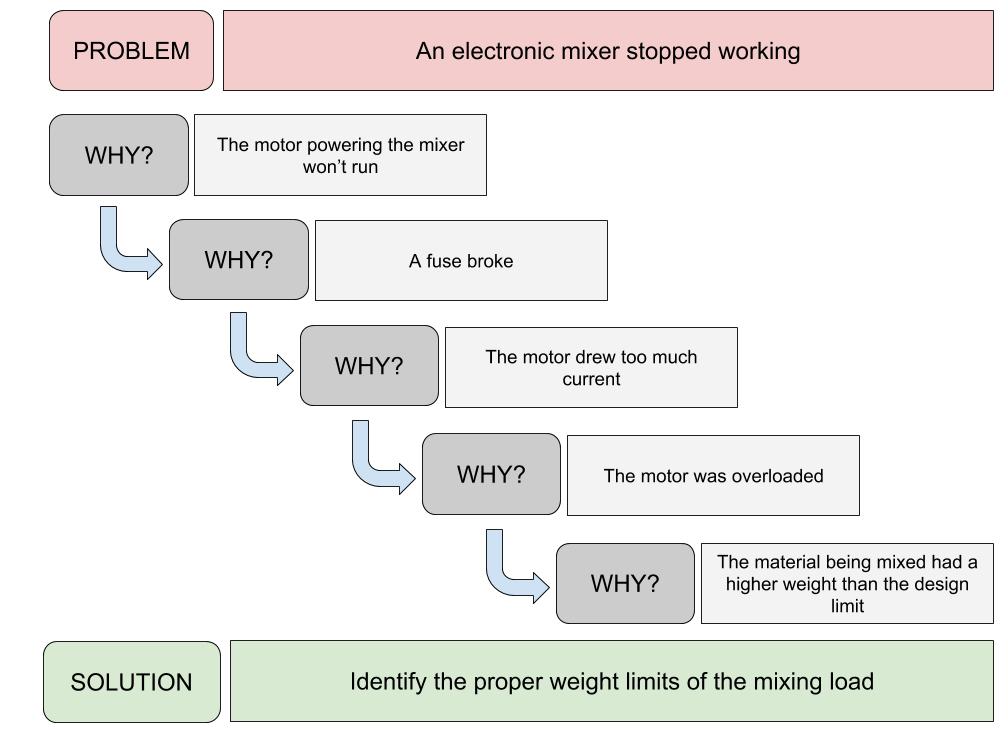
Now this flows onto like what we call the root cause ladder.
AshHOST
Have you guys ever heard of the root cause or figuring out the seven whys? Do you guys ever do that part of your commentary?
KevinHOST
Root cause.
KevinHOST
Root cause.
KevinHOST
I've heard of root beer.
KevinHOST
What's that? Yeah, what is that? Yeah, what is
AshHOST
that? Root cause.
AshHOST
Explain.

Minhajuddin AhmedHOST
Of all of the disease, meaning all the violations, whether it comes to the rights of Allah or rights of the creation of Allah, it goes back to denial of the hereafter.
Minhajuddin AhmedHOST
And when it comes on the, uh, flip side, on the positive side, the root cause, you know, RCA, Root Cause Analysis, of all the good and all the khair that, uh, comes into wujud, comes into existence, it is, uh, the belief in the hereafter, belief in accountability, belief of standing in front of Allah subhanahu wa ta'ala, taqwa.
Minhajuddin AhmedHOST
That is why it is repeated over and over and over and over and over and over again, uh, that there is a Day of Judgment, there is a Yawm ud-Deen, there is a Yawm ul-Jazaa, there is a Yawm ul-Hisab, Day of Reckoning, Day of Judgment, Day of Qiyamah, when you will have to stand in front of Allah Ta'ala.
Minhajuddin AhmedHOST
So belief in that is the root cause m-- of all of the khair that will come.

Sean ArcherGUEST
When you realize, man, I keep changing this bearing every – three months or whatnot, and it's not really getting a lot of use, you have to figure out why.
Sean ArcherGUEST
Is it aligned well? Does the role align well? So it's root cause analysis.
Sean ArcherGUEST
I know it's heard everywhere, but I think root cause analysis is the biggest lifesaver of any maintenance tech, maintenance manager, or supervisor.
Martin EngsterHOST
Do you guys have like a set standard operating procedure as far as like, hey, this is we're doing maintenance on this item X amount of times, like every four weeks we check all this stuff or or, you know, I talked to another company not so long ago.
Martin EngsterHOST
What they do specifically is they know that they have certain issues or certain reoccurring issues.

speaker_0HOST
What happens when the people who understand them best are no longer there? In this episode, we explore how Tweezer is creating a deterministic blueprint of complex application states across IBM Z, Linux One, and connected distributed environments.
speaker_0HOST
We also look at how that foundation can give AI agents the context they need to perform meaningful root cause analysis and, of course, propose fixes that can actually be tested.
speaker_0HOST
Ohad, welcome to Z in Action.
speaker_0HOST
Thank you very much.
11 MINS LATER
Ohad KotlerGUEST
And that's how actually we build legacy, right? Legacy is a result of decades of these types of changes and fixes and improvements getting kind of built one on top of the other.
Ohad KotlerGUEST
Well, today, that entire experience looks different.
Ohad KotlerGUEST
Today, in the banks that we work with, we enable that same operations team to be able to ask, in the case of an operative event, a nightly job fails, they are able to get a meaningful explanation of not only what just happened here, is what is the root cause analysis? What is the reasoning? What is the business role of this activity? How does that business role impacts other business capabilities and activities, not only at the level of technical meaning, right? Not only if this will not be triggered, then the next one will also be stuck, but rather, these clients or these bankers will not be able to provide them with the right uh credit facility for example right that's a pretty meaningful thing and and they are able to do that by simply asking a question or even automatically getting the trigger of an answer when an incident happens with a fully detailed analysis within minutes now add to that that once they provide that type of insight they are able to provide it back to Ben or to his team because now Ben is no longer the bottleneck.
Ohad KotlerGUEST
Ben is only kind of the orchestrator, the architect, the person who decides how good looks like, but he doesn't need to be in every detail to explain every last step that happens within the system.
MarkHOST
So our topic today at the Taproot Podcast, welcome to the Taproot Podcast, our topic today is going to be root cause analysis red flags.
MarkHOST
So these are going to be problems when you see these in an investigation, it's a red flag for you as an investigator, as a lead, as a person that might be evaluating root cause system, look for these red flags, you're going to see a problem with the way they're doing the investigation.
MarkHOST
So I want to start this off with kind of a question.
1 more episode mentions Root cause analysis.
Create an account to see the whole feed, search across every transcript, and follow the entities you care about.