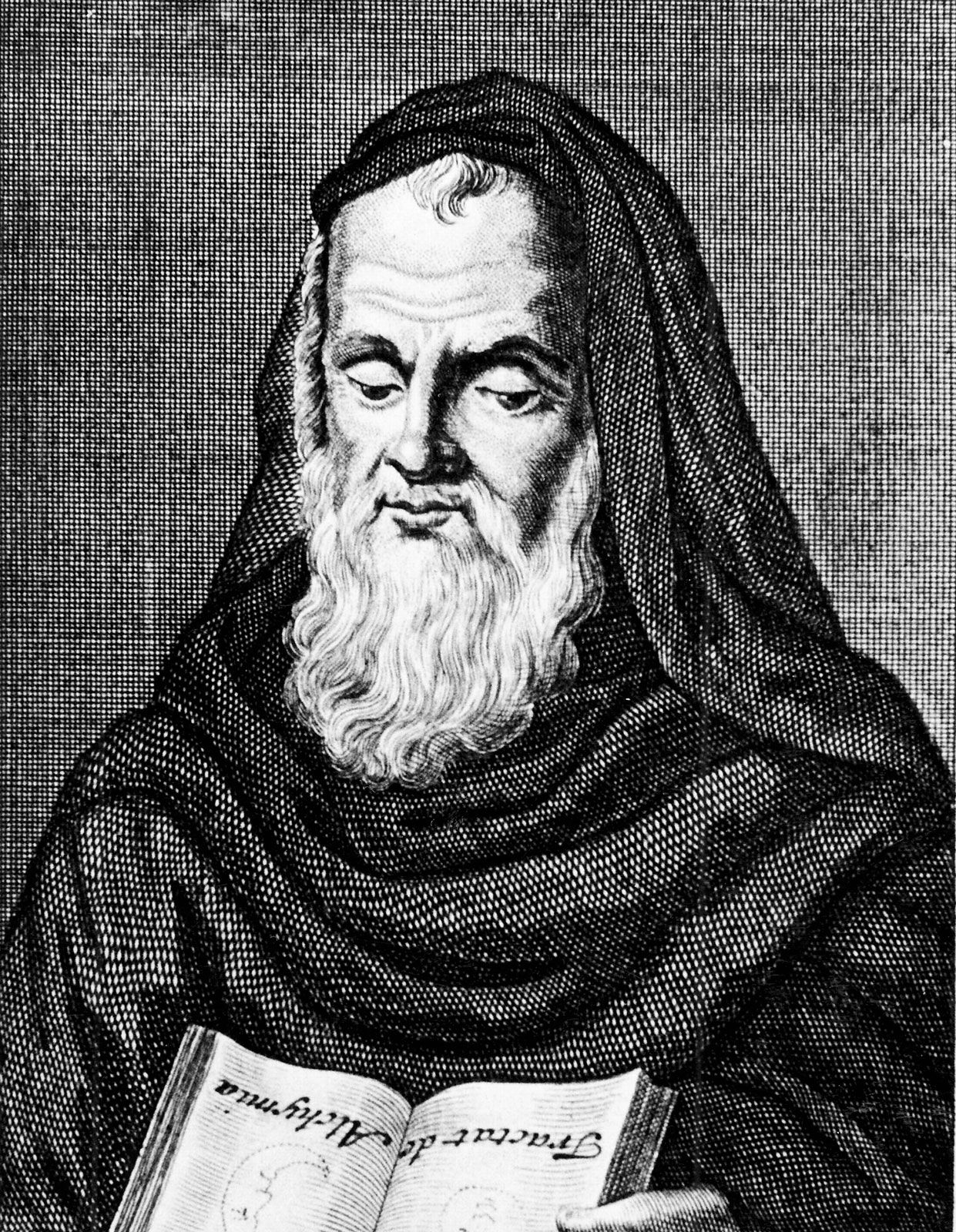
Roger Bacon
English polymath and philosopherWikipedia
143
MENTIONS
44
EPISODES
38
PODCASTS
Search complete. 143 mentions across 44 episodes found for "Roger Bacon".
Oct 14, 2026

LukeHOST
Um, it was- Probably used in Europe at the Battle of Leynica in 1241, though, uh, that's not, uh, definite.
LukeHOST
And then the first definite, uh, reference to it is Roger Bacon wrote, uh, in Opus Majus he mentions, uh, like, gunpowder as a, uh, firecracker, a form of firework.
LukeHOST
Um-
EleanorHOST
Mm-hmm.
LukeHOST
And there was a guy I've talked about before named William Rubruck who, who did go to the Mongol courts, and he was-
EleanorHOST
Mm
LukeHOST
... a known acquaintance of Roger Bacon.
LukeHOST
So I mean, there is, like, a...

Pamela NagamiNARRATOR
The necessity of clearly defining the doctrines of the Church tended to make its teaching dogmatic.
Pamela NagamiNARRATOR
Originality and research were discouraged, and men like Roger Bacon, who dared to think and experiment for themselves, felt the weight of ecclesiastical displeasure.
Pamela NagamiNARRATOR
In the Middle Ages, nevertheless, the mind of man was remarkably active, and having little new material on which to work, it was compelled to exercise its ingenuity in endless arguments on abstract and often unimportant questions, working upon itself, as Bacon says, as the spider worketh its web, bringing forth cobwebs of learning, admirable for its fineness of thread and work, but of no substance or profit.
Pamela NagamiNARRATOR
The ascetic ideal of the Middle Ages is well described by John Addington Simmons.

Daniel EverettGUEST
But, um, um, so the ability to infer, um, in, in my new book, this, this replaces the need for a universal grammar.
Daniel EverettGUEST
In fact, the first person to talk about universal grammar was, um, to use that term, which is Chomsky's term, that's what he's known for, this innate universal grammar, um, was the monk from the 13th century, Roger Bacon, who was a, a brilliant person.
Daniel EverettGUEST
And when he talked about language, he talked about a logical, not a biological, universal grammar, so that language was constrained by logic.
Daniel EverettGUEST
Now, if we jump forward to 1865, 600 years after Roger Bacon, we get to Cambridge, Massachusetts, to Charles Sanders Peirce, who argued that, um, uh, for universal grammar, and he was the first American to use the term universal grammar.
44 MINS LATER
Danny JonesHOST
Did you ever have any conversation with them, um, about like do they have any belief of what happens when they die? Or they just think it's they're dead and gone, and there's nothing there?
Daniel EverettGUEST
Yeah, right.
Daniel EverettGUEST
You know, I've asked somebody what happens when you die, and there's a dead monkey lying by the fire.
Daniel EverettGUEST
He said, "Well, that's what happens.

James EglintonHOST
And the act of, um...
James EglintonHOST
So there's a certain way of cultivating or where linguistic study, this is Roger Bacon's argument from the 13th century, careful, slow linguistic study is its own school of virtue.
James EglintonHOST
Um, so when he was talking about an- well, what we would just call ancient languages with Greek and Hebrew and Aramaic and so on, um, his category for this was wisdom languages, and I think part of that is because you're l- you're r- trying to relate to them as a creature that is inclined either to virtue or vice.
James EglintonHOST
So studying those ancient languages is meant to be hard, is meant to be slow, and trying to read texts for yourself that are written in those languages is meant to be, in one sense, both affirming and alienating.
James EglintonHOST
So, um, we just do live in a very utilitarian, monolingual society, and I think Christianity does...
James EglintonHOST
Well, Christianity like pushes a sort of, a sort of filters into that in a few different ways.
James EglintonHOST
Um, and maybe the way that it filters in through me is to maybe stand a bit like a Roger Bacon figure, um, in the Middle Ages, just to say, like, what does this do to us? And, um, it's not a question a lot of people are asking, but if I've, if, if the fruit of my pieces, uh, some people shift from group, uh, one to group two, then-
Gray SutantoHOST
That's success

CaveatNARRATOR
The latter date is fixed by the death of Albertus Magnus, who in his book De Mirabilis Mundi from internal evidence is obviously plagiarizing the Liber Ignium.
CaveatNARRATOR
Friar Roger Bacon, twelve fourteen to ninety-four, in two of his works refers at least twice to compositions containing saltpeter, powdered charcoal, and sulfur.
CaveatNARRATOR
In one place he refers to fires that shall burn at what distance we please.
CaveatNARRATOR
In other two, thunder and coruscations, which references seem to suggest that he is describing something of a pyrotechnic nature rather than the simple effect of gunpowder.
2 HRS 44 MINS LATER
Martha WellerNARRATOR
We will consider this class first.
Martha WellerNARRATOR
The two oldest forms of fireworks known are undoubtedly the cracker and the rocket.
Martha WellerNARRATOR
As we have already noted, both of these, or at least primitive forms, are mentioned by Marcus Graecus, Albertus, and Roger Bacon.
Martha WellerNARRATOR
The description by the former is sufficiently clear to leave no doubt in our minds that he is describing a rocket.

Peter EastmanNARRATOR
Such men have endeavoured to explain all phenomena as the outcome of an order of things which extends to every detail.
Peter EastmanNARRATOR
Geniuses such as Aristotle, or Archimedes, or Roger Bacon, must have been endowed with the full scientific mentality, which instinctively holds that all things great and small are conceivable as exemplifications of general principles which reign throughout the natural order.
Peter EastmanNARRATOR
But until the close of the Middle Ages the general educated public did not feel that intimate conviction, and that detailed interest, in such an idea, so as to lead to an unceasing supply of men with ability and opportunity adequate to maintain a co-ordinated search for the discovery of these hypothetical principles.
Peter EastmanNARRATOR
Either people were doubtful about the existence of such principles, or were doubtful about any success in finding them, or took no interest in thinking about them, or were oblivious to their practical importance when found.

Nicholas James BridgewaterNARRATOR
I am the carbuncle of the sun, a most noble clarified earth, by which thou mayest turn copper, iron, tin, and lead into most pure gold." The philosopher's stone was supposed to possess the most marvelous power.
Nicholas James BridgewaterNARRATOR
Roger Bacon, one of our own countrymen, declaring that it was able to transform a million times its weight of base metal into gold.
Nicholas James BridgewaterNARRATOR
Besides this, it was supposed to have the power of prolonging life and was therefore regarded as an elixir vitae.
Nicholas James BridgewaterNARRATOR
Many other beliefs held at that time were, however, equally absurd.

Jan BakerNARRATOR
Don't talk about lack of initiative in the Middle Ages.
Jan BakerNARRATOR
Frederick Harrison said, Of all the epochs of effort after a new life, that of the age of Aquinas, Roger Bacon, St. Francis, St. Louis, Giotto, and Dante is the most purely spiritual, the most really constructive, and indeed the most truly philosophic.
Jan BakerNARRATOR
Don't forget that in recent years there has been serious discussion as to whether the thirteenth century may not have been the greatest century of human existence.
Jan BakerNARRATOR
Don't scoff at the idea of a medieval century as the greatest until you have weighed Frederick Harrison's expression.

speaker_11NARRATOR
End of Medicine and its Subjects by Avicenna.
speaker_11NARRATOR
On the Science of Experiments from the Opus Tertium by Roger Bacon, 1214-1294, translated by Andrew George Little, 1863-1945.
speaker_11NARRATOR
This is a LibriVox recording.
speaker_11NARRATOR
All LibriVox recordings are in the public domain.
speaker_11NARRATOR
This is the origin of all philosophic images and incantations, and so this science distinguishes between those made according to the truth of philosophy and those made according to the falsity of magical art.
speaker_11NARRATOR
Aristotle used this science when he gave the world to Alexander, and Antichrist will use it far more powerfully than Aristotle.
speaker_11NARRATOR
End of On the Science of Experiments by Roger Bacon.
Colleen McMahonNARRATOR
Princess Who Became Peddler Tells Her Own Story of Moscow by Princess Nina Zizianov from The New York Times, April 17, 1921.

AmoryUNKNOWN
The objective was to find the Stone.
AmoryUNKNOWN
Roger Bacon told us of facts concerning the sciences that scientific men could not fully comprehend.
AmoryUNKNOWN
He believed the Philosopher's Stone to be the secret of indefinite prolongation, and that futures could be predicted by means of a mirror." Worth noting here is that Bacon actually conceptualized the vehicle independent of horses, declaring that the ancients had done this, and the art might be revived.
AmoryUNKNOWN
The Man Who Did It went on speaking.
AmoryUNKNOWN
"Read the story backward.
AmoryUNKNOWN
Hyper-capable, they demonstrate their philosophies like a mathematician shows his work, by means of simply radiating authentic gnosis from their core.
AmoryUNKNOWN
There is no need to wear a badge to lay rizz on the quantifiability of the results because, in the case of alchemy, they are the result.
AmoryUNKNOWN
So when we read the words of such a man like Roger Bacon, insisting that the future can be predicted with a mirror, we know that the ink and paper sentences won't be bringing us closer to any kinda inner light on its own, making us like the dog that stares at its master's finger in lieu of following its path to the ball that has been thrown just beyond our conceptual gaze.
34 more episodes mention Roger Bacon.
Create an account to see the whole feed, search across every transcript, and follow the entities you care about.