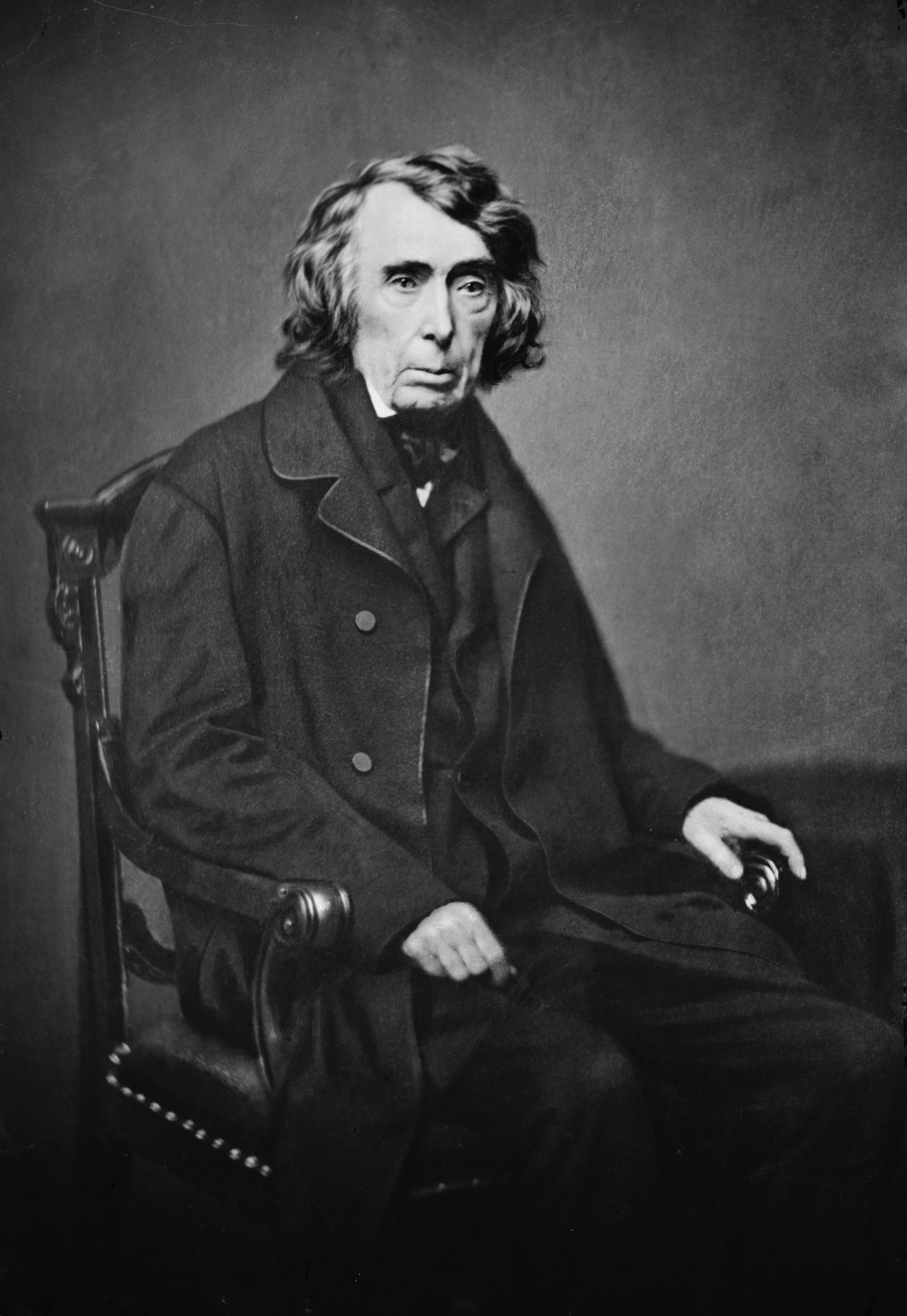
Roger B. Taney
Lawyer and former Chief Justice of the United StatesWikipedia
30
MENTIONS
17
EPISODES
17
PODCASTS
Search complete. 30 mentions across 17 episodes found for "Roger B. Taney".
Nov 8, 2026

David ClintonGUEST
though the absent state would still be at liberty to contest the proceeding at a future time if it shall choose to insist upon the objection, and, and here was the crucial phrase in Scott's opinion, the court has no power to enforce the appearance of the defendant state.
David ClintonGUEST
And then finally, proceeding to the question of the power of the court to compel a state to abide by its decision in such a case, Scott, relying on the opinion of Chief Justice Taney in Kentucky v. Denison of 1860, concluded that quote, the judgment of the court, whether it be reached in the presence or absence of the defendant, cannot be executed by force if the defendant is not minded to comply with its terms.
David ClintonGUEST
Scott's commentary, looking through the form to the substance, we thus see that the states of the American Union are treated as sovereign and equal states, having no superior, that the creation of a Supreme Court in which they may be sued does not create a body superior to the states, but merely an agency by means of which state may sue state in justiciable questions, that the subpoena is in the nature of an invitation, and that the judgment is in the nature of a recommendation.
David ClintonGUEST
Now, when recounting this history, Scott is not only asserting that his account is accurate historically, but also that the course followed by the Supreme Court was wise.

Rachel SheldonGUEST
religious influence.
Rachel SheldonGUEST
So, you know, there was a lot of concern in the mid-19th century about the role of the pope and how the pope might influence the independence of certain justices, including Roger Taney, chief justice who was Catholic.
Rachel SheldonGUEST
So independence was really about being able to make your own decisions.
Rachel SheldonGUEST
But your own decisions were fundamentally influenced by what you thought about the political system.

Bill HemmerHOST
Finally, on March 6, 1857, Dred Scott stood before the United States Supreme Court.
Bill HemmerHOST
Instead of justice, Chief Justice Roger Taney delivered one of the most infamous rulings in legal history.
Bill HemmerHOST
Taney declared that black people, whether enslaved or free, were not citizens under the Constitution and had no rights which the white man was bound to respect.
Bill HemmerHOST
Therefore, Scott had no standing to sue in a federal court at all.

Walker ToddGUEST
The inventors of the Hamiltonian point of view always point to it as ranting and raving by populist demagogues.
Walker ToddGUEST
It was drafted by Roger Taney, the very general at the time, who later was appointed to the Supreme Court.
Walker ToddGUEST
Trenton Banfield died.
Walker ToddGUEST
Carter was inspired in 1536.

Rachel SheldenGUEST
And during that time, the Democratic Party had become a little bit split over a variety of different things, including issues involving slavery.
Rachel SheldenGUEST
And so this case, when Justice Taney comes out and makes the argument of the court, he says that Dred Scott could not be freed and could not sue in federal court because he was not a citizen and Black people could not be citizens of the United States.
Rachel SheldenGUEST
and that the Missouri Compromise was unconstitutional because Congress did not have the right to legislate for the territories.
Rachel SheldenGUEST
So the Democratic Party reacts to this in split ways because many people in the United States, not just Republicans who existed at this time, not just other Northerners, really believed that Congress had the right to legislate for the territories, really believed that this was the only way to preserve the Union, among others.
6 MINS LATER
Rachel SheldenGUEST
And this is good in some ways because it really... does create those protections in a variety of different places.
Rachel SheldenGUEST
But in other ways, it changes the relationship between the federal courts and constitutional questions with an outsized reaction by the Supreme Court, who is now hearing many, many more constitutional questions as time goes by.
Rachel SheldenGUEST
So, Salmon Chase, who was Chief Justice in 1864, comes Chief Justice, replaces Roger Taney, who made the Dred Scott decision.
Rachel SheldenGUEST
Salmon Chase is someone who could not be more different from Roger Taney in that he had long made these arguments about the court not having this final authority and been really insistent that it was important that politics be the place where constitutional questions are answered.

Stephen P. HalbrookGUEST
Um, The whole fallacy of our founding was that these rights weren't extended to everyone.
Stephen P. HalbrookGUEST
We all know about the Dred Scott decision where Chief Justice Taney said, well, if African Americans were citizens, they could have rights to free speech and they could keep and carry arms wherever they went.
Stephen P. HalbrookGUEST
And so when we finally have a horrible war that ends up in the abolition of slavery, the southern states passed the Black Code provisions, and they still wanted to mandate that if a freed person had a gun, they had to have permission of the authorities to have it.
Stephen P. HalbrookGUEST
And so that was one of the impetus for the 14th Amendment being proposed because the idea was that these laws, For everyone who's born and under the jurisdiction of the United States as a citizen, they have due process rights and equal protection of the law and privileges and immunities.

Jonathan WhiteGUEST
He got thrown into Fort McHenry and was held in prison for six weeks.
Jonathan WhiteGUEST
And his arrest ended up leading to a major conflict between Abraham Lincoln and the Chief Justice of the United States Supreme Court, Roger Taney, in 1861.
Jonathan WhiteGUEST
And in the end, Taney declared that John Merriman should have been released from prison, but he had no power to do anything about it.
Jonathan WhiteGUEST
He sent his opinion to Lincoln at the White House, and Lincoln just ignored the Chief Justice of the United States.

Jeffrey RosenHOST
And then you say that Some originalists rely on societal practice to supplant original meaning, but Douglass rejects practice-based interpretation and instead believes the meaning of the Constitution is fixed and should be interpreted in light of natural law, which is why you call his approach natural law originalism.
Jeffrey RosenHOST
Tell us more about his critique of Justice Taney's opinion in the Dred Scott decision, which after all does rely on false claims about the intent of the framers and why that's not consistent with Douglas's approach.
Bradley RebeiroGUEST
Yeah, that's right.
Bradley RebeiroGUEST
If you look at Taney's opinion in Dred Scott.
Bradley RebeiroGUEST
So first, You know, Dred Scott.
Bradley RebeiroGUEST
Right.
Bradley RebeiroGUEST
He's a slave who's brought through Illinois into Wisconsin territory.
Bradley RebeiroGUEST
And then when he is brought back to Missouri, he actually sues in federal court and says, I'm actually now a free citizen by virtue of being brought into these jurisdictions that are free.

ClaraHOST
Yes, on the grounds that he had lived in free territories.
ClaraHOST
But the Supreme Court, under Chief Justice Roger Taney, ruled that African-Americans, whether enslaved or free, were not and could never be citizens of the United States.
AdrianHOST
Which is just horrifying.
ClaraHOST
It is.
7 more episodes mention Roger B. Taney.
Create an account to see the whole feed, search across every transcript, and follow the entities you care about.