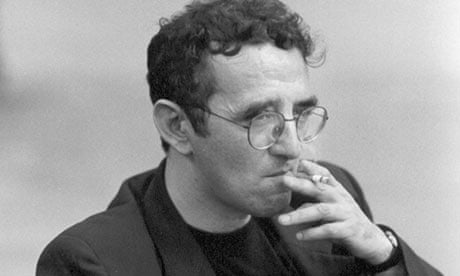
Roberto Bolaño
Chilean novelist and short story writerWikipedia
44
MENTIONS
16
EPISODES
16
PODCASTS
Search complete. 44 mentions across 16 episodes found for "Roberto Bolaño".
Sep 9, 2026

Peter OrnerHOST
Second prize with Zora Neale Hurston.
Peter OrnerHOST
Why is it always that people in the history of these kind of prizes that Zora Neale Hurston and Dorothy West and, and, and, you know, Roberto Bolano are always coming in second?
Yvette BenavidesHOST
That's true.
Yvette BenavidesHOST
Um, but think about-

Curly VelasquezHOST
But this short story is really an example of meta-literature.
Curly VelasquezHOST
writing that's reflecting on writing and all the possibilities of literature itself you see literature isn't a stale lifeless thing it's an encounter that can generate possibilities and those possibilities can keep going for as long as there are words on a page and people to read them and borges isn't the only writer who explored these possibilities i've got to tell you about los detectives salvajes The Savage Detectives by Chilean author Roberto Bolaño.
Curly VelasquezHOST
The 1998 novel is told through diary entries and interviews, and it's kind of a detective slash adventure story.
Curly VelasquezHOST
It follows some young poets on an international quest to find the extremely elusive founder of an obscure poetry movement called visceral realism.

Chris RyanHOST
It's fine
Andy GreenwaldHOST
... maybe I did, is celebrated for her understanding of Bolaño's intent and context and everything in Spanish.
Andy GreenwaldHOST
But really-
Chris RyanHOST
Can, can't wait to hear this get sampled.

Colm TóibínHOST
And of course, this is a big deal.
Colm TóibínHOST
It happened in Nazi literature in the Americas, for example, by Robert Bolaño, is a fictional account of all these Nazi writers who lived in the Americas through taking that encyclopedic idea and going with it.
Luke ClancyHOST
Jennifer Walsh, the composer you probably know, has a project where she invented the Irish musical avant-garde.
Luke ClancyHOST
Yeah.

Kaija StraumanisHOST
This is what our second grader drew last year.
Chad PostHOST
They, they remind me a little bit of the new Bolaño covers.
Chad PostHOST
Um, but the new Bolaño covers aren't, like, so, like, childlike in their drawing.
Chad PostHOST
They have something that's a little bit more crisp.
Chad PostHOST
But that's, this might be the new literary trend.

Arush KalraGUEST
I mean, if you see Bosch, if you see like, I don't know, like the whole Nabi movement, if you understand like the beginnings of how like ready-made was done, those stories are fascinating.
Arush KalraGUEST
It's like you read a 256 page of like 2666 with Roberto Bolaño's absolute masterpiece.
Arush KalraGUEST
Right.
Arush KalraGUEST
And his fictitious understanding of how Duchamp was in, you know, Duchamp was just sitting in like Argentina at his sister's wedding.

Andrew ThackeryHOST
100%.
Andrew ThackeryHOST
But Bolaño's, like, his generally straightforward prose mixed in with just the occasional awesome metaphor or simile or symbolism.
Andrew ThackeryHOST
Like, I feel like that's something Juan Rufo is doing, too.
Andrew ThackeryHOST
I've read this twice, and the first time, his prose really didn't stick out to me at all.
Andrew ThackeryHOST
And then the second time, I was just astonished by how good of a... how well he, just how beautiful his prose can be.
Andrew ThackeryHOST
And he's not trying to flex those muscles all the time, but he does just enough to show you that he can and to add to the aesthetic quality of the work.
Andrew ThackeryHOST
And I think that's something Bolaño does as well.
Andrew ThackeryHOST
very seldom is Bolaño like really trying to feel very literary, you know, like he's just kind of like, it almost feels unedited sometimes where it's just like, yep, that'll do.

Sean Thor ConroeHOST
I think that...
Sean Thor ConroeHOST
Bolaño takes much more from detective fiction.
Sean Thor ConroeHOST
He definitely does.
Sean Thor ConroeHOST
Obviously.
Harold RogersGUEST
They're trying to read the modernist.
Harold RogersGUEST
And then they're like,
Sean Thor ConroeHOST
wait, I can try reading Bolaño.
Sean Thor ConroeHOST
It's also the modernist.

Amanda BayNARRATOR
Once you start looking for them, Weld told us, references to the Spanish Civil War appear everywhere.
Amanda BayNARRATOR
From the writings of Pablo Neruda, Gabriel Garcia Marquez, and Roberto Bolaño, to the childhood memories of Fidel Castro and Che Guevara, both of whom were trained in guerrilla warfare by Spanish exiles.
Amanda BayNARRATOR
Other such references can be found in the Alarmed Sermons of Conservative Bishops and the Rants of Reactionary Ideologues.
Amanda BayNARRATOR
More than a memorable episode, the conflict between the Spanish Republic and its phalanges foes formed a rich and complex object lesson for both the left and the right.

THE INVISIBLE COLLEGE: Roberto Bolaño’s The Savage Detectives
Aug 30 · 20 Mentions
John PistelliHOST
But go listen to those songs for a, uh, a, a less abrasive than Lautgedicht soundtrack to this episode of The Invisible College.
John PistelliHOST
Which will be about Roberto Bolaño's The Savage Detectives.
John PistelliHOST
Roberto Bolaño's The Savage Detectives, a novel of 1998.
John PistelliHOST
We have come to the end of our seven-episode summer 2026 sequence from The New World, which was primarily concerned with writers from the Americas who, in certain ways, transgressed, uh, or trans something-ed the borders of the Americas, who, uh, and who also transgressed borders of literary genre and literary style, whether they initiated in the United States or in Canada or in Brazil or in Colombia or in Chile via Mexico, as is the case today.
John PistelliHOST
I have been o-obnoxiously over-pronouncing the Spanish language, uh, a-and I will, uh, probably continue to do so in this episode.
John PistelliHOST
There is a desire for a new type of culture.
John PistelliHOST
There is a desire to replace the old revolution, which had become decrepitly authoritarian, perhaps as emblematized by Gabo's friendship with Fidel Castro, as we discussed on the last episode, and there is a desire for something new.
John PistelliHOST
And what that turned out to be, [lips smack] uh, was the career and the work of Roberto Bolaño.
6 more episodes mention Roberto Bolaño.
Create an account to see the whole feed, search across every transcript, and follow the entities you care about.