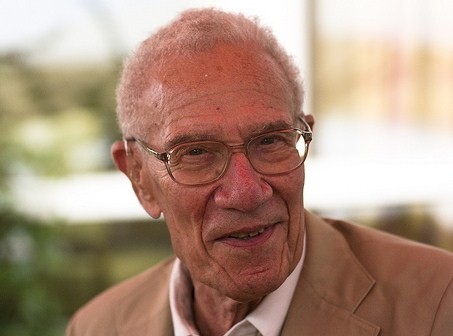
Robert Solow
American economistWikipedia
13
MENTIONS
11
EPISODES
9
PODCASTS
Search complete. 13 mentions across 11 episodes found for "Robert Solow".
Sep 18, 2026

Jeremy SiegelHOST
So where is it going? It's got to come in a way.
Jeremy SiegelHOST
You know, it really reminds me of my thesis advisor, Robert Solow.
Jeremy SiegelHOST
back in 1997, who said we see computers everywhere except in the GDP statistics.
Jeremy SiegelHOST
And within a year or two after that, we began to see them in the GDP statistics.

Shahin ValléeGUEST
I think there will be some, but it could also be that it's a lot smaller than, you know, what people make it to be.
Shahin ValléeGUEST
You know, confer the big discussion we had with, you know, the internet and tech in the late 90s and the Robert Solow paradox.
Shahin ValléeGUEST
You know, we see computers everywhere except in the numbers.
Shahin ValléeGUEST
So, you know, we see AI everywhere except that we don't see yet, you know, this clear boost in productivity or nearly as large as what will be required in front of these large investments.

JohnHOST
L'algoritmo maschera l'impreparazione umana e offre un profitto immediato.
MaryHOST
Sul blog Marginal Revolution l'economista Tyler Cowen ha fatto un'osservazione geniale: dice che dobbiamo aggiornare il modello di Solow.
MaryHOST
È il classico schema macroeconomico che ci insegna che la crescita deriva da capitale e lavoro.
JohnHOST
Ora il mercato sta inserendo l'intelligenza come fattore produttivo a sé stante e al mercato non interessa minimamente se quell'intelligenza ha un'origine biologica o è fatta di silicio.

Paul KrakeGUEST
Um, and you know, AI for me is not a productivity miracle per se, it's a cost miracle.
Paul KrakeGUEST
Um, Robert Solow said back in nineteen eighty-seven that computerization is everywhere except in the productivity statistics.
Henry WalshHOST
Yeah.
Paul KrakeGUEST
And I think what you're gonna see going forward is that AI will be everywhere except in the productivity numbers, because it does target cost more than, more than revenue.

Lizzie PennyGUEST
Yeah, and I think that actually it's been a problem even as we came into the digital age.
Lizzie PennyGUEST
I think when you think about, I think it was Robert Solow, the American economist in the 1980s, he said you can see the computer age everywhere except in the productivity statistics.
Lizzie PennyGUEST
I think part of the challenge with this is that AI is often adopted at an individual level because the person doing the job knows the job best.
Lizzie PennyGUEST
But actually, it starts with leadership.

Glenn LouryGUEST
My teachers encouraged me to avoid the University of Chicago because they thought it was too rigidly ideological and right.
Glenn LouryGUEST
So I ended up at MIT, and my teachers were people like Paul Samuelson and Robert Solow and Franco Modigliani and Peter Diamond and other people who have been honored for their accomplishments as economics researchers.
Glenn LouryGUEST
They were not Chicago free marketeers, but they were certainly neoliberals in the modern day sense of that word.
Glenn LouryGUEST
I mean, they believed in private property.

Peter BerezinGUEST
Now, maybe those gains will come down the road.
Peter BerezinGUEST
You know, uh, uh, Robert Solow famously said in 1989, "You can see the computer age everywhere but in the productivity statistics," making reference to the fact that the PC was introduced in the early 1980s.
Peter BerezinGUEST
Eventually, the productivity gain- gains came, but, like, in the mid-1990s.
Richard DiasHOST
Yeah.

Josh LevineHOST
Every general purpose technology looks like a bust at first.
Josh LevineHOST
In 2021, three authors published, economists published a paper called the Productivity J Curve.
Josh LevineHOST
And I've written about this.
Josh LevineHOST
Their argument is not that these technologies fail.
Markus BrunnermeierHOST
Uh, so of course there is huge developments in technology, artificial intelligence, uh, we have CRISPR, we have a lot of geo- we have geoengineering, we have gene engineering, all of these different things.
Markus BrunnermeierHOST
So the first question I have to Larry is, you know, w- if you like just look at the artificial intelligence, do you think we are in a bubble situation at the moment? And that's of course cor- correlated to the Solow paradox where Bob Solow said, you know, I can see...
Markus BrunnermeierHOST
In the '80s, he said, "I can see computers everywhere, but I cannot see any productivity statistics." The alternative view is that, you know, now AI is different, it is actually a automation of production of ideas, and if you think about endogenous growth models, it's, you know, it will lead to a higher growth, explosive growth rate on its own, so it's very different from traditional, uh, productivity enhancements, which are more level things, and here you have kind of the, you have innovation on the innovation.
Markus BrunnermeierHOST
So Larry, I would like to get your perspective on, on these big pictures before we go on further on technology.
Markus BrunnermeierHOST
Mm.
Lawrence SummersGUEST
I think that the combination of developments in artificial intelligence, knowledge creation, ability to substitute for tedious and burdensome, uh, work, combined with what that will mean for progress in the life sciences, combined with what I suspect will be energy at far lower costs than we have observed, leads me to think that the likelihood is that technology will be, um- ... transcendently transforming during her lifetime in the way that it was during my grandmother's, and in a way that it has not been during mine or, uh, yours.
Lawrence SummersGUEST
I think that the Solow paradox came at a time when there had been a decade or more of high technology, uh, investment in, uh, computers.
Lawrence SummersGUEST
We're in year two or three on artificial intelligence.

Markus BrunnermeierHOST
So let me give a few opening remarks, and then we pass on the mic to, to Laura.
Markus BrunnermeierHOST
And the qui-key questions Laura will address today is, you know, how is data exchanged? How can we measure and value data? And how will data accumulate affect firms' competition? How will it affect the firms', uh, competition? And of course it might also be that we mismeasure the GDP growth in times of AI, so that this reminds us of course to a saying by Bob Solow who said, "In the nineteen eighties, we can see computers everywhere, but we can't see it in the productivity statistics." Perhaps it's the same here today with artificial intelligence.
Markus BrunnermeierHOST
So we will learn more about it, uh, today.
Markus BrunnermeierHOST
And of course, Laura will talk about her new book, The Data Economy, together with Isaac Caballi, and I guess she will also go beyond the book, uh, today a little bit.
1 more episode mentions Robert Solow.
Create an account to see the whole feed, search across every transcript, and follow the entities you care about.