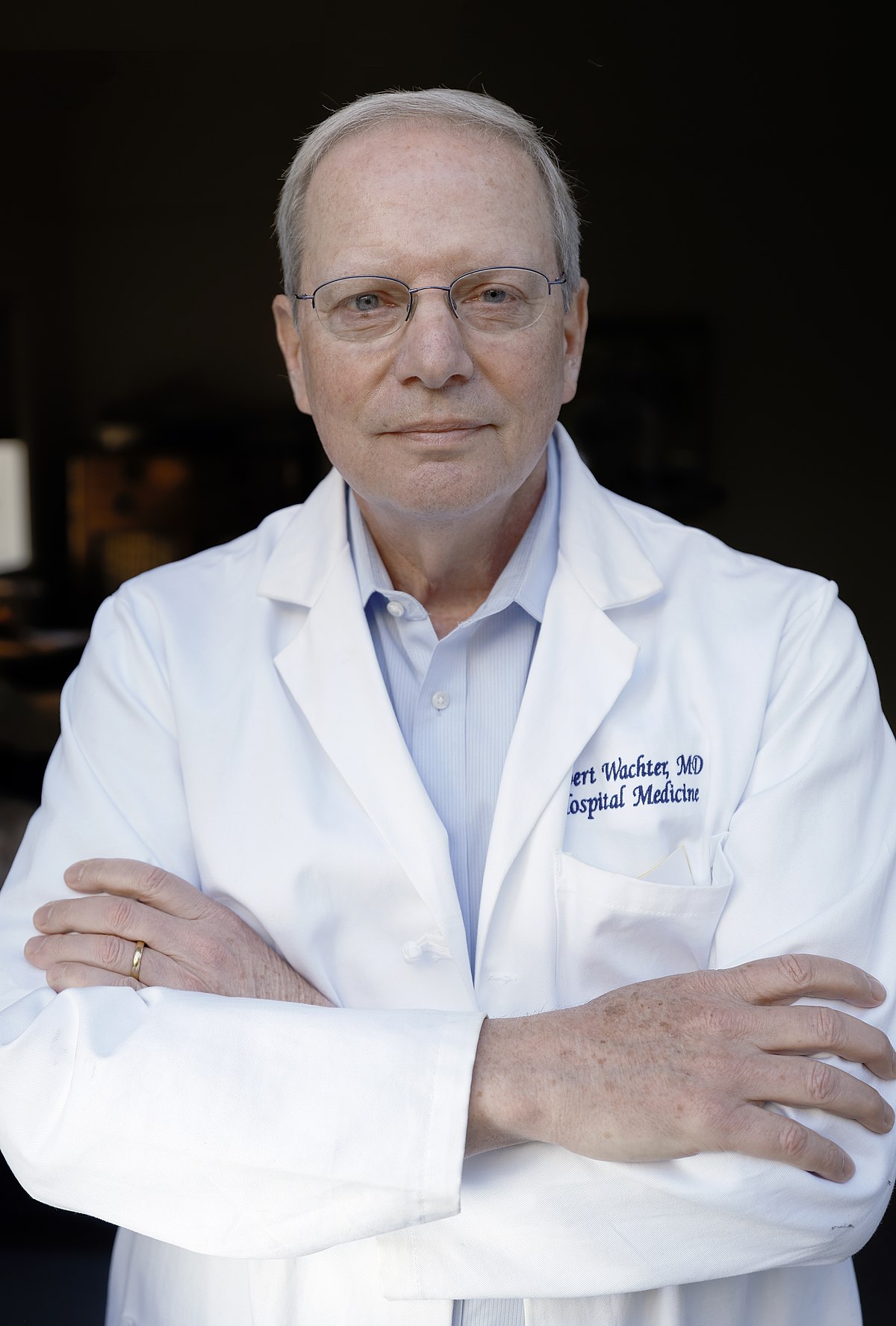
Robert M. Wachter
Physician and authorWikipedia
14
MENTIONS
10
EPISODES
10
PODCASTS
Search complete. 14 mentions across 10 episodes found for "Robert M. Wachter".
Oct 7, 2026

Michael TurkenGUEST
The difference being hallucination is seeing things that aren't there, whereas confabulation is more like making things up or there's a, a physician at UCSF, Dr.
Michael TurkenGUEST
Bob Wachter, sort of calls it...
Michael TurkenGUEST
He has a better term.
Michael TurkenGUEST
He says, "AI tends to BS a lot," and it's important to be on the watch for it.

Raed DweikGUEST
We have the AI lab.
Raed DweikGUEST
Our keynote speaker was on AI this conference.
Raed DweikGUEST
So a lot of AI going on.
Raed DweikGUEST
And I think it's a good conversation I had with our keynote speaker, Bob Wachter, about AI before his talk.
Raed DweikGUEST
I said, in ATS, we're trying to get, we have an AI task force, we're trying to get ahead of AI.
Raed DweikGUEST
He said, no, there's no way getting ahead of AI.

Sanjay JunejaHOST
And if nothing else, I would hope that the argument is pretty uniform that we have the humility to say that would be nice.
Ezekiel EmanuelGUEST
Well, I think Bob Wachter puts it well.
Ezekiel EmanuelGUEST
You know, he says, when I walk on the ward floors, you know, I feel like I have multiple consultants in my pocket.
Ezekiel EmanuelGUEST
I can just pull up open evidence and consult with them and, you know, maybe reassure that my judgment is right or, you know, find a perspective that I hadn't anticipated or fill in a blank that I can't remember at that point.
19 MINS LATER
Ezekiel EmanuelGUEST
He was right.
Ezekiel EmanuelGUEST
I was wrong.
Ezekiel EmanuelGUEST
But what approximately got me on was Bob Wachter's A Giant Leap.
Ezekiel EmanuelGUEST
And I read the book.

MattHOST
It's caused tons of hot takes and reactions.
MattHOST
I think of all the different reactions I've read, I align probably closest with Bob Wachter's response.
MattHOST
And he wrote a really nice sub stack on this.
MattHOST
And he called it the doorman problem.

Timothy JudsonGUEST
I think you've talked on this podcast about Rapid.
Timothy JudsonGUEST
That's an example of a use case where trying to answer a specific question has been successful and has changed care And then the question I think comes up naturally, well, is it ultimately going to get so good that you can just replace the clinician altogether? And I think there's a great discussion of this in one of my mentors, Bob Wachter, just wrote a book called A Giant Leap, and it talks all about AI in healthcare.
Timothy JudsonGUEST
And one of the questions that he grapples with is, should you be worried that as a physician, The diagnosis process is going to be totally taken over by AI.
Timothy JudsonGUEST
Should you expect that as a patient? And his argument is that although it's going to help, no, it's not going to take over completely because there's such a human side to medicine that we rely on in those discussions and in those relationships.

Steven LapkoffHOST
And on the podcast, we actually, I think had your residency director.
Steven LapkoffHOST
We had Bob Wachter here a few months ago.
Travis ZackGUEST
Amazing.
Travis ZackGUEST
Yes.

Cornelius JamesGUEST
That's going to happen.
Cornelius JamesGUEST
Bob Wachter wrote a paper in JAMA, I think it was published in 2024 or so, it was around this productivity paradox.
Cornelius JamesGUEST
And what he suggested was these innovations are going to get better, or these technological innovations particularly are going to get better.
Cornelius JamesGUEST
But there needs to be a parallel innovation in multiple areas for us to successfully integrate these tools into health care.

Brian MillerGUEST
I would say other components that touch clinical practice more, people have not yet widely adopted and that's, you know, understandable because in a technology adoption phase, there's gonna be the early adopters and then sort of the broad, uh, users and then sort of the late adopters, and I think we're, for the clinical tools, we're still in the early adopter phase.
Chip KahnHOST
Sort of looking, you know, futuristic a moment in, in listening to your last answer, earlier in our series, Bob Wachter from UCSF described the doctor of the future as a clinician curator rather than a clinician diagnostician.
Chip KahnHOST
Uh, the non-device framework rests on a physician meaning- meaningfully reviewing the AI's logic.
Chip KahnHOST
If Wachter is correct about what the physician is becoming, does that assumption survive? And if not, what are the implications for physician practice considering what you've described?

Sarah RussellGUEST
The other thing I'll say is I do think For AI in general, there's a tremendous opportunity to put AI against the question of the fullness of a patient's story and know that full story and what matters most in a very meaningful way.
Sarah RussellGUEST
I think right now models are not great at looking at a full chart that might be as long as Moby Dick, as Bob Wachter says, and say, what's most relevant here? Models aren't very good at that.
Sarah RussellGUEST
But I think as the models get better at that, it will be tremendously valuable to the ecosystem because we'll stop arguing about like, oh, what should we pay for? And instead we'll say, oh, what's best for this patient? Because, oh, we all agree on what happened.
Sarah RussellGUEST
We all agree what's in here.

Brinda AdhikariHOST
And while we continue to trust our individual doctors pretty much more than anyone else, are we now really supposed to trust AI with our health? Our guests today are Dr.
Brinda AdhikariHOST
Dhruv Kular, a physician who has written extensively about AI and medicine for The New Yorker, and Dr. Robert Wachter, one of the leading voices on technology and medicine, who has called AI the biggest experiment in the history of medicine.
Brinda AdhikariHOST
He finds himself squarely in the middle of today's debate.
Brinda AdhikariHOST
Let's get started.
16 MINS LATER
Brinda AdhikariHOST
He directs the Physicians Foundation Center for the Study of Physician Practice and Leadership and last year wrote a widely discussed piece asking if AI can diagnose patients, what are doctors for? Dhruv, welcome back to the show.
Dhruv KhullarGUEST
Thanks so much for having me.
Brinda AdhikariHOST
Dr. Robert Wachter is a professor and chair of the UCSF, University of California, San Francisco Department of Medicine.
Brinda AdhikariHOST
Bob Wachter coined the term hospitalist, which redefined what it meant to be a doctor.