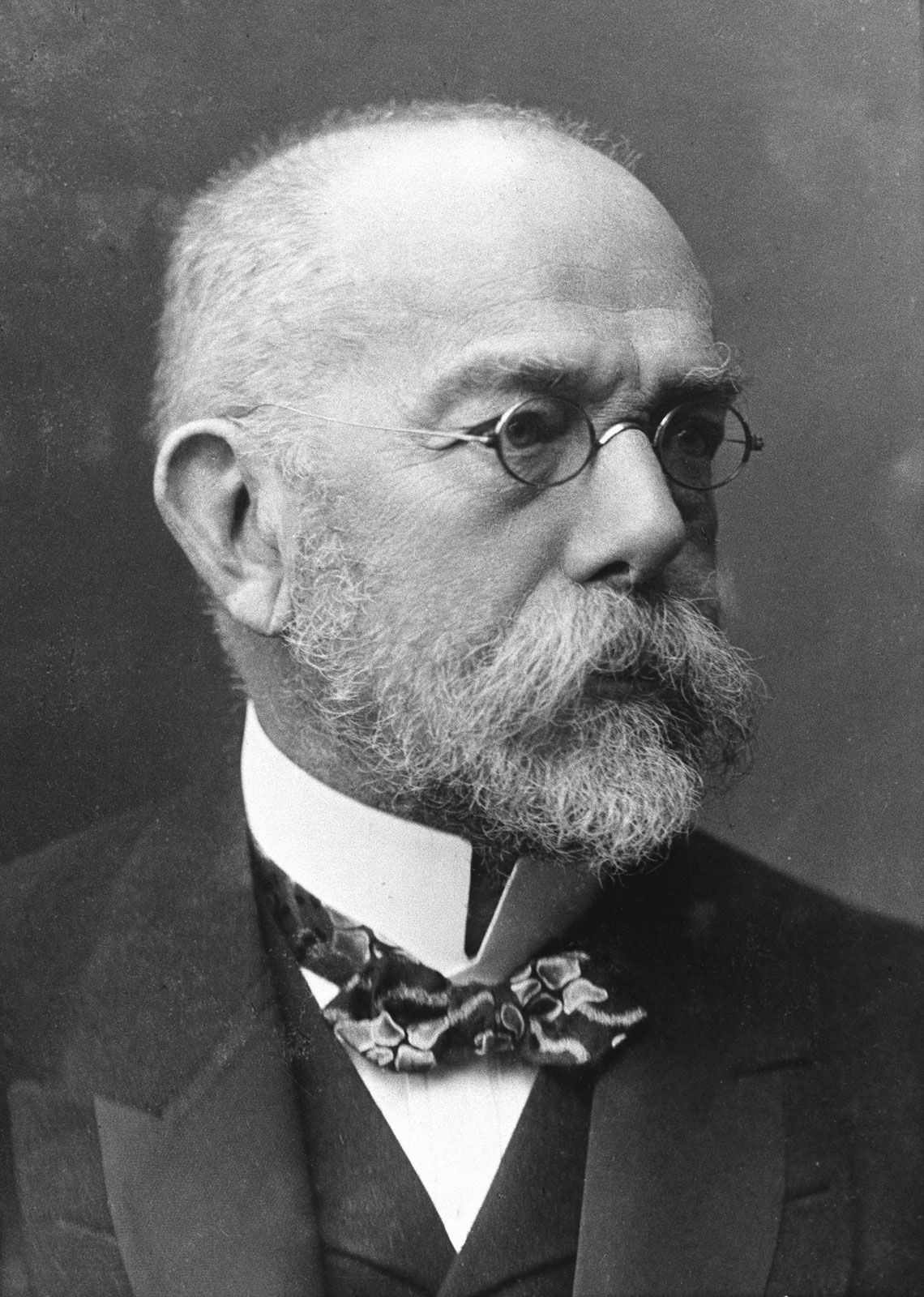
Robert Koch
German physician and microbiologistWikipedia
149
MENTIONS
40
EPISODES
38
PODCASTS
Search complete. 149 mentions across 40 episodes found for "Robert Koch".
Oct 4, 2026

speaker_2NARRATOR
This demolished the theory of spontaneous generation that had dominated scientific thinking for two thousand years.
speaker_2NARRATOR
Meanwhile, in Germany, Robert Koch was taking this further.
speaker_2NARRATOR
He was isolating specific bacteria and proving they cause specific diseases.
speaker_2NARRATOR
He developed techniques for growing pure cultures of microorganisms, staining them so they could be seen under microscopes, photographing them as evidence.

Rita BoutrosNARRATOR
The sufferers from this sow the germs of the disease in numerous often distant and obscure places, to which no choleric person is supposed to have come.
Rita BoutrosNARRATOR
Number 5 The discharges swarm with infective bacteria of various kinds, some of which, especially Koch's comma bacilli, seem to be specific.
Rita BoutrosNARRATOR
Number 6 The disease has been reproduced in men and some few animals by their swallowing the discharges.
Rita BoutrosNARRATOR
Number 7 The discharges, according to the experiments of Thiersch, Burden Sanderson, and McNamara, are not virulent and poisonous for the first twenty-four hours.
Rita BoutrosNARRATOR
Professor Robin reproduced cholera in dogs, and the celebrated dog Juno died of cholera in Egypt last year.
Rita BoutrosNARRATOR
Professor Botkin of the University of Dorpat reproduced cholera in dogs by the subcutaneous injection of the urine of cholera patients.
Rita BoutrosNARRATOR
Even if the common bacilli are not found in the urine, other bacteria are, and even Koch supposes that they secrete a virulent poison similar to that of some insects, which may be absorbed into the blood and escape from the kidneys.
Rita BoutrosNARRATOR
Number eight.

Larry WilsonNARRATOR
There is no doubt that the revelations of hygienic science have aroused the vigilance and zeal of public authorities in various new directions to try and cope with the spread of zymotic disease.
Larry WilsonNARRATOR
in no direction perhaps is the fruit of this energy so apparent as in the increasing supervision which it has incited over two of the greatest menaces to public health which hang over society viz our water and dairy supplies now that it has been proven beyond doubt that the germs of consumption typhoid fever and cholera can be and are distributed through the consumption of contaminated milk or water not to mention other diseases such as diphtheria and scarlet fever an ever increasing demand is being made that these all-important articles of diet shall be protected from pollution and that public authorities shall be made responsible for their distribution in a pure and wholesome condition it is however undoubtedly in the matter of water that the greatest service has been rendered by bacteriology to sanitary science and for the important advance in this department we are indebted to the beautifully simple and ingenious methods devised by robert not yet twenty years have passed since the new bacterial examination of water was introduced and systematically employed and the use which has been made of the opportunities thus opened up of investigating water problems on an entirely new basis is shown by the voluminous dimensions which the literature on this one branch of bacteriology alone has reached considerably upwards of two hundred different water bacteria have been isolated studied and their distinctive characters chronicled the behaviour of typhoid cholera and other disease producing microbes in waters of various kinds has been made the subject of exhaustive experiments the purification power of time-honored processes in operation at waterworks and elsewhere has been for the first time accurately estimated water engineers have through these bacteriological researches been provided with a code of conduct drawn up by the light of erudite scientific inquiries which has now rendered possible the removal of the process of water purification from the rule of empiricism guided by tradition and to raise it to the level of an intelligent and scientific undertaking the above short sketch may serve to convey some idea of the rise and phenomenal development of bacteriology during the past sixty years to record even in outline the individual triumphs of the various branches of this science would require volumes whilst the astounding mass of work already accumulated by its devotees is but the earnest the guarantee of greater achievements in the future the progress which has been made in this brief period of time must not necessarily be expected to continue at this rapid rate it may be that generations to come have yet the hardest and the longest task to accomplish for in science as in other walks of life it is as a rule the easiest problems which are first disposed of and the farther we advance the more complicated the more intricate become the questions to be attacked the difficulties to be overcome The late Queen's reign has bestowed a splendid legacy of bacteriological discoveries upon those who, in the future as in the present, must inevitably follow in the footsteps of those great and brilliant leaders of bacteriological science belonging to this auspicious era, Louis Pasteur and Robert Koch.
Larry WilsonNARRATOR
End of chapter 1 Chapter 2
Larry WilsonNARRATOR
Part 1 of Bacteria and Daily Life by Grace Coleridge Franklin.
40 MINS LATER
speaker_0ADVERTISER
SpinQuest.com. By American players, for American players.
Larry WilsonNARRATOR
Many others might be cited, but perhaps the most striking is that in which a scientific assistant of Tapinier contracted the disease, and succumbed to it, in the course of some experiments which were being made to ascertain whether consumption could be communicated to animals by spraying them with an emulsion of the sputum of consumptive patients.
Larry WilsonNARRATOR
it is of historical interest to note that these experiments were being conducted by tapigny three years before robert koch made the now classical announcement to the scientific world that he had succeeded in identifying isolating and in cultivating outside the human body the specific cause of consumption in the shape of the now familiar bacillus tuberculosis The opinion expressed by Koch at the Congress on Tuberculosis recently held in London, that human and bovine tuberculosis are distinct diseases, is still the subject of contention and experimental investigation.
Larry WilsonNARRATOR
even if the opinion of this great authority is correct and in this connection it is interesting to note that already in eighteen ninety six this opinion was brought forward by smith in the medical record at a time when koch was maintaining the identity of human and bovine tuberculosis granted that koch is correct it should not as so many fear cause any relaxation in the efforts which have been at last made to safeguard our dairy produce by reasonable hygienic precautions for even if tuberculosis is not transmissible from the cow to man we know that in the hygienic supervision of our dairy industry we place a great barrier between us and the bacillus tuberculosis and those numerous other disease germs which can and do gain access to milk from the personnel of a dairy and so spread infection with the alarming prevalence of consumption is it not justifiable to regard as certain that a definite proportion of the people engaged in milking for example are consumptive and knowing as we now do how such persons can give off the germs of the disease in the simple act of speaking the contamination of our milk with human tubercle bacilli must be regarded almost as a certainty would it not be reasonable that a code of simple precautions to be taken coupled with a few of the more cogent facts concerning consumption and its distribution should be drawn up and circulated amongst all engaged in the dairy industry the national health society has done much for the prevention of disease by disseminating through leaflets and lectures simple facts concerning health and its preservation might it not make itself the vehicle for the transmission of some such code which whilst instructing should impress upon its readers the responsibility which rests upon each and every individual member of society by his or her own personal efforts to assist in the great task of combating disease a fact which urgently needs the widest recognition is the possible dissemination of disease germs by individuals not themselves suffering from the disease in question but who have resided in the immediate surroundings of infected persons dr koch was the first to call attention to this danger when he discovered during the hamburg cholera epidemic that perfectly healthy persons were infected with cholera vibrius and were the unconscious means of spreading the disease Still more recently, it has been found that true typhoid germs may similarly be present in persons not suffering from typhoid fever, but sharing the same living rooms.

speaker_0NARRATOR
There is no doubt that the revelations of hygienic science have aroused the vigilance and zeal of public authorities in various new directions to try and cope with the spread of zymotic disease.
speaker_0NARRATOR
in no direction perhaps is the fruit of this energy so apparent as in the increasing supervision which it has incited over two of the greatest menaces to public health which hang over society that is our water and dairy supplies now that it has been proven beyond doubt that the germs of consumption typhoid fever and cholera can be and are distributed through the consumption of contaminated milk or water not to mention other diseases such as diphtheria and scarlet fever an ever increasing demand is being made that these all-important articles of diet shall be protected from pollution and that public authorities shall be made responsible for their distribution in a pure and wholesome condition it is however undoubtedly in the matter of water that the greatest service has been rendered by bacteriology to sanitary science and for the important advance in this department we are indebted to the beautifully simple and ingenious methods devised by robert not yet twenty years have passed since the new bacterial examination of water was introduced and systematically employed and the use which has been made of the opportunities thus opened up of investigating water problems on an entirely new basis is shown by the voluminous dimensions which the literature on this one branch of bacteriology alone has reached considerably upwards of two hundred different water bacteria have been isolated studied and their distinctive characters chronicled the behaviour of typhoid cholera and other disease producing microbes in waters of various kinds has been made the subject of exhaustive experiments The purification power of time-honored processes in operation at waterworks and elsewhere has been, for the first time, accurately estimated.
speaker_0NARRATOR
Water engineers have, through these bacteriological researches, been provided with a code of conduct drawn up by the light of erudite scientific inquiries, which has now rendered possible the removal of the process of water purification from the rule of empiricism guided by tradition, and to raise it to the level of an intelligent and scientific undertaking.
speaker_0NARRATOR
the above short sketch may serve to convey some idea of the rise and phenomenal development of bacteriology during the past sixty years to record even in outline the individual triumphs of the various branches of this science would require volumes whilst the astounding mass of work already accumulated by its devotees is but the earnest the guarantee of greater achievements in the future the progress which has been made in this brief period of time must not necessarily be expected to continue at this rapid rate it may be that generations to come have yet the hardest and the longest task to accomplish for in science as in other walks of life it is as a rule the easiest problems which are first disposed of and the farther we advance the more complicated the more intricate become the questions to be attacked the difficulties to be overcome The late Queen's reign has bestowed a splendid legacy of bacteriological discoveries upon those who, in the future as in the present, must inevitably follow in the footsteps of those great and brilliant leaders of bacteriological science belonging to this auspicious era, Louis Pasteur and Robert Koch.
34 MINS LATER
speaker_0NARRATOR
in as many as seventy one per cent of bovine tuberculosis cases the respiratory organs castleman found were the seat of the disease the undoubted contamination of the air which takes place in the surroundings of tuberculosis animals is not however due to the bacilli being exhaled by such cattle in the mere process of respiration for it has been repeatedly found by various investigators that the air expired by infected animals is free from the dreaded tubercle bacteria as in man so in animals it is by the act of coughing that tuberculosis secretions are discharged through the mouth and nasal passages some of which in the form of spray may enable the bacilli to remain suspended in the air for periods of five hours or more whilst other portions of such secretions fall on the ground or in the feeding troughs and later on as dust may again relentlessly claim their toll of victims In other cases of tuberculosis, the excrementitious matter becomes, of course, a fertile source of infection to the surroundings.
speaker_0NARRATOR
The dire results which may follow the introduction of a single tuberculosis animal into a healthy stall of cows may be realized from the fact that in one instance a whole herd of twenty-eight animals became in the course of one year infected in consequence of the admission of one diseased cow, the cowhouse having previously had a perfectly clean bill of health in this respect.
speaker_0NARRATOR
on the continent the risk of wholesale infection by such means is greater than in this country for abroad the animals are to a much greater extent stall fed and kept shut up both winter and summer a case is mentioned by the well-known veterinary authority m nocar of a whole stall of animals becoming infected through the cowman who tended them being consumptive he slept in a loft over the cows and his tuberculosis sputum in the form of dust was conveyed to the stalls below and so spread the infection it has been stated on high authority that domestic pets such as parrots make contract consumption from their masters and no less than thirty six per cent of these birds brought to the veterinary college in berlin are found to be suffering from tuberculosis in that much-dreaded south african cattle disease rinderpest the infection contrary to what is found in the case of tuberculosis animals is principally spread by the matures morbi being liberated in the air expired by afflicted cattle the contagious area surrounding an infected animal extending to as much as a hundred yards or more again as regards pleuronymonia in cattle the contagion is given off in the air expired and owing to the length of time which elapses before the lung becomes completely healed and healthy even after a period of from six to nine months the expired air may still prove a source of infection in an official report on the open-air treatment of consumption in germany a case is mentioned in which the patient a farmer by occupation had contracted the disease from some tuberculosis cattle which he had on his farm the writer goes on to say this case is worthy of special attention inasmuch as it indicates that in addition to the danger of contracting the disease from the use of milk or meat derived from tuberculosis animals the tending of such animals may serve to convey the infection to man possibly much more frequently than has hitherto been supposed in addition to the above instances of the responsible part played by air in the dissemination of consumption many others might be cited but perhaps the most striking is that in which a scientific assistant of tapinire contracted the disease and succumbed to it in the course of some experiments which were being made to ascertain whether consumption could be communicated to animals by spraying them with an emulsion of the sputum of consumptive patients it is of historical interest to note that these experiments were being conducted by tapigny three years before robert koch made the now classical announcement to the scientific world that he had succeeded in identifying isolating and in cultivating outside the human body the specific cause of consumption in the shape of the now familiar bacillus tuberculosis The opinion expressed by Koch at the Congress on Tuberculosis recently held in London, that human and bovine tuberculosis are distinct diseases, is still the subject of contention and experimental investigation.
speaker_0NARRATOR
even if the opinion of this great authority is correct and in this connection it is interesting to note that already in eighteen ninety six this opinion was brought forward by smith in the medical record at a time when koch was maintaining the identity of human and bovine tuberculosis granted that koch is correct it should not as so many fear cause any relaxation in the efforts which have been at last made to safeguard our dairy produce by reasonable hygienic precautions for even if tuberculosis is not transmissible from the cow to man we know that in the hygienic supervision of our dairy industry we place a great barrier between us and the bacillus tuberculosis and those numerous other disease germs which can and do gain access to milk from the personnel of a dairy and so spread infection with the alarming prevalence of consumption is it not justifiable to regard as certain that a definite proportion of the people engaged in milking for example are consumptive and knowing as we now do how such persons can give off the germs of the disease in the simple act of speaking the contamination of our milk with human tubercle bacilli must be regarded almost as a certainty would it not be reasonable that a code of simple precautions to be taken coupled with a few of the more cogent facts concerning consumption and its distribution should be drawn up and circulated amongst all engaged in the dairy industry the national health society has done much for the prevention of disease by disseminating through leaflets and lectures simple facts concerning health and its preservation might it not make itself the vehicle for the transmission of some such code which whilst instructing should impress upon its readers the responsibility which rests upon each and every individual member of society by his or her own personal efforts to assist in the great task of combating disease A fact which urgently needs the widest recognition is the possible dissemination of disease germs by individuals not themselves suffering from the disease in question, but who have resided in the immediate surroundings of infected persons.

Nicholas James BridgewaterNARRATOR
Now that it has been proven beyond doubt that the germs of consumption, typhoid fever, and cholera can be and are distributed through the consumption of contaminated milk or water, not to mention other diseases such as diphtheria and scarlet fever, an ever-increasing demand is being made that these all-important articles of diet shall be protected from pollution and that public authorities shall be made responsible for their distribution in a pure and wholesome condition.
Nicholas James BridgewaterNARRATOR
It is, however, undoubtedly in the matter of water that the greatest service has been rendered by bacteriology to sanitary science, and for the important advance in this department we are indebted to the beautifully simple and ingenious methods devised by Robert Koch.
Nicholas James BridgewaterNARRATOR
Not yet twenty years have passed since the new bacterial examination of water was introduced and systematically employed, and the use which has been made of the opportunities thus opened up of investigating water problems on an entirely new basis is shown by the voluminous dimensions which the literature on this one branch of bacteriology alone has reached.
Nicholas James BridgewaterNARRATOR
Considerably upwards of two hundred different water bacteria have been isolated, studied, and their distinctive characters chronicled.
Nicholas James BridgewaterNARRATOR
It may be that generations to come have yet the hardest and the longest task to accomplish, for in science, as in other walks of life, it is as a rule the easiest problems which are first disposed of.
Nicholas James BridgewaterNARRATOR
And the farther we advance, the more complicated, the more intricate become the questions to be attacked, the difficulties to be overcome.
Nicholas James BridgewaterNARRATOR
The late Queen's reign has bestowed a splendid legacy of bacteriological discoveries upon those who, in the future as in the present, must inevitably follow in the footsteps of those great and brilliant leaders of bacteriological science belonging to this auspicious era, Louis Pasteur and Robert Koch.
Nicholas James BridgewaterNARRATOR
End of chapter 1 Chapter 2 Part 1 of Bacteria in Daily Life by Grace Coleridge Frankland This LibriVox recording is in the public domain What we breathe Few people realize that, with the advent of autumn, the great majority of the swarms of bacteria which have been circulating in the air during the hot summer months take their leave of us and disappear.

Andy JonesHOST
Having passed nine different examinations, nine degrees, nine.
Andy JonesHOST
At various points over the years, he also said he had been a submarine captain in the German Navy, an inventor, an electrical engineer for the government of Australia, a physician, and a count.
Andy JonesHOST
I wonder if I'm related to this guy.
Andy JonesHOST
I know, right? You might be.
17 MINS LATER
Monty MaderHOST
The second source is her cousin who told a Tennessee newspaper the same month that Elena's, quote, two rescues from death, quote, meaning the electrical treatments, had been so painful that Elena finally died hating her rescuer.
Monty MaderHOST
Wow.
Monty MaderHOST
The third is von Kossel himself, who in his own account kept, he admits that Aurora opposed the courtship and the family had a disruption over him and that another physician interfered, which probably means they called a doctor that was actually qualified and not trying to sleep with their sick daughter.
Andy JonesHOST
Wow.

Elisabeth BikGUEST
So in my PhD, I worked on cholera.
Elisabeth BikGUEST
And I was able somehow to get a copy of the original paper by Robert Koch, like, from 1800 something, like, it's very hard to read.
Elisabeth BikGUEST
But if you read that paper, I mean, the language is very different than we would use now.
Elisabeth BikGUEST
And it's very long.
30 more episodes mention Robert Koch.
Create an account to see the whole feed, search across every transcript, and follow the entities you care about.