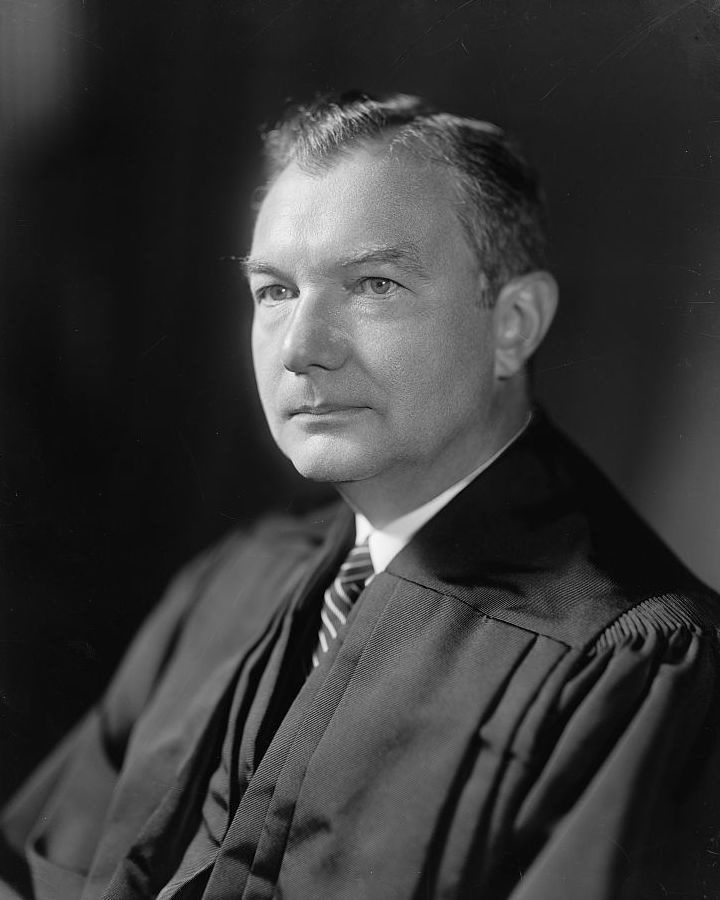
Robert Jackson
Lawyer and former Associate Justice of the Supreme Court of the United StatesWikipedia
66
MENTIONS
30
EPISODES
22
PODCASTS
Search complete. 66 mentions across 30 episodes found for "Robert Jackson".
Sep 18, 2026

speaker_2HOST
What happens when the president acts without Congress or even explicitly against them?
speaker_1HOST
For this, we turn immediately to the most famous framework in constitutional law, Justice Robert Jackson's concurring opinion in Youngstown Sheet & Tube Co. v. Sawyer.
speaker_1HOST
If you wanna understand presidential power, this is the hydraulic system of the American Republic.
speaker_2HOST
Let's set the stage for Youngstown because the history explains the mechanism.

John AughenbaughHOST
Yes, and so some prominent Supreme Court justices were previous attorneys general.
John AughenbaughHOST
Frank Murphy was, Robert Jackson, Harlan Fisk Stone.
John AughenbaughHOST
They all ended up getting on the Supreme Court.
John AughenbaughHOST
So, I mean, that was considered, you know, one of the potential pathways for you to get on the Supreme Court.

Scott ReischHOST
And how about a legal quote? Quote, the citizen's safety lies in the prosecutors who seeks truth, not victims, end quote.
Scott ReischHOST
Robert H. Jackson.
Scott ReischHOST
The point is simple.
Scott ReischHOST
A prosecutor's job is not just to win.

John A. JenkinsGUEST
First in his class.
Rund AbdelfatahHOST
And then he lands a clerkship with US Supreme Court Justice Robert Jackson, who was a strong advocate for First Amendment rights and civil liberties.
John A. JenkinsGUEST
So he just had a supreme self-confidence.
Rund AbdelfatahHOST
And it was during his clerkship with Jackson, five months in, where Rehnquist would show what kind of conservative he was.
speaker_3HOST
And to analyze whether a presidential action is valid, you do not just hunt for random case law.
speaker_3HOST
You must apply the single most important analytical framework in all of executive power jurisprudence, Justice Robert Jackson's three-part concurring opinion from Youngstown Sheet & Tube Co. v. Sawyer.
speaker_2HOST
The factual background of Youngstown is essential.
speaker_2HOST
It is 1952.
52 MINS LATER
speaker_7NARRATOR
Do not begin by asking if the nation faces a crisis.
speaker_7NARRATOR
Instead, you must ask, "What is the legal source of the president's authority?" It must stem either directly from the constitutional text or from a statutory delegation by Congress.
speaker_7NARRATOR
The mandatory analytical tool for evaluating the validity of any executive action is Justice Robert Jackson's three-part framework from Youngstown Sheet & Tube Co. v. Sawyer.
speaker_7NARRATOR
You must apply this framework.
speaker_3HOST
When the president acts, how do we measure the constitutionality of that action?
speaker_2HOST
Almost every presidential action must be analyzed through the lens of Justice Robert Jackson's famous three-part concurring opinion in Youngstown Sheet & Tube Co.
speaker_3HOST
During the Korean War, President Truman unilaterally seized the nation's steel mills to prevent a labor strike, claiming inherent executive power as commander-in-chief.
speaker_2HOST
The Supreme Court struck the seizure down, but Jackson's framework became the gold standard for analyzing executive power.
speaker_2HOST
The president's primary constitutional job is to execute the law, but the exam questions always arise when the president acts without Congress or even against Congress.
speaker_3HOST
This is where we bring in the ghost of Justice Robert Jackson and his definitive three-part framework from Youngstown Sheet & Tube Company v. Sawyer.
speaker_2HOST
The facts here are legendary.
speaker_2HOST
It's 1952, the height of the Korean War.
speaker_4HOST
But the enduring legacy of Youngstown is not the majority opinion.
speaker_4HOST
It is the concurring opinion of Justice Robert Jackson, which established the definitive framework for analyzing presidential power.
speaker_3HOST
Jackson recognized that presidential power is not fixed.
speaker_3HOST
It fluctuates depending upon its relationship with congressional action.

Mary Anne FranksGUEST
And particularly the case of West Virginia Board of Education versus Barnett is, I think, it is the case that we should be looking to to see what the First Amendment is.
Mary Anne FranksGUEST
really should have always meant and should continue to mean if we are going if it is going to do its one job and i firmly believe this and you know if i'm on the other side of people when i say this so be it but the first amendment's one job is to keep us from becoming a totalitarian society that's its primary job everything else is secondary and if your free speech doctrine if your free speech law isn't keeping us from sliding into fascism but is instead accelerating our path to fascism then it's not working So what do we have in 1943? We have Justice Robert Jackson, who in two years later is going to become such a key figure in the Nuremberg trials, someone who is paying attention to what is happening in Nazi Germany.
Mary Anne FranksGUEST
who is paying attention over and over again to the idea that democratic ideals, including freedom of speech, can be appropriated for fascist ends.
Mary Anne FranksGUEST
He is aware of it in a way that I think is probably singular among Supreme Court justices.

Mary Anne FranksGUEST
And particularly the case of West Virginia Board of Education versus Barnett is, I think, it is the case that we should be looking to to see what the First Amendment is.
Mary Anne FranksGUEST
really should have always meant and should continue to mean if we are going if it is going to do its one job and i firmly believe this and you know if i'm on the other side of people when i say this so be it but the first amendment's one job is to keep us from becoming a totalitarian society that's its primary job everything else is secondary and if your free speech doctrine if your free speech law isn't keeping us from sliding into fascism but is instead accelerating our path to fascism then it's not working So what do we have in 1943? We have Justice Robert Jackson, who in two years later is going to become such a key figure in the Nuremberg trials, someone who is paying attention to what is happening in Nazi Germany.
Mary Anne FranksGUEST
who is paying attention over and over again to the idea that democratic ideals, including freedom of speech, can be appropriated for fascist ends.
Mary Anne FranksGUEST
He is aware of it in a way that I think is probably singular among Supreme Court justices.
20 more episodes mention Robert Jackson.
Create an account to see the whole feed, search across every transcript, and follow the entities you care about.