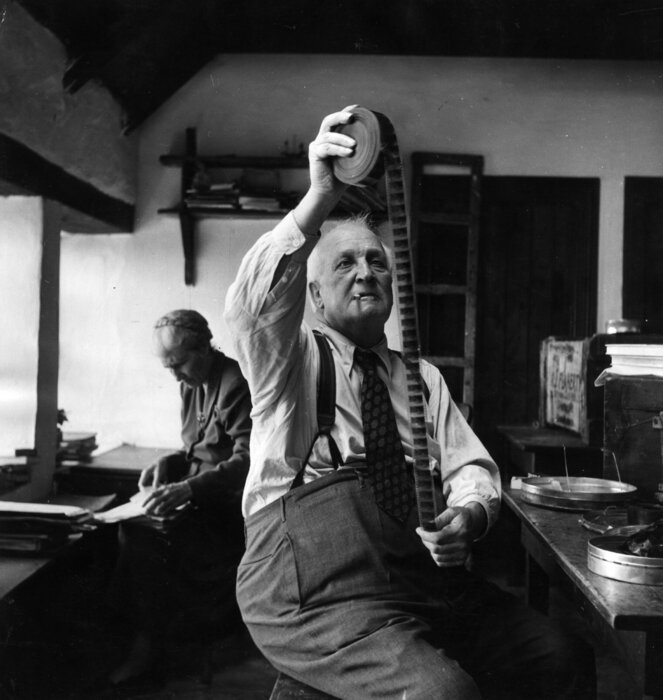
Robert J. Flaherty
American filmmakerWikipedia
36
MENTIONS
11
EPISODES
10
PODCASTS
Search complete. 36 mentions across 11 episodes found for "Robert J. Flaherty".
Oct 27, 2026

Radheyan SimonpillaiGUEST
Yeah, I mean, in one sense, you take this all the way back to a movie like Nunuk of the North, which is not a Canadian film, but it was shot up here in Canada, like up in the Inuk territory.
Radheyan SimonpillaiGUEST
And, you know, in that movie, you got Robert Flaherty coaching performances out of these real subjects, out of these Inuk people.
Radheyan SimonpillaiGUEST
And coaching them to stage their rituals of daily life.
Radheyan SimonpillaiGUEST
But these are staging like walrus hunting in a way that they don't do it like that anymore.

Keith MaitlandHOST
So we're talking about what is arguably the first documentary ever made, which is called Nanook of the North.
Keith MaitlandHOST
And this Canadian Robert Flaherty goes up to, is it Alaska?
Ben SteinbauerHOST
yeah yeah alaska
Keith MaitlandHOST
and he films with the inuit tribe and finds a guy named nanook and he basically makes a portrait of nanook come to find out many years later we're all showing this in film school this is like foundational documentary she's a

Carolyn BeelerHOST
More than a century later, it is still visually stunning, even if we now know that many of the scenes were actually staged.
Carolyn BeelerHOST
After its release, it was the filmmaker, Robert Flaherty, who grabbed the spotlight.
Carolyn BeelerHOST
Anthropologist Kirk French wanted to change that.
Marco WermanHOST
He filmed a documentary called A Century After Nanook, working with the residents of Inukjuak, the Canadian village where Nanook was filmed.
Marco WermanHOST
Uh, Shomic, let me start with you.
Marco WermanHOST
I mean, the man who is featured in Nanook of the North was not actually named Nanook.
Marco WermanHOST
Uh, Robert Flaherty made that up.
Marco WermanHOST
What was his real name?

speaker_2NARRATOR
More than a century later, it is still visually stunning, even if we now know that many of the scenes were actually staged.
speaker_2NARRATOR
After its release, it was the filmmaker Robert Flaherty who grabbed the spotlight.
speaker_2NARRATOR
Anthropologist Kirk French wanted to change that.
Marco WermanHOST
He filmed a documentary called A Century After Nanook, working with the residents of Inukjuak, the Canadian village where Nanook was filmed.
Marco WermanHOST
Shomik, let me start with you.
Marco WermanHOST
I mean, the man who is featured in Nanook of the North was not actually named Nanook.
Marco WermanHOST
Robert Flaherty made that up.
Marco WermanHOST
What was his real name? His real name was Alakarellak.

Sina Basila HickeyHOST
This program comes from the Sanctuary for Independent Media in Troy, New York.
Ren LeeHOST
York.This year, the Robert Flaherty Film Seminar has coordinated a series of pods which will, will present its program at seven international venues, including Skidmore College's Tang Museum.
Ren LeeHOST
The three-day series will begin on, uh, on Thursday, October 8th, culminating in a day-long program on Saturday, October 10th, 2026.
Ren LeeHOST
HMM producer Carolyn Tennant spoke with two, two Picturelock 1's co-founders, Emma Baiada and Adam Tinkle, to discuss the Flaherty, what it make, what makes it unique, and how the seminar was inspired or has inspired Picturelock 1.
Ren LeeHOST
To learn more about the program and to register for the event, visit www.tang.skidmore.edu.
Carolyn TennantCORRESPONDENT
2026 marks the 71st anniversary of the Robert Flaherty Film Seminar, a unique gathering of cinephiles and media makers who take a deep dive into the world of film, all framed and organized by a central theme.
Carolyn TennantCORRESPONDENT
This year, it's Gestures of Refusal.
Carolyn TennantCORRESPONDENT
The seminar has collaborated with a network of venues, including Skidmore's Tang Museum, to host a series of Flaherty pods.
Carolyn TennantHOST
2026 marks the 71st anniversary of the Robert Flaherty Film Seminar, a unique gathering of cinephiles and media makers who take a deep dive into the world of film, all framed and organized by a central theme.
Carolyn TennantHOST
This year, it's Gestures of Refusal.
Carolyn TennantHOST
The seminar has collaborated with a network of venues, including Skidmore's Tang Museum, to host a series of Flaherty Pods.
Adam TinkleGUEST
Uh, we have a little screening space in a bank vault at 54th Street downtown.
Adam TinkleGUEST
We've also been working, uh, with a number of other organizations to co-present, um, programs, and this is our second year, um, as Picture Loch One, uh, co-presenting, uh, a Flaherty Pod, uh, which it- of which this year there are seven around the world, um, offering up the film program that the Flaherty has curated for, uh, more intimate local groups in different places.
Carolyn TennantHOST
So for those who don't know Robert Flaherty and have not heard of the seminar, can you tell us who Robert Flaherty is and how the seminar started?
Adam TinkleGUEST
Robert Flaherty was a, a foundational figure in the development of documentary film.
Adam TinkleGUEST
He's well known, uh, for Nanook of the North and other films frequently taught in intro film courses that really, um, uh, pioneered an approach to, uh, observational cinema in some ways, although he was also controversial for staging, uh, many of the aspects of his films.

speaker_1HOST
Inventing it badly.
speaker_0HOST
And the fact that they achieved it while dealing with the most tortured production history imaginable just adds to the legacy, which means we have to address the tragedy at the center of this, which is Robert Flaherty.
speaker_1HOST
Yes.
speaker_1HOST
Let's talk about the original architect, because this is where the real tragedy of the film lies.
19 MINS LATER
speaker_0HOST
They pushed the medium forward precisely when the entire industry was paralyzed by the sound panic.
speaker_1HOST
They didn't push the medium forward.
speaker_1HOST
They dragged Robert Flaherty's creative corpse across the finish line.
speaker_0HOST
That's so incredibly dismissive.

Lukas FryerGUEST
Because clearly when a documentary is presented to people as important cinema, like one of the big movies of the year to see, people see it.
Lukas FryerGUEST
I mean, the earliest example is obviously going all the way back to Robert Flaherty, like Nana to the North.
Lukas FryerGUEST
These were big movies of the time.
Lukas FryerGUEST
It's weird to think about a billboard in Times Square for a documentary.

Peter CudlipHOST
All right, a quick bit of background about how what you are listening to in this show evolved.
Peter CudlipHOST
Some listeners may recall an episode back in May of 2025 that was about classical music the director Stanley Kubrick used in his movies.
Peter CudlipHOST
When some fans of the podcast wrote suggesting some more movie music, I thought about doing a show based this time around on the English director David Lean.
Peter CudlipHOST
Lean, maybe best known for Lawrence of Arabia and Dr. Zhivago, commissioned scores from some of the greatest composers of the 20th century, as opposed to Kubrick who tended to pick from existing works.
Peter CudlipHOST
But the Lean scores opened up a hopefully bigger idea of film scores by composers who were actually better known in the concert hall.
Peter CudlipHOST
Though I have in the past played you works that Dmitri Shostakovich and Sergei Prokofiev wrote for the screen.
Peter CudlipHOST
Okay, some more music.
Peter CudlipHOST
In 1934, the Hungarian-born London-based producer-director Alexander Korda approached the writer H.G. Wells and asked him to adapt his book The Shape of Things to Come into a film script.

Peter CudlipHOST
The Louisiana Story tells of an impoverished Cajun family in the bayous of the Mississippi who are at first wary of the oil company men but whose lives ultimately are changed for the better by the money they receive.
Peter CudlipHOST
The director Robert Flaherty had worked with the American composer Virgil Thomson on an earlier documentary and commissioned him to do the score for The Louisiana Story.
Peter CudlipHOST
Thomson is yet another composer in this show whose reputation has waned but his was perhaps eclipsed by his notoriety as a rather cantankerous New York music critic.
Peter CudlipHOST
In his writing though he was a passionate supporter of much challenging new music but his own music used hymns and folk tunes as starting points and I think you can hear that in this seven minute opening section he called Pastoral.
1 more episode mentions Robert J. Flaherty.
Create an account to see the whole feed, search across every transcript, and follow the entities you care about.