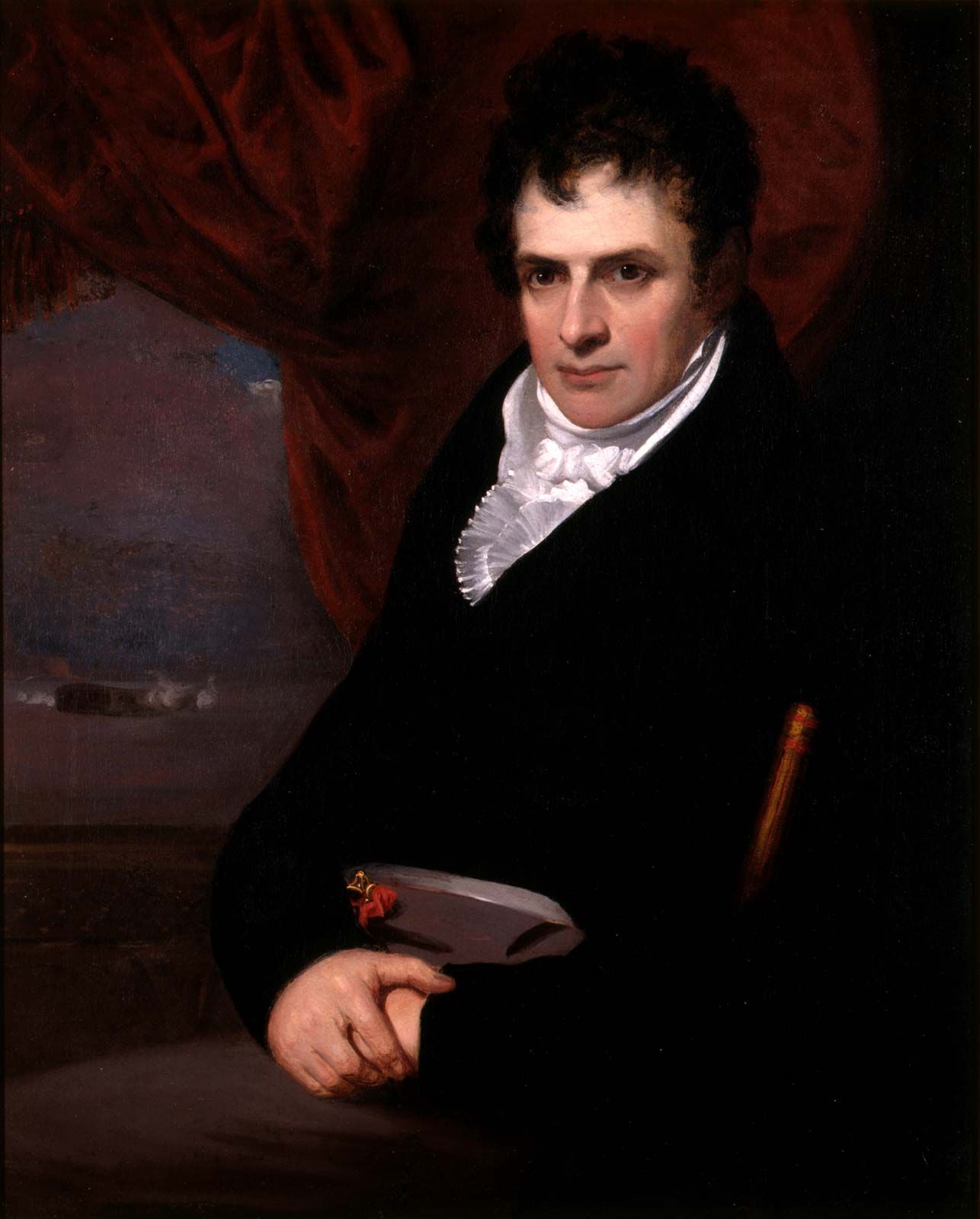
Robert Fulton
American engineer and inventorWikipedia
64
MENTIONS
34
EPISODES
33
PODCASTS
Search complete. 64 mentions across 34 episodes found for "Robert Fulton".
Oct 15, 2026
History of the United States, Vol. IV The West and Jacksonian Democracy-Charles Austin Beard, Mary Ritter Beard
K
36:30Katie GiboneyNARRATOR
Jefferson too was interested in every phase of Western development, the survey of lands, the exploration of the waterways, the opening of trade, and even the discovery of the bones of prehistoric animals.
K
36:44Katie GiboneyNARRATOR
Robert Fulton, the inventor of the steamboat, was another man of vision who for many years pressed upon his countrymen the necessity of uniting East and West by a canal which would cement the Union, raise the value of the public lands, and extend the principles of Confederate and Republican government.
K
37:04Katie GiboneyNARRATOR
The difficulties of early transportation.
K
37:08Katie GiboneyNARRATOR
Means of communication played an important part in the strategy of all those who sought to bring together the seaboard and the frontier.
Unfettered Invention: How the X Patents Sparked Early American Technology with Scott B. Guthery, Julie Burke, and Michael Risch
J
40:58Julie BurkeGUEST
And he had no problem in 1814 whatsoever as superintendent of the Patent Office, filing a patent application 2245 for the steam wheel, the steamboat wheel.
J
41:13Julie BurkeGUEST
the same one that Robert Fulton had received a patent, X-995 in 1809.
J
41:19Julie BurkeGUEST
He gave himself his own patent.
J
41:20Julie BurkeGUEST
He had a record of doing this, and we found the administrative letter from the Secretary of State setting down the law that superintendents of patents cannot issue patents to themselves.
Are You Ready
B
38:50Billy Hahn Jr.HOST
The Bible was written amid this scientific environment, but it has never taught such errors.
B
38:55Billy Hahn Jr.HOST
The majority was wrong when they called Robert Fulton's steamboat Fulton's Folly.
B
39:01Billy Hahn Jr.HOST
In 1903, the Wright brothers believed they could create a machine which could fly through the air.
B
39:06Billy Hahn Jr.HOST
The majority of people laughed at them and called them fools.
History of the United States, Vol. IV The West and Jacksonian Democracy-Charles Austin Beard, Mary Ritter Beard
K
36:04Katie GibneyNARRATOR
Jefferson, too, was interested in every phase of Western development—the survey of lands, the exploration of the waterways, the opening of trade, and even the discovery of the bones of prehistoric animals.
K
36:18Katie GibneyNARRATOR
Robert Fulton, the inventor of the steamboat, was another man of vision who for many years pressed upon his countrymen the necessity of uniting east and west by a canal which would cement the Union, raise the value of the public lands, and extend the principles of Confederate and Republican government.
K
36:38Katie GibneyNARRATOR
The difficulties of early transportation.
K
36:41Katie GibneyNARRATOR
Means of communication played an important part in the strategy of all those who sought to bring together the seaboard and the frontier.
Jack Benny - Trimming Christmas Tree
J
4:02Jack BennyHOST
Oh, Rochester, i- imagine being afraid of electricity.
J
4:05Jack BennyHOST
Suppose Robert Fulton was afraid of electricity, he never would've invented the electric light.
J
4:14Jack BennyHOST
Woody.
M
4:15Mary LivingstonePANELIST
Jack, you're thinking of Thomas Edison.
J
4:17Jack BennyHOST
Edison? Well, then what did Robert Fulton do?
R
4:20RochesterPANELIST
He said, "Don't give up the ship."
J
4:23Jack BennyHOST
That was John Paul Jones.
Short Nonfiction Collection, Vol. 072-Various
B
208:00Betty B.NARRATOR
Read by Betty B.
A
208:06AbayiNARRATOR
Robert Fulton.
A
208:08AbayiNARRATOR
This is a LibriVox recording.
A
208:11AbayiNARRATOR
All LibriVox recordings are in the public domain.
A
208:13AbayiNARRATOR
For more information or to volunteer please visit LibriVox.org. Recording by Abayi in January 2020.
A
208:24AbayiNARRATOR
Robert Fulton from The Scientific American, Volume 2, Issue 1, September 1846.
A
208:33AbayiNARRATOR
Edited by Rufus Porter.
A
208:36AbayiNARRATOR
Robert Fulton, a celebrated engineer whose name is connected with steamboat navigation, was born in the town of Little Britain in the State of Pennsylvania in 1765.
Games for Kids: Who Invented It? Trivia for Kids and Parents
S
3:40speaker_0HOST
Kids, let's sit back and watch those parents do their work.
S
3:44speaker_0HOST
[bell dings] Question one: Robert Fulton is credited with building the first commercially successful version of what mode of river transportation in the early 1800s? And the answer is the steamboat.
S
4:01speaker_0HOST
Question two: In 1846, Elias Howe patented what household invention that changed how clothes were made both at home and in factories? And the answer is the sewing machine.
S
4:17speaker_0HOST
Question three: What invention, made safe for tall buildings thanks to a safety break patented by Elisha Otis in 1852, lets people travel quickly between floors? And the answer is the elevator.
Short Nonfiction Collection, Vol. 072-Various
B
201:39Betty B.NARRATOR
Read by Betty B.
A
201:46AbayiNARRATOR
Robert Fulton.
A
201:48AbayiNARRATOR
This is a LibriVox recording.
A
201:50AbayiNARRATOR
All LibriVox recordings are in the public domain.
A
201:52AbayiNARRATOR
For more information or to volunteer please visit LibriVox.org. Recording by Abayi in January 2020.
A
202:03AbayiNARRATOR
Robert Fulton from the Scientific American, Volume 2, Issue 1, September 1846.
A
202:12AbayiNARRATOR
Edited by Rufus Porter.
A
202:15AbayiNARRATOR
Robert Fulton, a celebrated engineer whose name is connected with steamboat navigation, was born in the town of Little Britain in the State of Pennsylvania in 1765.
P
Unknown podcast
History of the United States, Vol. IV The West and Jacksonian Democracy-Charles Austin Beard, Mary Ritter Beard
Oct 3 · 1 Mention
K
30:43Katie GibneyNARRATOR
In the subdivision of the soil and the great equality of condition, as Webster said on more than one occasion, lay the true basis, most certainly, of popular government.
K
30:55Katie GibneyNARRATOR
there was the undoubted source of jacksonian democracy the characteristics of the western people travelers into the northwest during the early years of the nineteenth century were agreed that the people of that region were almost uniformly marked by the characteristics common to an independent yeomanry a close observer thus recorded his impressions a spirit of adventurous enterprise a willingness to go through any hardship to accomplish an object independence of thought and action they have felt the influence of these principles from their childhood men who can endure anything that have lived almost without restraint free as the mountain air or as the deer and the buffalo of their forests and who know they are americans all an apparent roughness which some would deem rudeness of manner where there is perfect equality in a neighborhood of people who know little about each other's previous history or ancestry but where each is lord of the soil he cultivates where a log cabin is all that the best of families can expect to have for years and of course can possess few of the external decorations which have so much influence in creating a diversity of rank in society these circumstances have laid the foundation for that equality of intercourse simplicity of manners want of deference want of reserve great readiness to make acquaintances freedom of speech indisposition to brook real or imaginary insults which one witnesses among people of the west this equality this independence this rudeness so often described by the traveler as marking a new country were all accentuated by the character of the settlers themselves traces of the fierce unsociable eagle-eyed hard-drinking hunter remained the settlers who followed the hunter were with some exceptions soldiers of the revolutionary army farmers of the middling order and mechanics from the towns english scotch-irish germans poor in possessions and thrown upon the labor of their own hands for support sons and daughters from well-to-do eastern homes sometimes brought softer manners but the equality of life and the leveling force of labor in forest and field soon made them one in spirit with their struggling neighbors even the preachers and teachers who came when the cabins were raised in the clearings and rude churches and schoolhouses were built preached sermons and taught lessons that savored of the frontier as any one may know who reads peter cartwright's a muscular christian or eggleston's the hoosier schoolmaster the west and the east meet the east alarmed a people so independent as the westerners and so attached to local self-government gave the conservative east many a rude shock setting gentlemen in powdered wigs and knee breeches agog with the idea that terrible things might happen in the mississippi valley not without good grounds did washington fear that a touch of a feather would turn the western settlers away from the seaboard to the spaniards and seriously did he urge the east not to neglect them lest they be drawn into the arms of or be dependent upon foreigners taking advantage of the restless spirit in the southwest aaron burr having disgraced himself by killing alexander hamilton in a duel laid wild plans if not to bring about a secession in that region at least to build a state of some kind out of the spanish dominions adjoining louisiana frightened at such enterprises and fearing the dominance of the west the federalists with a few conspicuous exceptions opposed equality between the sections had their narrow views prevailed the west with its new democracy would have been held in perpetual tutelage to the seaboard or perhaps been driven into independence as the thirteen colonies had been not long before eastern friends of the west fortunately for the nation there were many eastern leaders particularly from the south who understood the west approved its spirit and sought to bring the two sections together by common bonds washington kept alive and keen the zeal for western advancement which he acquired in his youth as a surveyor he never grew tired of urging upon his eastern friends the importance of the lands beyond the mountains he pressed upon the governor of virginia a project for a wagon road connecting the seaboard with the ohio country and was active in a movement to improve the navigation of the potomac he advocated strengthening the ties of commerce smooth the roads he said and make easy the way for them and then see what an influx of articles will be poured upon us how amazingly our exports will be increased by them and how amply we shall be compensated for any trouble and expense we may encounter to effect it jefferson too was interested in every phase of western development the survey of lands the exploration of the waterways the opening of trade and even the discovery of the bones of prehistoric animals robert fulton the inventor of the steamboat was another man of vision who for many years pressed upon his countrymen the necessity of uniting east and west by a canal which would cement the union raise the value of the public lands and extend the principles of confederate and republican government the difficulties of early transportation means of communication played an important part in the strategy of all those who sought to bring together the seaboard and the frontier the produce of the west wheat corn bacon hemp cattle and tobacco was bulky and the cost of overland transportation was prohibitive in the eastern market a cow and her calf were given for a bushel of salt while a suit of store clothes cost as much as a farm in such circumstances the inhabitants of the mississippi valley were forced to ship their produce over a long route by way of new orleans and to pay high freight rates for everything that was brought across the mountains scows of from five to fifty tons were built at the towns along the rivers and piloted down the stream to the crescent city in a few cases small ocean-going vessels were built to transport goods to the west indies or to the eastern coast towns salt iron guns powder and the absolute essentials which the pioneers had to buy mainly in eastern markets were carried over narrow wagon trails that were almost impassable in the rainy season the National Road.
K
38:08Katie GibneyNARRATOR
To far-sighted men, like Albert Gallatin, the father of internal improvements, the solution of this problem was the construction of roads and canals.
K
38:18Katie GibneyNARRATOR
Early in Jefferson's administration, Congress dedicated a part of the proceeds from the sale of lands to building highways from the headwaters of the navigable waters emptying into the Atlantic to the Ohio River and beyond into the northwest territory in eighteen o six after many misgivings it authorized a great national highway binding the east and the west the cumberland road as it was called began in northwestern maryland wound through southern pennsylvania crossed the narrow neck of virginia at wheeling and then shot almost straight across ohio indiana and illinois into missouri By 1817, stagecoaches were running between Washington and Wheeling.
History of the United States, Vol. IV The West and Jacksonian Democracy-Charles Austin Beard, Mary Ritter Beard
K
36:25Katie GibneyNARRATOR
He pressed upon the governor of Virginia a project for a wagon road connecting the seaboard with the Ohio country and was active in a movement to improve the navigation of the Potomac.
K
36:37Katie GibneyNARRATOR
he advocated strengthening the ties of commerce smooth the roads he said and make easy the way for them and then see what an influx of articles will be poured upon us how amazingly our exports will be increased by them and how amply we shall be compensated for any trouble and expense we may encounter to effect it jefferson too was interested in every phase of western development the survey of lands the exploration of the waterways the opening of trade and even the discovery of the bones of prehistoric animals robert fulton the inventor of the steamboat was another man of vision who for many years pressed upon his countrymen the necessity of uniting east and west by a canal which would cement the union raise the value of the public lands and extend the principles of confederate and republican government the difficulties of early transportation means of communication played an important part in the strategy of all those who sought to bring together the seaboard and the frontier the produce of the west wheat corn bacon hemp cattle and tobacco was bulky and the cost of overland transportation was prohibitive in the eastern market a cow and her calf were given for a bushel of salt while a suit of store clothes cost as much as a farm in such circumstances the inhabitants of the mississippi valley were forced to ship their produce over a long route by way of new orleans and to pay high freight rates for everything that was brought across the mountains scows of from five to fifty tons were built at the towns along the rivers and piloted down the stream to the crescent city in a few cases small ocean-going vessels were built to transport goods to the west indies or to the eastern coast towns salt iron guns powder and the absolute essentials which the pioneers had to buy mainly in eastern markets were carried over narrow wagon trails that were almost impassable in the rainy season the national road to far-sighted men like albert gallatin the father of internal improvements the solution of this problem was the construction of roads and canals early in jefferson's administration congress dedicated a part of the proceeds from the sale of lands to building highways from the headwaters of the navigable waters emptying into the atlantic to the ohio river and beyond into the northwest territory in eighteen o six after many misgivings it authorized a great national highway binding the east and the west the cumberland road as it was called began in northwestern maryland wound through southern pennsylvania crossed the narrow neck of virginia at wheeling and then shot almost straight across ohio indiana and illinois into missouri By 1817, stagecoaches were running between Washington and Wheeling.
K
39:48Katie GibneyNARRATOR
By 1833, contractors had carried their work to Columbus, Ohio, and by 1852 to Vandalia, Illinois.
K
39:57Katie GibneyNARRATOR
Over this ballasted road, mail and passenger coaches could go at high speed, and heavy freight wagons proceed in safety at a steady pace.
24 more episodes mention Robert Fulton.
Create an account to see the whole feed, search across every transcript, and follow the entities you care about.