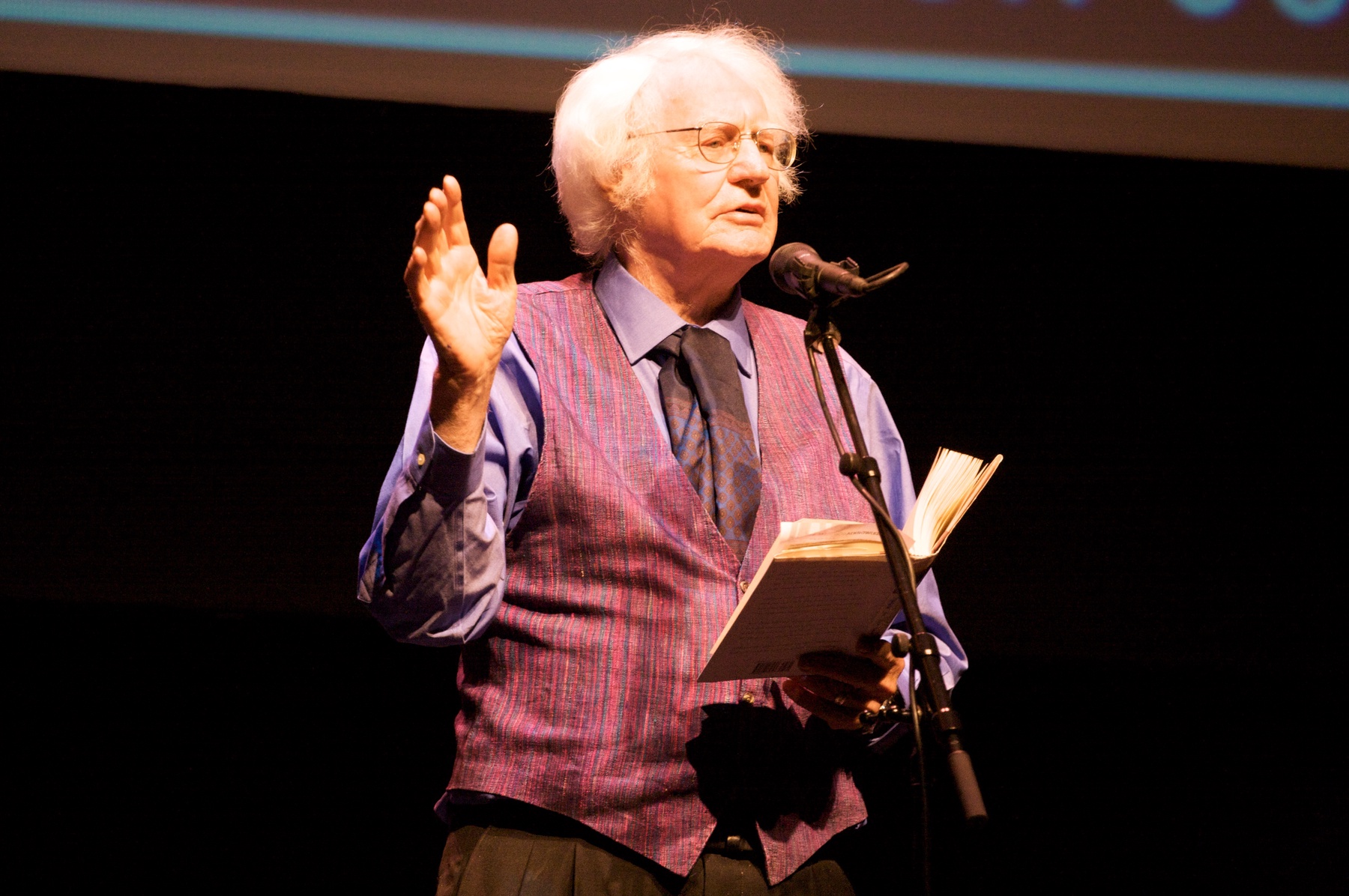
Robert Bly
American poet and essayistWikipedia
51
MENTIONS
38
EPISODES
34
PODCASTS
Search complete. 51 mentions across 38 episodes found for "Robert Bly".
Sep 17, 2026

Daniel BurgessGUEST
Yeah, that's so beautiful and so well said.
Daniel BurgessGUEST
I know you've read Robert Moore and Robert Bly and I think it's Robert Moore I first learned this for.
Daniel BurgessGUEST
It's like for a man, it's the shift from competition to creation.
Daniel BurgessGUEST
Like competition destructs eventually, right? If you think about give them...

Robin BeckHOST
Yeah.
Robin BeckHOST
You came up alongside Robert Bly and James Hillman in the 1980s with this book, The Rag and Bone Shop of the Heart, which is one of the first ones that I was familiarized by.
Robin BeckHOST
to come to know your work.
Robin BeckHOST
And I think since then you've moved well beyond that into more of a broader multicultural and intergenerational frame.

Layman PascalHOST
Great.
Marc GafniGUEST
Book came out like 20 or 25 years ago, Meeting the Shadow, you know, you know, Robert Bly, you know, the whole gang, you know, and this book was put out by, um, you know, Connie Zweig, who's written more about this, and Jeremiah Abrams, who I think was the, you know, a torture.
Marc GafniGUEST
And, you know, this book extensively works with Bly's sense of shadow, which I believe is fundamentally wrong, right? And what's wrong with the shadow literature.
Marc GafniGUEST
So, you know, Bly has this thing called The Little Book of Shadow.
6 MINS LATER
Marc GafniGUEST
So I act out.
Marc GafniGUEST
i've lost access to the fullness of my era so i act out in pseudo eros in other words shadow qualities contraction bitterness jealousy right so shadow qualities are the acting out of a a collapsed unique self right, seeking to cover over the emptiness because the vital aliveness has been emptied.
Marc GafniGUEST
That is completely different than what Robert Bly is describing that got canonically adopted by New Age idiocy, right, you know, across the spectrum and therapists adopting New Age idiocy across the spectrum for several decades and ruining an unimaginable amount of patients.
Marc GafniGUEST
And that's therapy is a broken field today.

Catherine SvehlaHOST
Which brings me to the flowers, the nosegay.
Catherine SvehlaHOST
This reminds me of a fairy tale that Robert Bly popularized some years ago called Iron John.
Catherine SvehlaHOST
There are a number of common elements between these two stories.
Catherine SvehlaHOST
A prince in disguise as a common person who enters a contest to win the hand of a princess and receives magical help, who appears three times with red, white, and black horses in gear and slips away until his third appearance when he's wounded and subsequently discovered through the persistence of the princess who is an active agent in her destiny.

Ian McKenzieHOST
And just been somewhat peripherally aware of your efforts and good work you're doing.
Ian McKenzieHOST
And then I was doing some research on the deep masculine, which is a phrase I believe I first encountered in Robert Bly's book, Iron John, not so much as a like a noun, but maybe just a descriptor.
Ian McKenzieHOST
And that was also an inspiration for the program that I created with my collaborator, Deus Forte, called the deep masculine.
Ian McKenzieHOST
And when I found when I searched for it, I found it was an e-book based on a paper, I believe, an academic paper that you'd written, I think, way back in 2005.
7 MINS LATER
Jayson GaddisGUEST
So there can be a cool context there that I think on the positive side, an initiatory experience, and then I get an emblem, something that signifies my passage through the initiation.
Jayson GaddisGUEST
But too often it just goes off the rails.
Jayson GaddisGUEST
And I think the reason it goes off the rails, because I've studied this a lot and I gave a lot of talks on this back in the day, And the books you've obviously read and Michael Mead and Robert Bly and so forth speak to in Melodoma Somae, like this kind of unconscious need in a boy to become a man.
Jayson GaddisGUEST
And this maybe story, but maybe possibly it's more in our biology that we want to go through something hard to be an adult.

David WhyteGUEST
... serious young man, serious young poet.
David WhyteGUEST
And, uh, I was involved with a lot of Robert Bly's work around grief and men's work and things, and it was all about grief, you know? So I was going to write my long epic on grief.
David WhyteGUEST
And, uh, uh, but after just a few lines, I came across this image, and I didn't want to look at it.
David WhyteGUEST
Not because I was afraid of, of the revelation.

Graham Joseph HillHOST
Some of it was healthy, let's be fair, and some of it was empire building with a Bible on top.
Graham Joseph HillHOST
In our own time, we've had Robert Bly's Iron John and the mytho-poetic men's movement of the 1990s, and promise keepers filling stadiums, and now the online manosphere selling supplements and resentment.
Graham Joseph HillHOST
And actually, this connects to something I've been thinking about for a while.
Graham Joseph HillHOST
Every one of these movements, I reckon, the noble and the ridiculous alike, is answering the same longing.

Rachelle LambHOST
What belief is underneath it? What are you protecting? And is that thing, that image, that story, that version of yourself actually in danger? Or is it simply being asked to make a little room for something more complicated and more true? Defensiveness is not the enemy, but like anger, it's a signal, and what it's usually pointing toward is somewhere we haven't yet looked.
Rachelle LambHOST
I conclude this episode with some beautiful words from the poet Rilke, from The Book of Hours, translated by Robert Bly.
Rachelle LambHOST
It's a poem I like to read to help me lighten my attachment to any fixed idea of who I am, and to open the door to wonder.
Rachelle LambHOST
Here it is.

James BarazGUEST
[clears throat] And that's how the process of, of transformation happens.
James BarazGUEST
I, I mentioned, uh, that Robert Bly quote.
James BarazGUEST
Did I mention that Bly- Robert Bly quote here? It was from that book.
James BarazGUEST
It said, "Every part of our personality that we do not learn to love or to embrace will become hostile to us." So whatever it is for you, make friends with it.
James BarazGUEST
Make friends with your humanness.

Martin SheenHOST
In this war, books are weapons, and it is part of your dedication always to make them weapons for man's freedom.
Martin SheenHOST
And for our final selection, What to Do with the Garden by Robert Bly.
Martin SheenHOST
I'll just stay here.
Martin SheenHOST
You go on.
Martin SheenHOST
Robert, give up your longing for a different childhood.
Martin SheenHOST
You'll recall that Fabra, when he was 70, found for his insects one acre of stony ground.
Martin SheenHOST
Robert Bly, American poet, essayist, and activist, was born on December 23, 1926, in Parley County, Minnesota.
Martin SheenHOST
His best-known prose book is Iron John, a book about men, published in 1990, which spent 62 weeks on the New York Times bestseller list and is a key text of the mythopoetic men's movement.
28 more episodes mention Robert Bly.
Create an account to see the whole feed, search across every transcript, and follow the entities you care about.