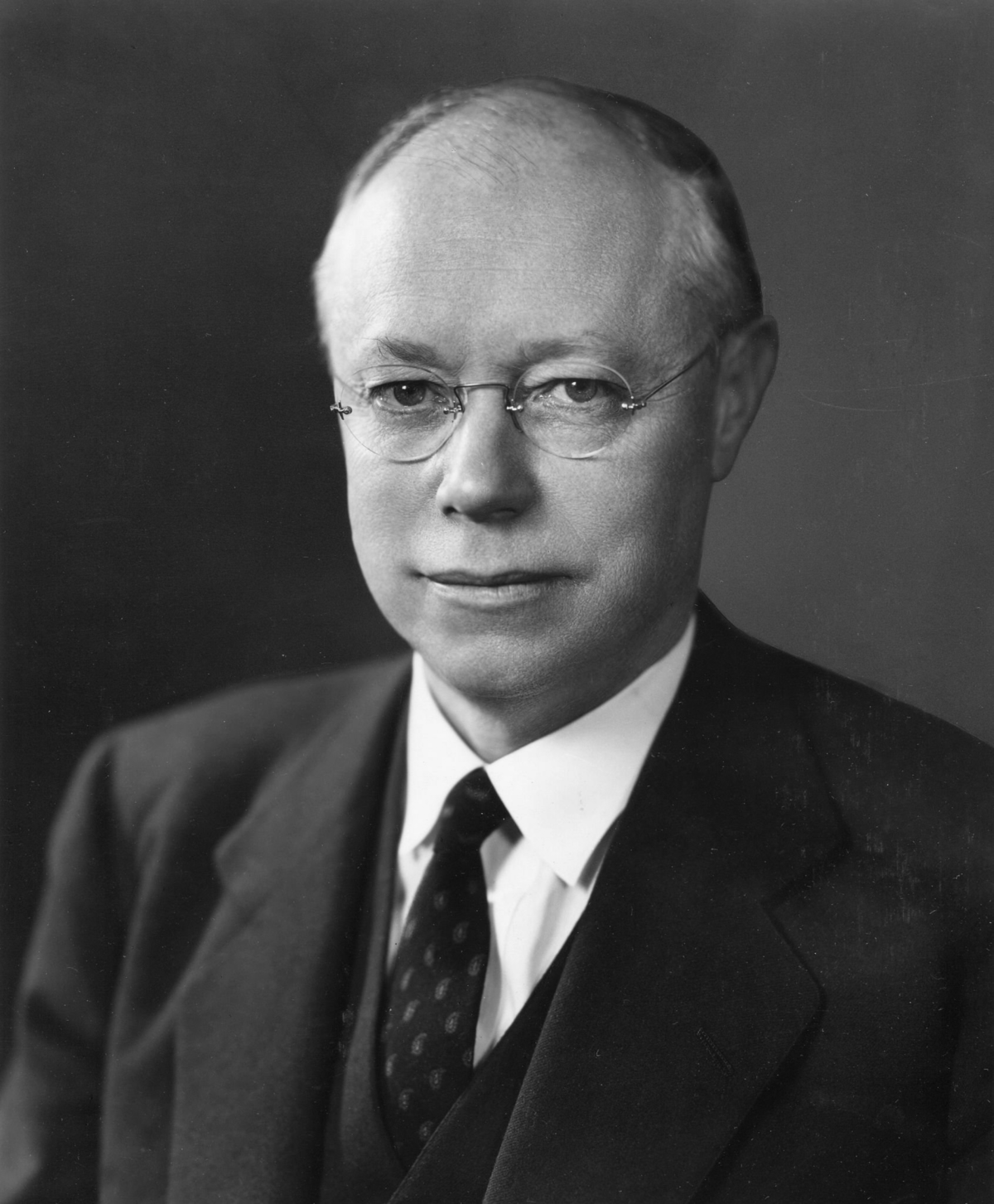
Robert Alphonso Taft
Lawyer and former Majority Leader of the United States SenateWikipedia
53
MENTIONS
18
EPISODES
14
PODCASTS
Search complete. 53 mentions across 18 episodes found for "Robert Alphonso Taft".
Sep 21, 2026

Jacob WeisbergGUEST
And to do that, he created a kind of gallery of past senators who he thought had not necessarily done the right thing in terms of like taking positions he would have agreed with.
Jacob WeisbergGUEST
I mean, you know, one of them is Robert Taft opposing the Nuremberg trials.
Jacob WeisbergGUEST
But acting on principle and being willing to sacrifice their political careers, you know, lose an election for something that they felt was a fundamental principle.
Jacob WeisbergGUEST
And I think it kind of worked for Kennedy.

Dean KarayanisHOST
Here is Anita Dunn, senior advisor to President Obama and Howie Kirk.
Anita DunnSOUNDBITE_SPEAKER
It's fair to say about Fox, and certainly the way we view it, is that it really is more a wing of the Republican Party.
Anita DunnSOUNDBITE_SPEAKER
That's evidence of that.
Dean KarayanisHOST
Is that the reason the president did not go on Fox News Sunday a few weeks
Anita DunnSOUNDBITE_SPEAKER
story selection.
Anita DunnSOUNDBITE_SPEAKER
There's a very different, even down to the chyron they run below stories, that, you know, this isn't us making it up, Howie, but let's be realistic here, Howie.
Anita DunnSOUNDBITE_SPEAKER
You know, they are, they're widely viewed as, you know, a part of the Republican Party.
Anita DunnSOUNDBITE_SPEAKER
Take their talking points, put them on the air.

Bill KristolHOST
I mean, this is sort of like having, I mean, I'm exaggerating, but the '30s with, I don't know, you know, F- Father Coughlin as president or something insane, right? I mean-
Robert KaganGUEST
Well, it could even have been, it could have even have been Herbert Hoover or, or Robert Taft.
Robert KaganGUEST
They, uh, they would have also pursued a different foreign policy.
Robert KaganGUEST
And, and I think the one thing that I think people don't really realize is that, among other things, World War II was, within America, a victory of the liberal worldview over the conservative worldview.

John HeilemannHOST
deference to his father's friendship with McCarthy.
John HeilemannHOST
In Weisberg's view, whatever else profiles and courage may have been, the book, which took the form of eight narrative profiles of senators such as John Quincy Adams, Sam Houston, and Robert Taft, who had famously put principle above political self-interest, was also Kennedy's attempt to make sense of what that kind of courage was so he could locate some inside himself.
John HeilemannHOST
Profiles in Courage went on to win a Pulitzer Prize and has remained hugely influential in the seven decades since its publication as a touchstone and a template for how modern politicians discuss moral leadership.
John HeilemannHOST
And now, Jacob Weisberg has paid the book a unique kind of compliment by producing a bizarro world mirror image homage and sequel to it.

Jeremi SuriGUEST
At the time of the Korean War, after the North Korean invasion of South Korea, Harry Truman responded with military force that was probably the right response, but he did not go to Congress for a declaration of war.
Jeremi SuriGUEST
and Senator Robert Taft from Ohio, who would have been president if Eisenhower hadn't run, famously made the case that this was, he didn't use the word imperial presidency, but that this was the president going beyond what were the constitutional limits, because Truman was in essence fighting a war without declaring it.
Jeremi SuriGUEST
Exhibit A of the imperial presidency ever since.
Jeremi SuriGUEST
And Truman

Jacob WeisbergGUEST
He was also not at all courageous on civil rights in that era.
Jacob WeisbergGUEST
And I think he wrote the book in part because he wanted to give himself courage by looking to examples of earlier previous senators and all the profiles in that book are of senators who had taken decisions against their own interests who had sacrificed their careers or risked their careers because of principles they thought were important and uh it's interesting that substantively these are not at all people uh kennedy would necessarily have agreed with on the substance of their views you know robert taft uh yeah i'm putting
Andrew KeenHOST
on the screen the the characters that uh jfk uh wrote about in this book including john quincy adams sam houston robert taft as you said
Jacob WeisbergGUEST
Yeah, I mean, Taft thought that the Nuremberg trials were a terrible violation of constitutional democracy and an example of victor's justice.
Jacob WeisbergGUEST
And, well, there's an argument about all that, but I don't think Kennedy agreed with it.

Thomas777GUEST
I mean, that was, that's kind of like what turned national socialism into like a, a pretty conventional right wing tendency, honestly.
Thomas777GUEST
Like I, uh, not, not in the sense of, you know, not, not, not, not right wing in terms of like Donald Trump or not even right wing in terms of like Robert Taft, but by European standards, um, the third right was more conventionally right wing than people will acknowledge.
Thomas777GUEST
I mean, they, because there's, there's moronic stuff like, like Jonah Goldberg saying like, Oh, fascists are a bunch of like Hillary Clinton liberals or something like, but it, but there's serious people too, who aren't prone to that kind of moronic stuff who don't like really understand because they, you know, they, they read these like dispatches from, uh, um, from, um, from Dietrich Eckert and from Ernst Rahn, like saying, yeah, God is dead, you know, like the hell with the capitalists and the Jews, like burn everything down.
Thomas777GUEST
You know, we're going to, we're going to march on everything and we're going to kill everybody.
37 MINS LATER
Thomas777GUEST
It's just the way it is.
Thomas777GUEST
And yeah, that's, if you, um, And the North was a little bit different.
Thomas777GUEST
But at the same time, too, like I said, even, you know, the old right, what was called old right in the 20th century, you know, America First and Robert Taft and stuff, those guys were Hamiltonian Republicans.
Thomas777GUEST
They were like northern city slickers.

Ron PaulSOUNDBITE_SPEAKER
Well, I think the party has lost its way because the conservative wing of the Republican Party always advocated a non-interventionist foreign policy.
Ron PaulSOUNDBITE_SPEAKER
Senator Robert Taft didn't want to be in NATO.
Ron PaulSOUNDBITE_SPEAKER
George Bush won the election in year 2000 campaigning on a humble foreign policy.
Ron PaulSOUNDBITE_SPEAKER
No nation-building, no policing of the world.

ThomasGUEST
I mean, that's kind of like what turned National Socialism into, like, a pretty conventional right-wing tendency, honestly.
ThomasGUEST
Like, not in the sense of, you know, not right-wing in terms of, like, Donald Trump or not even right-wing in terms of, like, Robert Taft, but by European standards.
ThomasGUEST
The Third Reich was more conventionally right-wing than people will acknowledge.
ThomasGUEST
I mean, because there's moronic stuff like, like Jonah Goldberg saying like, Oh, fascists are a bunch of like Hillary Clinton liberals or something like, but it, but there's serious people too, who aren't prone to that kind of moronic stuff who don't like really understand.
39 MINS LATER
ThomasGUEST
That's not good or bad, it's just the way it is.
ThomasGUEST
And, yeah, that's In the North, it was a little bit different.
ThomasGUEST
But at the same time, too, like I said, even the old right, what was called old right in the 20th century, America First and Robert Taft and stuff, those guys were Hamiltonian Republicans.
ThomasGUEST
They were like northern city slickers.
ThomasGUEST
was part of it um definitely but i mean he he um his concession there i mean nixon actually looked like a gentleman in 1960 in a lot of ways especially especially um he never gave up till the end but there was a lot of dirty pool in that election and probably in absolute terms like in real in real numbers terms it was probably too close to call kind of full the kind of full frontal assault on nixon by the east coast press um i missed uh that kind of presentation that you know the national audience had been afforded would have um would have been somewhat unseemly i make the point about 62 because in a lot of ways like the proverbial mask dropped um What prompted Nixon's comeback? You know, as we've talked about, you know, the catastrophic defeat of Barry Goldwater, you know, Goldwater himself was a bizarre placeholder, but it wasn't just owing to a lack of personages who could interface effectively with kind of the era of new media.
ThomasGUEST
You know, is that like we've talked about Kennedy's literal eulogy to Taft in Profiles in Courage, you know, post Nuremberg, there was no more American right.
ThomasGUEST
It was it was It was for all practical purposes, illegal in policy terms and in ethical and optical terms.
ThomasGUEST
It was just unthinkable, you know, to have an America first party.
12 MINS LATER
ThomasGUEST
The New Republic was quoted as saying, quote, the current gravitation of power into the hands of Congress at the expense of the executive is a phenomenon so fatuous as to be incredible if the facts were not so patent.
ThomasGUEST
That's the New Republic, you know, which in the 50s was, um, dividing its time between screaming that everybody in America is racist and talking about how great the Soviet Union is.
ThomasGUEST
This wasn't the Wall Street Journal, and it wasn't a bunch of John Birchers, and it wasn't a bunch of dissident America firsters who had hoped to see Robert Taft become the president.
ThomasGUEST
This was literally a bunch of reds saying this.
8 more episodes mention Robert Alphonso Taft.
Create an account to see the whole feed, search across every transcript, and follow the entities you care about.