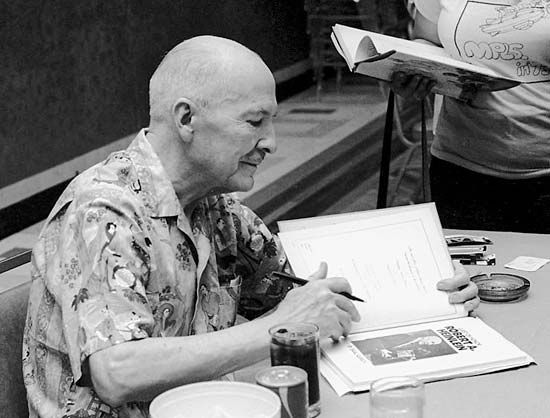
Robert A. Heinlein
American science-fiction writerWikipedia
285
MENTIONS
122
EPISODES
102
PODCASTS
Search complete. 285 mentions across 122 episodes found for "Robert A. Heinlein".
Sep 12, 2026

Tom LombardoGUEST
Rereading for the third time, Asimov's Foundation series.
Tom LombardoGUEST
and reading Heinlein's series of future history stories and lots of other significant writers of the 1940s.
Tom LombardoGUEST
I'm coming close, hopefully this year, to finishing both books, the one on the future of consciousness and also the one on science fiction of the golden age, the 1940s primarily.
Tom LombardoGUEST
Somewhere along the line, I developed this history habit of working on two different major projects back and forth simultaneously, as opposed to just doing one at a time.
Tom LombardoGUEST
The expression came about because in 1938, John Campbell, who was the writer of Who Goes There, which was made into the movie The Thing, became the editor of Astounding Stories.
Tom LombardoGUEST
It became Astounding Science Fiction.
Tom LombardoGUEST
And when Campbell became the editor in 1938, He drew in a set of new writers that became very famous, like Asimov and Heinlein and other people, Van Valk, the Canadian science fiction writer.
Tom LombardoGUEST
People began referring to that era of the 1940s when Campbell was the editor of Astounding as the golden age of science fiction.

MikeyHOST
Yeah.
JeremyHOST
Robert Heinlein, I think.
JeremyHOST
Yeah.
JeremyHOST
Damn, it's a

Victor SterlingHOST
A radiation accident leaves rocket engineer Reisling blind and sends him on a new course among the working crews of the future solar system as a singer and poet of the spaceways.
Victor SterlingHOST
Ladies and gentlemen, from NBC's Dimension X comes Episode 32, The Green Hills of Earth, originally broadcast December 24, 1950. adapted by Ernest Kenoy from Robert A. Heinlein's short story.
Victor SterlingHOST
It stars Ken Williams as Riesling, with songs sung by Tom Glazer.
Victor SterlingHOST
Riesling's travels carry him from rocket ship to rocket ship, while Earth remains the distant home he remembers.

Paulina BorsookGUEST
And I think that that is really right.
Paulina BorsookGUEST
So you could have this love and peace liberatory thing, and then you could have these people that read too much Heinlein and, you know, thought, didn't realize Starship Troopers was a parody.
Paulina BorsookGUEST
In other words, you had those people there.
Paulina BorsookGUEST
I mean, it's like, it was a mix of people and ideas and, and I really think, to me, it's like once you had that stockholder theory of value takeover, the party was over.

Type 3 AudioNARRATOR
But this pov is also missing the history of where sci-fi even came from as a genre.
Type 3 AudioNARRATOR
The progenitors of the golden age of science fiction, Heinlein, Campbell, Asimov, etc., lived through an age of wonders.
Type 3 AudioNARRATOR
Radio, TV, airplanes, computers, nukes, satellites, the moon landing.
Type 3 AudioNARRATOR
They were not just making shit up for fun, They wrote about robots and starships in part because they were surrounded by evidence that technological society was capable of inventing wonders and they expected further wonders.

QCSOUNDBITE_SPEAKER
But this point of view is also missing the history of where sci-fi even came from as a genre, the progenitors of the golden age of science fiction.
QCSOUNDBITE_SPEAKER
Heinlein, Campbell, Asimov, etc.
QCSOUNDBITE_SPEAKER
lived through an age of wonders.
QCSOUNDBITE_SPEAKER
Radio, TV, airplanes, computers, nukes, satellites, the moon landing.

speaker_2UNKNOWN
science
Robyn Roxanne KincaidHOST
fiction, you know, for God's sakes, the AI over at what used to be Twitter is named after a made-up word by Robert A. Heinlein in Stranger in a Strange Land, a novel that came out in, what, 1959, 1960? Yeah.
Robyn Roxanne KincaidHOST
So that would be almost 70 years ago.
Robyn Roxanne KincaidHOST
And do no harm, protect all humans.

Type Three AudioNARRATOR
But this pov is also missing the history of where sci-fi even came from as a genre.
Type Three AudioNARRATOR
The progenitors of the golden age of science fiction, Heinlein, Campbell, Asimov, etc., lived through an age of wonders.
Type Three AudioNARRATOR
Radio, TV, airplanes, computers, nukes, satellites, the moon landing.
Type Three AudioNARRATOR
They were not just making shit up for fun, They wrote about robots and starships in part because they were surrounded by evidence that technological society was capable of inventing wonders and they expected further wonders.

Andrew BrancaHOST
You could have military service.
Andrew BrancaHOST
Being one of those surrogates, if you've served your nation, you've earned the franchise like in Starship Troopers, the Robert Heinlein book.
Andrew BrancaHOST
Not the movie.
Andrew BrancaHOST
The movie's not worth talking about.

Paul McGuireHOST
And a very selected group of prestigious, prominent science fiction authors and guys and girls who knew how to think outside of the box in terms of creativity and the conceptualization of weaponry and defense technology that could only be developed by people who thought way out of the box.
Paul McGuireHOST
And the Navy... responded to an appeal by Robert Heinlein, the great science fiction author who wrote such best-selling sci-fi novels as Stranger in a Strange Land and many others.
Paul McGuireHOST
And he was also an officer in naval intelligence.
Paul McGuireHOST
Then Isaac Asimov, another prolific Golden Age era sci-fi author and fiction author and nonfiction author, joined this out-of-the-box
Paul McGuireHOST
He was an officer
Paul McGuireHOST
in naval intelligence, and he met with this group, too.
Paul McGuireHOST
And later on, not that long after that, or even simultaneously to the meeting with this group, L. Ron Hubbard was the close friend of Robert Heinlein and the others.
Paul McGuireHOST
L. Ron Hubbard began the initial overtures to found the religion of Scientology and wrote his best-selling books on Scientology, beginning with Dianetics.
112 more episodes mention Robert A. Heinlein.
Create an account to see the whole feed, search across every transcript, and follow the entities you care about.