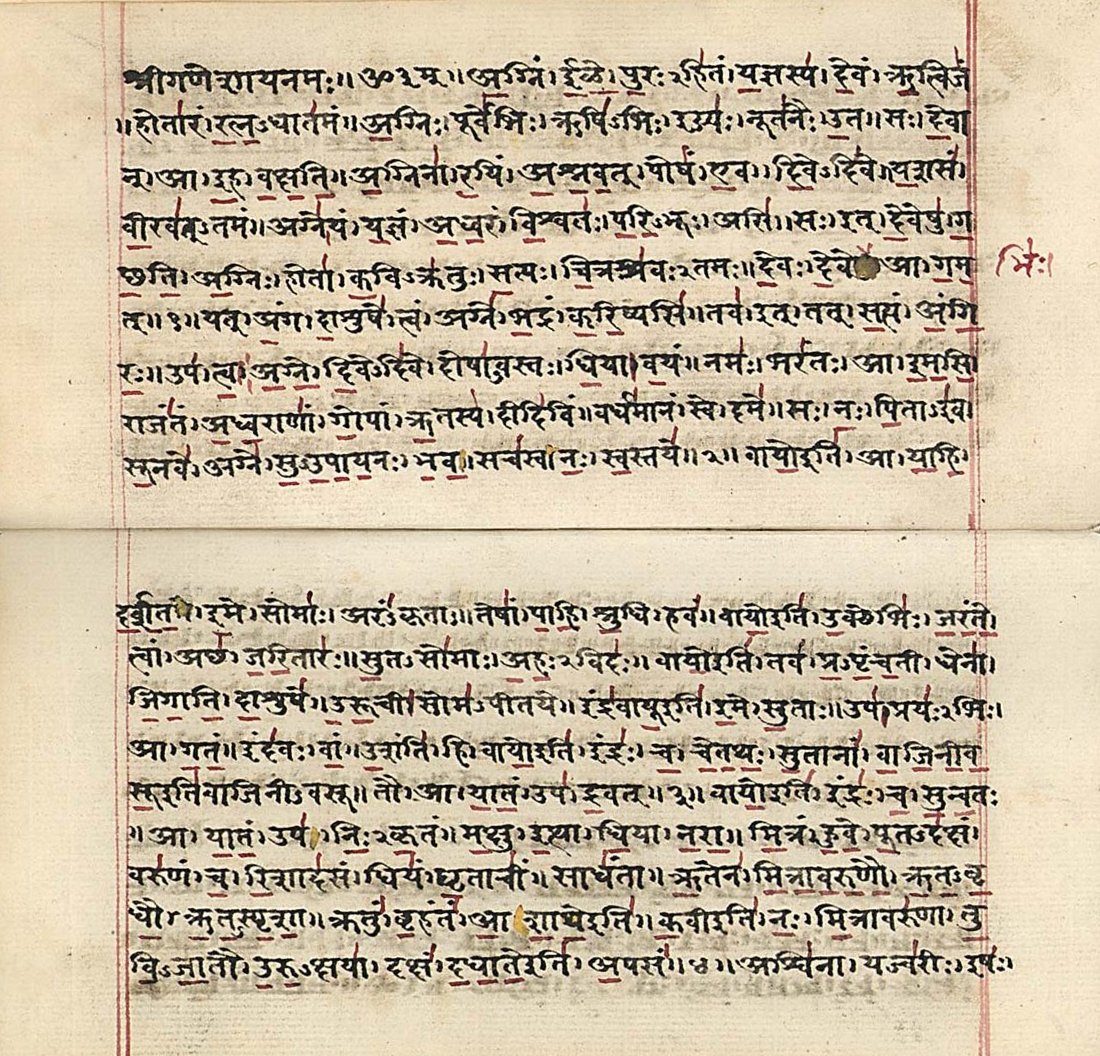
Rigveda
CanonWikipedia
164
MENTIONS
50
EPISODES
41
PODCASTS
Search complete. 164 mentions across 50 episodes found for "Rigveda".
Sep 13, 2026

Jyoti TharavanathNARRATOR
He was called Ayasa Angirasa, for he is the sap rasa of the limbs Anga.
Jyoti TharavanathNARRATOR
verily breath is the sap of the limbs yes breath is the sap of the limbs therefore from whatever limb breath goes away that limb withers for breath verily is the sap of the limbs He breath is also Brihaspati, for speech is Brihati, Rig Veda, and he is her Lord, therefore he is Brihaspati.
Jyoti TharavanathNARRATOR
He breath is also Brahmanasipati, for speech is Brahman, Yajur Veda, and he is her Lord, therefore he is Brahmanasipati.
Jyoti TharavanathNARRATOR
he breath is also saman the udgita for speech is saman samaveda and that is both speech sa and breath ama that is why saman is called saman or because he is equal sama to a grub equal to a gnat equal to an elephant equal to those three worlds nay equal to this universe therefore he is
30 MINS LATER
Jyoti TharavanathNARRATOR
Earth is speech, sky mind, heaven breath.
Jyoti TharavanathNARRATOR
These are the three Vedas.
Jyoti TharavanathNARRATOR
The Rig Veda is speech, the Yajur Veda, mind, the Sama Veda, breath.
Jyoti TharavanathNARRATOR
These are the Devas, fathers and men.

Jyoti TharavanatNARRATOR
Thus does that deity carry him who knows this across death.
Jyoti TharavanatNARRATOR
then breath vital by singing obtained for himself eatable food for whatever food is eaten is eaten by breath alone and in it breath rests the devas said verily thus far whatever food there is thou hast by singing acquired it for thyself now therefore give us a share in that food he said you there enter into me they said yes and entered all into him therefore whatever food is eaten by breath by it the other senses are satisfied if a man knows this then his own relations come to him in the same manner he becomes their supporter their chief leader their strong ruler and if everyone tries to oppose one who is possessed of such knowledge among his own relatives then he will not be able to support his own belongings but he who follows the man who is possessed of such knowledge and who with his permission wishes to support those whom he has to support he indeed will be able to support his own belongings he was called ayasa angirasa for he is the sap rasa of the limbs verily breath is the sap of the limbs yes breath is the sap of the limbs therefore from whatever limb breath goes away that limb withers for breath verily is the sap of the limbs He breath is also Brihaspati, for speech is Brihati, Rig Veda, and he is her Lord.
Jyoti TharavanatNARRATOR
Therefore, he is Brihaspati.
Jyoti TharavanatNARRATOR
He breath is also Brahmanasipati, for speech is Brahman, Yajur Veda, and he is her Lord.
29 MINS LATER
Jyoti TharavanatNARRATOR
These are the three worlds.
Jyoti TharavanatNARRATOR
Earth is speech, sky mind, heaven breath.
Jyoti TharavanatNARRATOR
these are the three vedas the rig veda is speech the yajur veda mind the sama veda breath these are the devas fathers and men the devas are speech the fathers mind men breath These are father, mother, and child.
Jyoti TharavanatNARRATOR
The father is mind, the mother speech, the child breath.
Jyoti TharavanathNARRATOR
That which is true is Brahman.
Jyoti TharavanathNARRATOR
that which is brahman is light and that which is light is the sun and this sun became the self of that om he divided himself threefold for om consists of three letters a u m through them all this is contained in him as warp and woof for thus it is said meditate on that sun as om join yourself the breath with the self of the sun and thus it has been said elsewhere The Udgita of the Samaveda is the Pranava of the Rigveda, and the Pranava is the Udgita, and thus the sun is Udgita, and he is Pranava, or Om.
Jyoti TharavanathNARRATOR
For thus it is said, The Udgita, called Pranava, the leader in the performance of sacrifices, the bright, the sleepless, free from old age and death, three-footed, consisting of three letters, A, U, M, and likewise to be known as fivefold, five pranas placed in the cave.
Jyoti TharavanathNARRATOR
And it is also said, the three-footed brahman has its root upward the branches are ether wind fire water earth c this one aswatha by name the world is brahman and of it that is the light which is called the sun and it is also called the light of that syllable om therefore let him forever worship that breath and sun as manifestations of brahman with the syllable om he alone enlightens us for thus it is said this alone is the pure syllable this alone is the highest syllable he who knows that syllable only whatever he desires is his and thus it has been said elsewhere this om is the sound endowed body of him This is his gender-endowed body, namely, feminine, masculine, neuter.

Mark SmithNARRATOR
Some old authors say that it is called so because it contains sixty-four chapters.
Mark SmithNARRATOR
Others are of opinion that the author of this part, being a person named Panchala, and the person who recited the part of the Rig Veda called Dashatapa, which contains sixty-four verses, being also called Panchala, the name Sixty-Four has been given to the part of the work in honor of the Rig Vedas.
Mark SmithNARRATOR
The followers of Vabhravya say on the other hand that this part contains eight subjects, that is, the embrace, kissing, scratching with the nails or fingers, biting, lying down, making various sounds, playing the part of a man, and the Apurishtaka, or mouth congress.
Mark SmithNARRATOR
Each of these subjects being of eight kinds, and eight multiplied by eight being sixty-four, this part is therefore named Sixty-Four.

Alok PandeyHOST
One is The Secret of the Vedas, which we all know.
Alok PandeyHOST
Hymns to the Mystic Fire, which is also there, which were most of the hymns from the Rig Veda, which are referring to invoking the God Agni.
Alok PandeyHOST
are there and two wonderful chapters which are a must read if one wants to enter into secret of the Vedas.
Alok PandeyHOST
We have the Upanishads which now is two volumes, Isha Upanishads and the other Upanishads which is part of the Vedic lore, I mean basically.
20 MINS LATER
Alok PandeyHOST
He was born blind because he was cursed in the womb.
Alok PandeyHOST
And this blind rishi writes his fascinating story, but we'll not go into it.
Alok PandeyHOST
He writes one of the famous verses of the Rig Veda, ekam sad vipra bahudhavadanti.
Alok PandeyHOST
There is one truth, the why is called by many names.

speaker_2NARRATOR
The Vedas were oral traditions that were transmitted through memorization for centuries before they were written, after 500 B.C. Memorization was so valued that entire families dedicated themselves to memorizing complete Vedic texts, word by word, transmitting them from generation to generation.
speaker_2NARRATOR
The Rig Veda is the oldest, composed approximately around 1500 BC in the Punjab region.
speaker_2NARRATOR
It is a collection of 1028 poems divided into 10 sections, or mandalas, as they are known.
speaker_2NARRATOR
are not simply religious texts, they are windows to an entire society.
speaker_2NARRATOR
Over time, however, a caste system emerged that divided society into different groups according to occupation and birth.
speaker_2NARRATOR
Este sistema persistiría a lo largo de la historia de la India y moldearía la civilización durante miles de años.
speaker_2NARRATOR
El Rig Veda también nos muestra lo importantes que eran los caballos y carros para estos pueblos pastores.
speaker_2NARRATOR
Los caballos aparecen constantemente en los textos, a veces como ofrendas a los dioses, a veces como premios en competiciones, y otras veces como parte de rituales de sacrificio.

speaker_3NARRATOR
Memorization was so highly valued that entire families devoted themselves to memorizing complete Vedic texts word for word, passing them down from generation to generation.
speaker_3NARRATOR
The Rig Veda is the oldest, composed approximately around fifteen hundred BC in the Punjab region.
speaker_3NARRATOR
It is a collection of one thousand twenty-eight poems divided into ten sections, or mandalas, as they are known.
speaker_3NARRATOR
They are not simply religious texts.
speaker_3NARRATOR
Over time, however, a caste system emerged that divided society into distinct groups according to occupation and birth.
speaker_3NARRATOR
This system would persist throughout Indian history and shape civilization for thousands of years.
speaker_3NARRATOR
The Rig Veda also shows us how important horses and chariots were to these pastoral peoples.
speaker_3NARRATOR
Horses appear constantly in the texts, sometimes as offerings to the gods, sometimes as prizes in competitions, and sometimes as part of sacrificial rituals.

Daniel C. SimpsonGUEST
... that there were people who smoked a lot of it who called themselves holy men, and [laughs] I thought they were onto something.
Daniel C. SimpsonGUEST
And the more I discovered about these people, I realized that they were regarded, in some ways, as yogis, and that they were quite similar to other characters going as far back as the Rigveda, who are described basically ingesting some kind of psychoactive substance and having some kind of transcendent experience.
Daniel C. SimpsonGUEST
And so I thought-
Matthew HueyHOST
Hmm

Jaya RowHOST
Yeah.
Jaya RowHOST
And, uh, you know, in the, uh, Rig Veda, there's this, uh, phrase, "ekam sat vipra bahudha Vadanti, Vadanti." Is that correct? Am I pronouncing it-
Jaya RowGUEST
Ekam sat vipra bahudha Vadanti
Jaya RowHOST
Correct.

Michael LeeADVERTISER
This is Marni Castor with KUT Public Media.
Marnie CastorHOST
The concept of chakras can easily be conflated with a New Age worldview, but it's important to note that the chakras were first mentioned in an ancient Indian text called the Rig Veda.
Marnie CastorHOST
Chakra is the Sanskrit word for wheel, and the chakras are stacked vertically along the energetic spine, starting at the base of the spine to the crown of the head.
Marnie CastorHOST
The first chakra is the root chakra.
40 more episodes mention Rigveda.
Create an account to see the whole feed, search across every transcript, and follow the entities you care about.