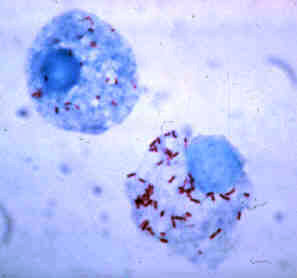
Rickettsia
BacteriaWikipedia
18
MENTIONS
9
EPISODES
8
PODCASTS
Search complete. 18 mentions across 9 episodes found for "Rickettsia".
Oct 1, 2026

Stephen BarkerGUEST
It doesn't seem to be nearly as bad.
Stephen BarkerGUEST
It's called Rickettsia australis, Australian tick fever.
Stephen BarkerGUEST
Rickettsia australis.
Stephen BarkerGUEST
And it was discovered during Second World War, actually up on the Atherton Tablelands, where there were tens of thousands of American and Australian troops all getting ready to go to New Guinea.
Stephen BarkerGUEST
And they kept getting sick.
Stephen BarkerGUEST
And the medical doctor up there in the army, he saw so many patients, he was able to figure out, okay, these guys have got Rickettsia, a fever.
Stephen BarkerGUEST
And so people get that.
Stephen BarkerGUEST
It's not nearly as bad as the fever,

Richard HorowitzGUEST
Um, but there's ways of like kind of limiting it down.
Richard HorowitzGUEST
Like you can still use local labs for Lyme testing, for Babesia, Bartonella, Ehrlichia, Anaplasma, Rickettsia, all these other tick-borne infections.
Richard HorowitzGUEST
But unfortunately, they're not always gonna be positive through the local lab.
Richard HorowitzGUEST
So I give people the, the options like consider Igenex, consider T Lab, where you can get DNA testing or RNA testing if the local labs are just not figuring out.

MarilynGUEST
isn't anything I've ever had before, but it came up, so I read it.
Penny KellyHOST
I had, for just a moment, a touch of Rickettsia.
MarilynGUEST
Yes, and Q-Fever talks about Rickettsia.
Penny KellyHOST
Oh, does
MarilynGUEST
it? Oh, it does, yes, because I was looking at this, because I'm reading it, like Q-Fever, what is this? And then I'm reading it, and Rickettsia is in there.
MarilynGUEST
So it's another one of my million tick bites over my life.
Penny KellyHOST
Oh, okay.

Joseph BurrascanoGUEST
So antibiotic for Lyme is not gonna touch this, so that's another issue.
Joseph BurrascanoGUEST
Then you have Anaplasma, Ehrlichia, and the different Rickettsias.
Joseph BurrascanoGUEST
These actually are the most commonly found organisms when someone surveys property for ticks.
Joseph BurrascanoGUEST
They say, "Well, what's in our tick?" More ticks contain these organisms than even Lyme or Babesia, and I think they're being overlooked clinically.
Joseph BurrascanoGUEST
Researchers, including Willy Burgdorf himself, have found even parasites, nematodes, in the ticks, and the question is, are they transmitted, and if so, what do they do to people? So we're talking here about a mixed infection.
Joseph BurrascanoGUEST
And so when someone says, "Oh, I got Lyme disease.
Joseph BurrascanoGUEST
I took some penicillin and I should be fine," well, probably it'll help the Lyme to some degree, but it will do absolutely nothing for Babesia or any of the Rickettsias.
Joseph BurrascanoGUEST
And now another thing we see is Bartonella.

Tony ChenHOST
Today, we're going to continue looking at the potential impacts of El Nino on the aquaculture industry, and specifically, we're going to look at the potential impact it may have on the industry in Chile and its potential to influence additional SRS outbreaks across the country's farming region.
Tony ChenHOST
SRS or Salmon Rickettsial Septicemia is a unique challenge that the industry faces in Chile, and one that isn't dealt with in the same way in many other salmon farming regions around the world.
Tony ChenHOST
So today, we'll look into a few different aspects as we evaluate the challenge heading into the coming months.
Tony ChenHOST
We'll look directly at the disease itself by analyzing its history around the world, what makes it a particularly challenging bacterium to combat, the risk factors associated with the cases of the disease, and lastly, how this particular El Nino may impact the severity of the outcomes in the upcoming Chilean summer.
Tony ChenHOST
I think you're really going to learn something new today, so let's dive in.
Tony ChenHOST
To start, let's talk about the history and challenge of the disease.
Tony ChenHOST
Salmon Rickettsial Septicemia, also known as Prickely Rickettsiosis, affects Atlantic salmon, coho salmon, and rainbow trout.
Tony ChenHOST
It was first discovered in the late '80s during a mortality outbreak in coho salmon within Chile, where approximately one point five million fish died, leading to an economic impact of roughly ten million USD.

David JerniganGUEST
You know, that's just amazing.
David JerniganGUEST
All the Bartonella's that you can name are represented in the Lyme relapsing fever All the Rickettsias, even the Swiss agent, which is a Rickettsia helvetica, is targeted now.
David JerniganGUEST
We were able to finally get that specimen.
David JerniganGUEST
Because remember, you have to have the original specimen in order to start the phage induction process.

Chris MotleyHOST
And when you have resilience, you can handle a lot of stress.
Chris MotleyHOST
Now, when the brain is under stress, let's say from high amounts of Lyme disease, infections that have made its way past the blood brain barrier could be Borrelia, Bartonella, Babesia, Ehrlichia, Rickettsia.
Chris MotleyHOST
When they make it past the blood brain barrier and they get into the tissues, it causes high inflammation.
Chris MotleyHOST
High inflammation means these little molecules called cytokines, a cytokine storm.
Chris MotleyHOST
And they really dive into and go deep into different strands, the different types of bacteria, the different types of co-infections.
Chris MotleyHOST
Because they don't just test for those four to five strands.
Chris MotleyHOST
They look for Bartonella, Borrelia, Babesia, Ehrlichia, Rickettsia, all the strands and all the forms.
Chris MotleyHOST
Remember that.
Hannah GreenGUEST
It was a classic one.
Hannah GreenGUEST
So it's Rickettsia, Bartonella, Babesia.
Hannah GreenGUEST
How do you say it? The one with the Ehrlichia?
RichHOST
Ehrlichia?

Fran StorchHOST
They can carry Mycoplasma.
Fran StorchHOST
They can carry Rickettsia, Rocky Mountain spotted fever.
Fran StorchHOST
They can carry tick-borne relapsing fever, depending on the species.
Fran StorchHOST
They can make you have alpha-gal.