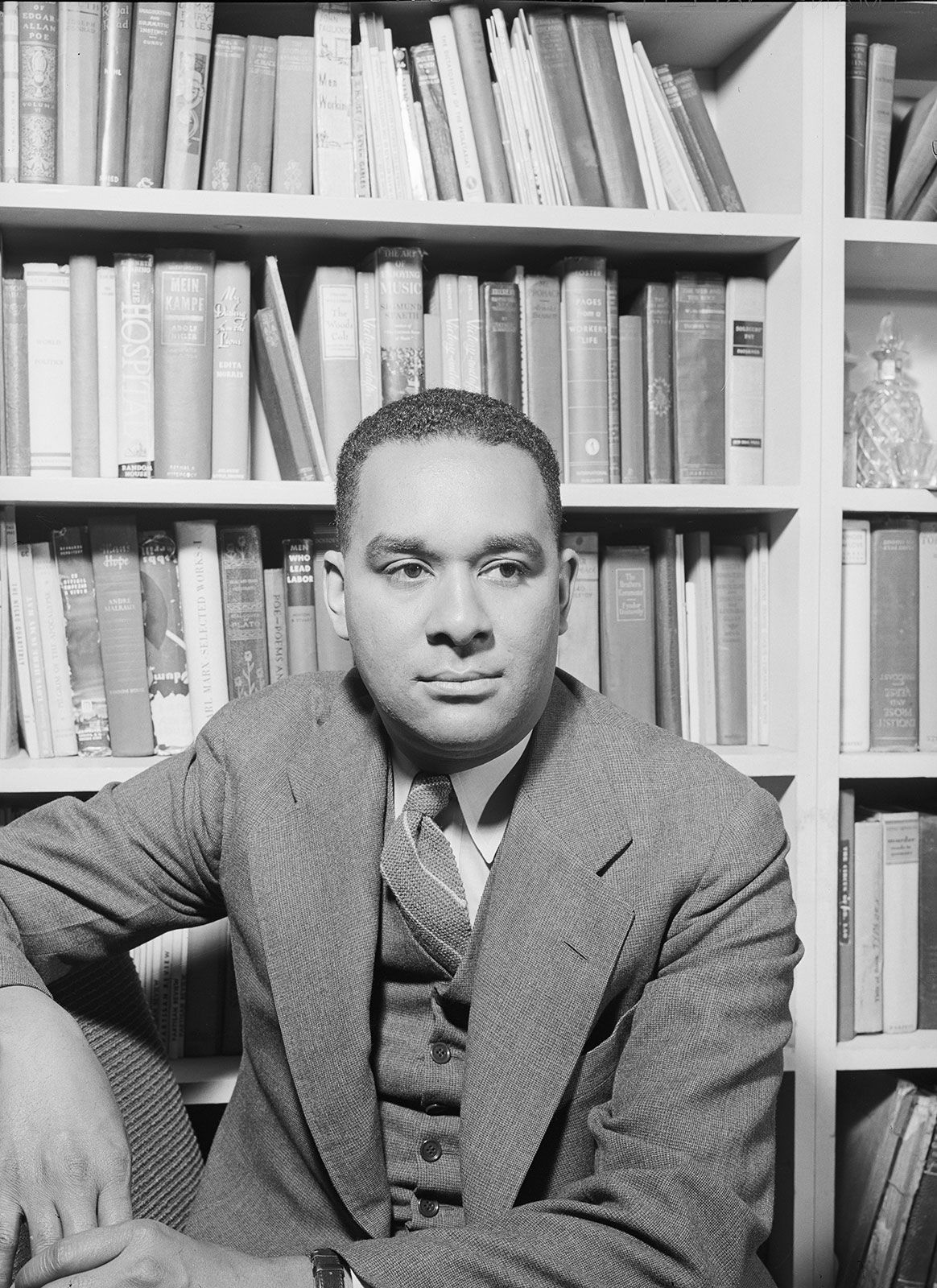
Richard Wright
American author of novelsWikipedia
51
MENTIONS
33
EPISODES
30
PODCASTS
Search complete. 51 mentions across 33 episodes found for "Richard Wright".
Sep 17, 2026

Naomi FryHOST
Yeah.
Vinson CunninghamHOST
The other, I mean, another text that I re- I mean, a little bit before high school, but it's definitely, like, a high school level text was, um, Richard Wright's Black Boy, and I remember [laughs] being on the way to school and the older kids being like, "Wait till you get to the page where he, like, does this," or, "You know, he's talking about bigs in there," you know?
Alexandra SchwartzHOST
Mm-hmm.
Alexandra SchwartzHOST
Totally.

Delia FalconerHOST
very grateful for that.
Delia FalconerHOST
So in your introduction, you offer an absolutely fantastic quote from Hazel Rowley, referring to her work on the African-American writer Richard Wright.
Delia FalconerHOST
And Hazel Rowley said that she wanted to write about outsiders with courage, people who, and this is a quote from her, generate steam, which is such a brilliant term.
Delia FalconerHOST
We're going to see as we speak that mosquito generates plenty of steam, but...
27 MINS LATER
Delia FalconerHOST
yeah.
Delia FalconerHOST
So you said to me as we were preparing for this conversation that you felt in a way that Mosquito had sort of taught you to be a better historian in the process of writing this book.
Delia FalconerHOST
What was the hardest thing about writing it and what did you learn about yourself as a writer and historian in the process?
Naomi Parry DuncanGUEST
Sorry, that's quite a...

Jason MilesHOST
Those are exceptions to the rule.
Jason MilesHOST
The rule is that these people born into poverty have a pathology." You know who well said that? Richard Wright.
Jason MilesHOST
That's basically what Native Son is about.
Jason MilesHOST
These people born into immense poverty for generations will produce A pathological spawn that you can do nothing with.

Darrell HughsonHOST
I don't love Native Son.
Darrell HughsonHOST
Native Son by Richard Wright.
Elia AgudoHOST
Honestly, I got a B for Richard Wright, but that's not really for this episode.
Darrell HughsonHOST
So true, Bestie.
Darrell HughsonHOST
Yeah.

Jane BaldwinGUEST
So the first one, obviously we've talked at length about, The House of Mirth by Edith Wharton.
Jane BaldwinGUEST
Then My Ántonia by Willa Cather, Native Son by Richard Wright, East of Eden by John Steinbeck, Fahrenheit 451 by Ray Bradbury, Song of Solomon by Toni Morrison, The House on Mango Street by Sandra Cisneros, The Joy Luck Club by Amy Tan, The Poisonwood Bible by Barbara Kingsolver, and Braiding Sweetgrass by Robin Wall Kimmerer, which that last one is not exactly a classic, but [laughs] it's one that I've been meaning to read for a while, and also I thought it was important to include an indigenous work in my personal curriculum about American literature, so.
Anne BogelHOST
It doesn't seem too soon to call that a hugely influential American book.
Jane BaldwinGUEST
Yeah, I would agree with that-

Patrick DubuqueHOST
Also reading the most, um, excruciating book.
Patrick DubuqueHOST
Uh, I'm reading Native Son by Richard Wright.
Patrick DubuqueHOST
Uh, and, uh, it is, it's a good book.
Patrick DubuqueHOST
Boy, it's...

LernerHOST
Reading Richard Wright's Native Son is, well, it's honestly like being strapped into the passenger seat of a slow motion car crash.
speaker_1UNKNOWN
Oh, absolutely.
speaker_1UNKNOWN
A totally unavoidable

JessHOST
But there's some other ones in there that I might just end up doing just to do the rest of the other ones, like the other, um, like the back list one.
JessHOST
I did, I did, um, Uncle Tom's Children with Richard Wright.
Shelbey MonaeHOST
Right.
JessHOST
And that was act- actually, that's a great book, just so you know.
JessHOST
And it's another whole kerfuffle of things from there, 'cause it's a whole other stuff that happens after that.
JessHOST
You think that's the end of it? No, there's more.
JessHOST
And it's just aft- one thing after another, and I think what we concluded overall, because Richard Wright is, he's a very, um, radical writer, so a lot of what he's saying in his text is very enraged, furious, and at- attacking the society, obviously the racism at that time.
Shelbey MonaeHOST
Right.

speaker_3NARRATOR
Morton and six others were banished in 1630 as an immoral influence.
speaker_3NARRATOR
Sir Christopher Gardner, Philip Ratcliffe, Richard Wright, the Walfords, and Henry Lynn were all forced to leave in 1630 and 1631 as unmeet to inhabit here.
speaker_3NARRATOR
Roger Williams, the tolerationist and upholder of soul liberty, who complained of the magistrates for oppression and of the elders for injustice and who opposed the close union of church and state, was compelled to leave during the winter of 1635 and 1636.
speaker_3NARRATOR
But the great expulsion came in 1637 when an epidemic of heresy struck the colony.

Chuck KlostermanGUEST
Like there was...
Chuck KlostermanGUEST
Oh, when I was in eighth grade, you know, I read Black Boy by Richard Wright.
Chuck KlostermanGUEST
And it's a weird thing for me to be reading, but I was like, "I love this.
Chuck KlostermanGUEST
This is an amazing thing to me." And then I got into like Dave Barry in high school, and then I got into Douglas Coupland at college, and then I really got into, uh, like, um, old-
23 more episodes mention Richard Wright.
Create an account to see the whole feed, search across every transcript, and follow the entities you care about.