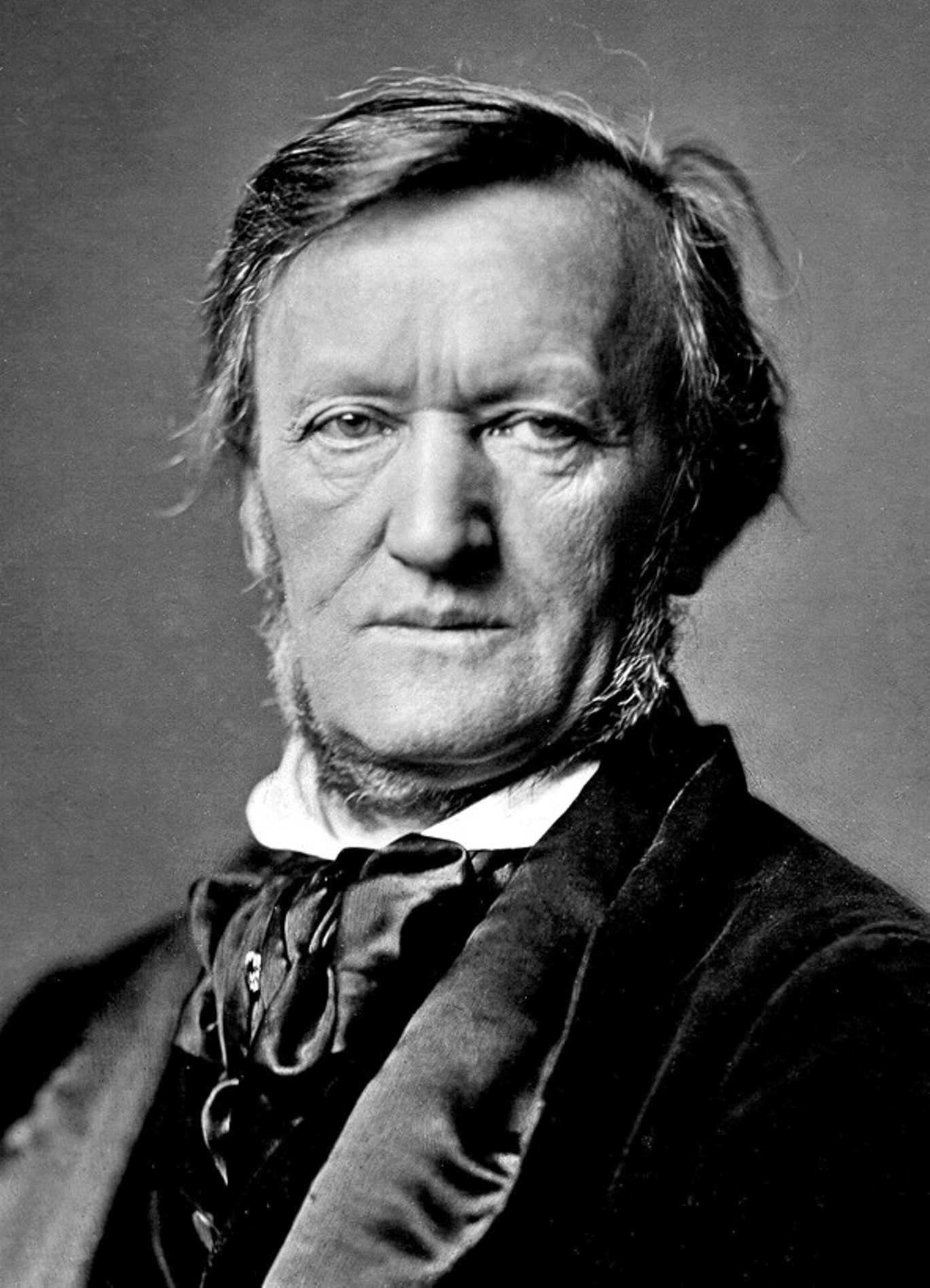
Richard Wagner
Composer and theatre directorWikipedia
395
MENTIONS
108
EPISODES
88
PODCASTS
Search complete. 395 mentions across 108 episodes found for "Richard Wagner".
Oct 28, 2026

Ben LukeHOST
And you've used them really productively, like in Zugzwang.
Ben LukeHOST
Obviously, there's a very direct reference to music in there because you're using Wagner's Tannhäuser and then allying it to the most ordinary sounds in everyday life.
Ben LukeHOST
Again, talking about everyday life, this idea, you know, you're using office sounds.
Ben LukeHOST
But curiously, is it right that you had to sort of tune the office sounds to kind of fit with the Wagner opera sound?
Sung TieuGUEST
Yeah, we had to tune a lot.
Sung TieuGUEST
We had to electronically manipulate a lot of those sounds to make them work with Wagner's overture to Tannhäuser.
Sung TieuGUEST
But that was a lot of fun.
Sung TieuGUEST
It was sort of like a joke on Wagner in many ways.

speaker_0ADVERTISER
See your Rocky Mountain Chevy dealers.
speaker_1NARRATOR
FORWARD the writer of a thumbnail biography of richard strauss finds himself confronted with a troublesome assignment strauss lived well beyond the scriptural age allotted the average man he would have been eighty-six had he reached his next birthday there was nothing romantic or sensational about his passing for he died of a complication of the illnesses of old age there was not much truly spectacular about the course of his life which was most happily free from the material troubles which bedevilled the existence of so many great masters and he was not called upon to starve or to struggle to achieve the material rewards of his gifts he had not to pass through the conflicts which embittered the lives of wagner or berlioz and he was never compelled to suffer like mozart or schubert there is no record of his ever humiliating himself or performing degrading chores for publishers in return for a wretched pittance he had wealth enough without compromising his art to keep the pot boiling and for this one can only feel devoutly thankful what if he was taxed with sensationalism how many of the masters of music has not had at one time or another to endure this reproach if salome and elektra ein heldenleben and till eulenspiegel were in their day scandalously sensational did not the whirligig of time reveal them as incontestable products of genius irrespective of inequalities and flaws however richard strauss compares in the last analysis with this or that master he contributed to the language of music idioms procedures and technical accomplishments typical of the confused years and conflicting ideals out of which they were born his works are most decidedly of an age whether or not they are for all time in a way he was almost as fortunate as mendelssohn need any one begrudge him this The late spring of 1864 brought two events which, though seemingly unrelated, actually had a kind of mystic kinship and were to stir the surfaces of music.
speaker_1NARRATOR
Early in May of that year, Richard Wagner was summoned to Munich to become the friend and protégé of the young Bavarian sovereign, Ludwig II, whose real mission on earth was to save the composer for the world.
speaker_1NARRATOR
hardly more than a month later there was born in the same city a boy likewise named ricard who was destined in the fulness of time to become in a sense an heir and continuator of the old master though by no means a vain copy of his artistic and spiritual lineaments and long before the span of his days reached its end he had taken an undisputed place in history as a seminal force in music for all the disagreements and conflicts his art was to engender through a large part of his more than fourscore years richard strauss first saw the light on june eleventh eighteen sixty four in a house on the altheimer eck munich at the centre of the town and a stone's throw from the twin steeples of the frauenkirche the edifice in which the future composer of salome electra and der rosenkavalier was born forms part of a complex of buildings in which a number of larger and smaller beer halls and restaurants separated by cobbled courtyards housed the brewery of georg schorr senior whose son georg schorr junior enlarged the establishment Furthermore, he improved the quality of its products till Shorebrow beer became, it seemed to many, including the writer of these pages, the most incomparable refreshment this side of heaven, despite the close proximity of the Hofbräuhaus, the Löwenbräu, the Augustinerbräu, and the unnumbered other Munich breweries and affiliated Bierstuben.
speaker_1NARRATOR
at this point the writer ought logically to confess that he bases his present recollections on what he remembers from his wanderings in the bavarian capital prior to the second world war since which time changes without number may well have changed the picture but one thing is reasonably certain if the old house at alzheimer eck number two still stands it continues to have affixed to its wall the decorative inscription on eleventh june eighteen sixty four were here richard strauss geboren on june eleventh eighteen sixty four richard strauss was born here the shores apart from being excellent brewers were excellent musicians one of the four daughters josephine later ricard's mother a fairly accomplished pianist taught her son piano in his fifth year A noted harpist, Auguste Trombeau, continued the lessons, and by the time the boy was seven he was administered violin instruction.
51 MINS LATER
speaker_1NARRATOR
Nevertheless, Wilhelm II remarked to Hülsen, I am sorry that Strauss composed this Salome.
speaker_1NARRATOR
I like him, but he is going to do himself terrible harm with it.
speaker_1NARRATOR
at the dress rehearsal the famous high b flat of the double basses so filled count seebeck with the fear of an outbreak of hilarity that he prevailed upon the player of the english horn to mitigate the effect somewhat by means of a sustained b flat on that instrument strauss's own father hearing his son play a portion of the opera on the piano exclaimed a short time before his death my god this nervous music it is as if beetles were crawling about in one's clothing and Cosima Wagner declared after listening to the closing scene, This is madness! The clergy, too, was up in arms, and the first performance at the Vienna State Opera in October 1918 took place only after an agitated exchange of letters with Archbishop Piffel.

Jeffrey Alan StumpfNARRATOR
Life, like a dome of many-colored glass, stains the white radiance of eternity until death tramples it to fragments.
Jeffrey Alan StumpfNARRATOR
What an unspeakable gain, says Richard Wagner.
Jeffrey Alan StumpfNARRATOR
We should bring to those who are terrified by the threats of the church and, on the other hand, to those who are reduced to despair by our physicists.
Jeffrey Alan StumpfNARRATOR
If we could quicken the noble edifice of love, faith, and hope with a clear consciousness of the ideality of the world, conditioned by the laws of space and time, which form the sole basis of our perceptive capacity, in that case all anxious inquiries as to a where and when of the other world would be understood to be only answerable by a blissful smile.

Dan JonesGUEST
So you could be a sort of Ludwig II of Bavaria, the king of Bavaria in the 19th century, who built Neuschwanstein, not a castle that had any real military purpose.
Dan JonesGUEST
Ludwig II built Neuschwanstein purely for his love of the composer Richard Wagner and Wagner's vision of an Arthurian past.
Dan JonesGUEST
And Neuschwanstein is a sort of As the name suggests, the new Swanstone is a tribute to Lohengrin, the Wagner opera about the Swan Knight.
Dan JonesGUEST
So that's on the peak of a very, very high point in Bavaria.

speaker_1UNKNOWN
¶¶
Denise Finnegan-HillHOST
Before Richard Wagner's leitmotifs, there was Carl Maria von Weber, experimenting with recurring musical motives related to things and ideas in his opera Der Freischütz.
Denise Finnegan-HillHOST
Although rarely performed today, it remains a historical masterpiece of a work.
Denise Finnegan-HillHOST
We'll hear the overture to Der Freischütz and many more works this hour on Anytime Classical.
15 MINS LATER
Steve SealeSOUNDBITE_SPEAKER
When you make a contribution today, you're helping to power great music for yourself and others to enjoy.
Steve SealeSOUNDBITE_SPEAKER
Here's how, and thanks.
Denise Finnegan-HillHOST
Next, some music of Karl Maria von Weber, an early Romantic German composer, who began experimenting with recurring musical motives related to things and ideas in his opera Der Freischütz, well before Wagner established the leitmotif as we know it.
Denise Finnegan-HillHOST
This is the Overture to Der Freischütz, performed by Staatskapelle Dresden under the direction of Gustav Kuhn.

Andrew LeachGUEST
And one of those is the Sorcerer's Apprentice, Paul Dukas, which is featured in Fantasia, which revived Mickey Mouse's career after Pluto and Goofy and Donald Duck came on board and made him a little bit uncool.
Andrew LeachGUEST
Another one is the Ride of the Valkyries, Wagner's Ride of the Valkyries, which was featured in Apocalypse Now.
Andrew LeachGUEST
Such a great scene.
Andrew LeachGUEST
Blaring out of the helicopters

Dan JonesGUEST
If we go back to medieval literature, Sir Gawain and the Green Knight, any of the Arthurian stories, the castle was a heavily symbolic presence in those stories as well.
Dan JonesGUEST
If you look back in the 19th century, you have Richard Wagner, turning Arthurian myth as recounted by von Eschenbach into some of his great operas, Parzival, Lohengrin.
Dan JonesGUEST
He's sponsored by Ludwig II, King of Bavaria, who falls so deeply in love with Wagner and his vision of the Arthurian Middle Ages, the Gothic, the Romantic, that he builds Neuschwanstein, one of the iconic castles in the world on top of this Bavarian mountain top in tribute to Wagner and his Arthurian operas.
Dan JonesGUEST
Now, Neuschwanstein looks like a castle.

speaker_0HOST
This is called Parsifal for the Course.
speaker_0HOST
Back to the Royal Opera House for a mammoth undertaking, a Wagner opera.
speaker_0HOST
Completing the sort of research that compels writers of historical fiction to go on fact-finding missions to ancient Italian and Greek ruins, rather than looking up stuff in Wikipedia as everyone else does, I knew that the Royal Opera House would provide a booster cushion should I need one.
speaker_0HOST
The seat I chose was the second cheapest, below that price point you don't even get one, and was described as a bench seat, so I thought I'd ask the old boy at the cloakroom if he recommended a cushion.
speaker_0HOST
He looked at me with the tired eyes of someone who has presumably sat through this sort of stuff before and said, it's Wagner, whatever you do is hard on the rear.
speaker_0HOST
His advice was to borrow one from behind the place that sells ice creams, and if they tell you you're too young, set for your elderly mother.
speaker_0HOST
krishan inquired i decided i needed to have something to eat i had already seen and rejected the main restaurant for two reasons i couldn't understand the menu and the price of the starters was just above the price i would normally pay for a main course therefore i made my way trepidatiously to the level five bar from where i had bought my wine on thursday here i saw an exotic display of artisan filled rolls that looked as if they belonged in a sunday newspaper glossy supplement once again i struggled with the language barrier but fortunately the barman knew what i meant when i asked for one of those posh ham roll things I think in terms of description, this is up there with un loiseau de la mer, which was how I described a seagull to a French shopkeeper.
speaker_0HOST
I'm not sure.
speaker_9UNKNOWN
Thank you.
Denise Finnegan-HillHOST
Richard Wagner has no shortage of famous works to his name, although arguably the most famous is The Ride of the Valkyries from Die Valkyrie, the second work in his four-music drama cycle Der Ring der Nibelungen.
Denise Finnegan-HillHOST
Although Wagner at first resisted ongoing requests to create a separate concert version of the piece, it has been a popular concert piece since he caved and conducted the first non-operatic performance of the work in 1877.
Denise Finnegan-HillHOST
Since then, filmmakers, in appreciation of the melodramatic nature of the work, have used it in no less than 25 different films.
Denise Finnegan-HillHOST
You're listening to Anytime Classical.
38 MINS LATER
Denise Finnegan-HillHOST
I'm your host, Denise Finnegan-Hill, and you're listening to Anytime Classical.
Denise Finnegan-HillHOST
Even if you're new to classical music, you've most likely heard this next piece.
Denise Finnegan-HillHOST
This is Ride of the Valkyries by Richard Wagner.

speaker_7VOICE_ACTOR
Who was this Stuart Houston Chamberlain? An
Basil RathboneVOICE_ACTOR
Englishman who married one of Richard Wagner's daughters and became a German citizen.
Basil RathboneVOICE_ACTOR
And an arch enemy of England.
speaker_7VOICE_ACTOR
I'll try to dissuade Maitland.
98 more episodes mention Richard Wagner.
Create an account to see the whole feed, search across every transcript, and follow the entities you care about.