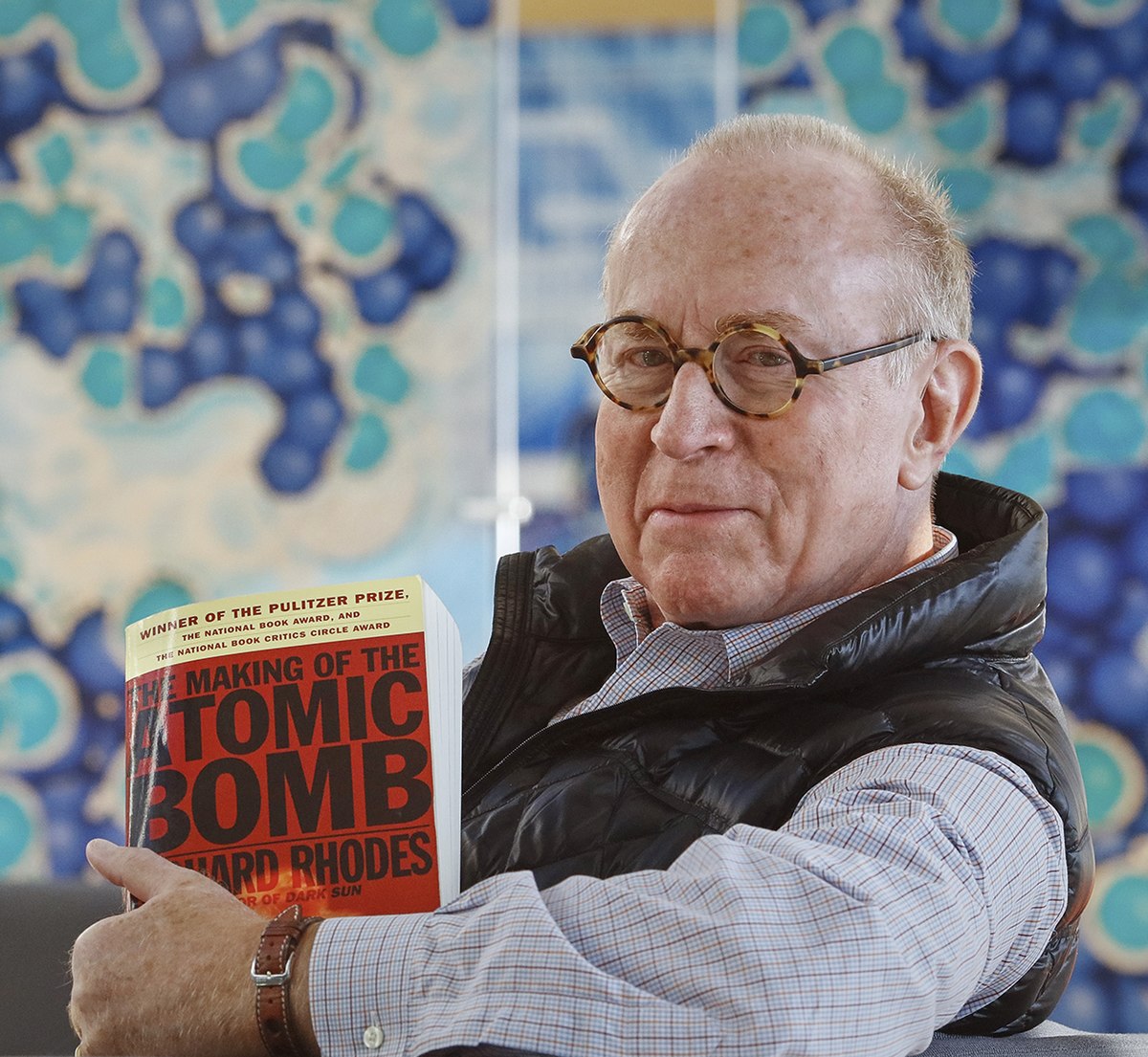
Richard Rhodes
American historian and journalistWikipedia
11
MENTIONS
9
EPISODES
9
PODCASTS
Search complete. 11 mentions across 9 episodes found for "Richard Rhodes".
Nov 19, 2026

Brian McCulloughHOST
Some employees describe the IPO with a shrug, liking it to just another funding round.
Brian McCulloughHOST
This is a peculiar attitude for a where the common books on display include Richard Rhodes' The Making of the Atomic Bomb and paperback printouts of company writings such as Mr. Amodai's Machines of Loving Grace and the in-house philosopher Amanda Askell's Claude's Constitution.
Brian McCulloughHOST
No one is compelled to work the grueling 996 hours, 9 a.m. to 9 p.m., six days a week, that have become common in the tech industry, but a good number of ants do so anyway out of their own feverish devotion.
Brian McCulloughHOST
Many cram themselves into modest group apartments, host house parties, wear few, if any, drink, and blank when I ask how they spend their lavish salaries, even with my prompts.

Kevin RooseGUEST
He used to give away something called the Szilard Award at OpenAI to sort of researchers who made safety-minded sacrifices.
Kevin RooseGUEST
For years at Anthropic, if you got a job there, they would hand you a copy of The Making of the Atomic Bomb, the Richard Rhodes book about the Manhattan Project, in which Leo Szilard is the central hero.
Kevin RooseGUEST
So it's not subtle.
Kevin RooseGUEST
And he believes that this is the reason to race, even though it could be quite dangerous, is because it will definitely happen somewhere.

Kent AndersonHOST
to Nolan's Oppenheimer.
Kent AndersonHOST
And I was in Japan in Osaka when I picked up a copy of Richard's Richard Rhodes, the making of the atomic bomb and read it from front to back in Osaka while going around to places in Japan and being, you know, interacting with Japanese people and having Japanese friends and, you know, all this stuff.
Kent AndersonHOST
And that book hit me like, you know, uh, hit me hard at the time because it's such a beautiful culture and the people are wonderful.
Kent AndersonHOST
And Richard Rhodes did such a good job of portraying the horrors of the bombing of Hiroshima and Nagasaki.
Kent AndersonHOST
And this book goes into, or this movie goes into those things and there's survivor guilt, It really embraces Godzilla as a metaphor of atomic weapons.
Kent AndersonHOST
And then it's just...

Kai BirdGUEST
Of
Neil deGrasse TysonHOST
course, there's already a book with that title, The Making of the Atomic Bomb by Richard Rhodes.
Neil deGrasse TysonHOST
By
Kai BirdGUEST
Richard Rhodes, right.
Kai BirdGUEST
Also a
Neil deGrasse TysonHOST
Porter Prize winning book, by the

Kevin RooseGUEST
So the people making AI are students of the Manhattan Project.
Kevin RooseGUEST
In fact, for years, new hires at Anthropic would be given a copy of this book about the Manhattan Project, The Making of the Atomic Bomb by Richard Rhodes, which was Dario Amadei, the CEO of Anthropic's favorite book.
Kevin RooseGUEST
And he had explicitly sort of patterned his career after that, not of Oppenheimer, who is generally the sort of famous scientist that they make movies about, but of this other Manhattan Project scientist, Leo Szilard.
Kevin RooseGUEST
And Leo Szilard came up with the nuclear chain reaction, the sort of technology that made the atomic bomb possible.

Kevin RooseGUEST
I read a lot of science fiction.
Kevin RooseGUEST
I read The Making of the Atomic Bomb was a book that was weirdly central in the AI race because it's this incredible Pulitzer-winning history by Richard Rhodes of the Manhattan Project.
Kevin RooseGUEST
And again, Dario read this book as a young man, and it really shaped him.
Kevin RooseGUEST
He really identified with this character, Leo Szilard, who was a Hungarian-American scientist, physicist, who basically discovers the nuclear chain reaction, fights to keep it secret, and then when it gets out to the Nazis, he joins the Manhattan Project and tries to build the bomb before the Nazis do.

Kevin RooseGUEST
And I think many people would say this was correct in hindsight, was that if America built the nuclear bomb before the Nazis did, they stood a better chance of having democracy prevail and the West prevail and us not all living under Nazi rule.
Kevin RooseGUEST
And... that is the logic that is the explicit logic that leads these companies to race toward agi even though they know it could be destructive you know for years like if you got a job at anthropic they would hand you with your onboarding packet a copy of the making of the atomic bomb the richard rhodes history of the manhattan project because they saw their work in explicitly parallel terms we are racing toward a thing that we know could blow up the world because if we don't do it It's not a secret.
Kevin RooseGUEST
The recipe's out there, and the bad guys will get there first.
Megan McArdleHOST
So you suggested that there's a little element of self-justification here, right? Yes, we have to stop it, but also this is so cool.

JamesHOST
Because I just finished this really cool book.
JamesHOST
It was called The Making of the Atomic Bomb by Richard Rhodes.
JamesHOST
And I think there's a lot of lessons that we can pull from it that are applicable as real estate investors.
JamesHOST
Today on the furlough capital real estate podcast, where we dive into the intricacies of passive real estate investing.

Kevin RooseGUEST
And it helps to know maybe one piece of useful information here is that all these people are students of history.
Kevin RooseGUEST
Dario Amadei in particular is obsessed with this book, The Making of the Atomic Bomb, which is a Pulitzer-winning history of the Manhattan Project written by Richard Rhodes.
Kevin RooseGUEST
And the hero of that book and Dario's scientific hero is not Oppenheimer.
Kevin RooseGUEST
It's this guy, Leo Szilard.