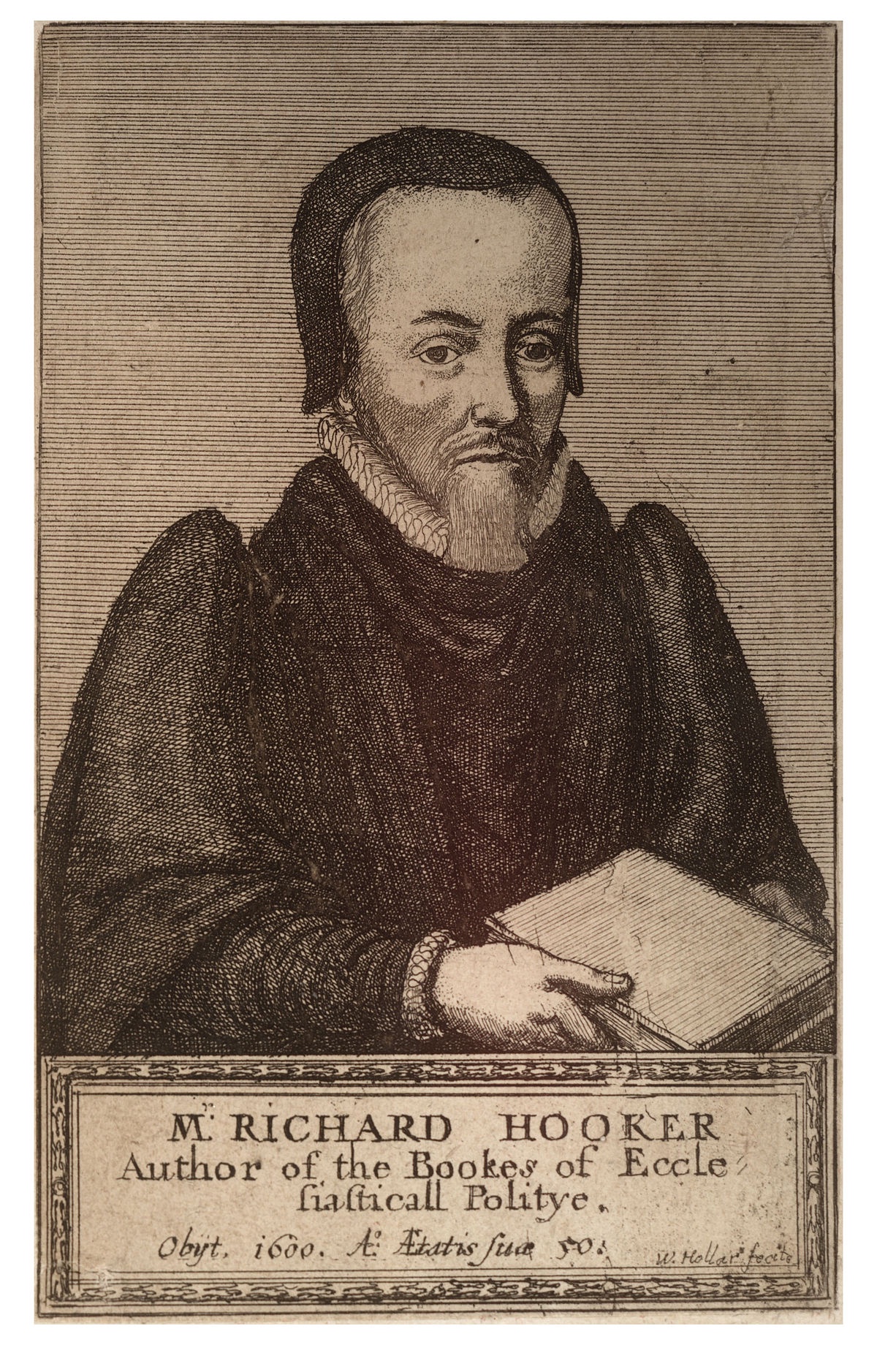
Richard Hooker
English priestWikipedia
72
MENTIONS
22
EPISODES
18
PODCASTS
Search complete. 72 mentions across 22 episodes found for "Richard Hooker".
Nov 25, 2026

Ricky McCarlHOST
And so we've gotten rid of all of the errors of the Roman church.
Ricky McCarlHOST
and so that's what defines a reformed catholic now perkins isn't the only one who uses this term the other person who uses this term is richard hooker who is really kind of our systematic theologian richard hooker wrote the book laws of ecclesiastical polity and what the laws of ecclesiastical polity do is they make an argument for the church of england against both the puritans on one side and the Papists on the other.
Ricky McCarlHOST
And so what he's saying is, we are a Catholic Church, we have apostolic succession, we have bishops and historic succession with the apostles, we have the Eucharist, we have baptism, we have the faith articulated in the ecumenical creeds, we believe both the New Testament and the Old Testament, we are Catholic, but we're Reformed Catholic because we're getting rid of all the corruption.
TrevorHOST
You ever heard that song, Stuck in the Middle with You?
TrevorHOST
Fools on the left of me, jokers on the right.
Ricky McCarlHOST
Stuck in the middle with you, yeah.
TrevorHOST
That's Richard Hooker.
Ricky McCarlHOST
That's Richard Hooker.

Kevin Francis DonlanHOST
And so It echoes a classical ideal of the golden mean.
Kevin Francis DonlanHOST
And it was Richard Hooker who adapted that self-description of the golden mean as a concept for self-understanding of the English church after the separation from Rome.
Kevin Francis DonlanHOST
And, of course, Hooker was its greatest intellectual architect.
Kevin Francis DonlanHOST
He was a priest.
Kevin Francis DonlanHOST
He was a scholar who served as master of the temple in London in the 16th century.
Kevin Francis DonlanHOST
And he wrote, of course, as many of us know, the laws of ecclesiastical polity, which began to articulate this architecture via media.
Kevin Francis DonlanHOST
Now, many people... articulates that they know Hooker and they articulate that Hooker's via media was the middle way between two warring sides.
Kevin Francis DonlanHOST
Hooker's via media was not a middle position between liberals and conservatives, for example.

Robert BarronGUEST
I think I mentioned this name in the talk.
Robert BarronGUEST
An interesting figure to me is Richard Hooker.
Robert BarronGUEST
He's always called the judicious Hooker by the Anglicans.
Robert BarronGUEST
He was an Anglican divine, late 16th century, early figure, like Elizabethan figure.
Robert BarronGUEST
Jefferson, Madison, Hamilton, Adams, all those people would have read him for sure.
Robert BarronGUEST
Now, I'm going to argue they might have read Robert Bellarmine too, but that's another story.
Robert BarronGUEST
But they certainly read Richard Hooker.
Robert BarronGUEST
And that would have grounded them in this much earlier medieval tradition of – virtue, ordered liberty, happiness is the goal of the moral life, all of that they would have gotten from him.

Austin SuggsHOST
And this affinity for Platonism itself can be seen as another product of his Anglicanism.
Austin SuggsHOST
not only because Richard Hooker was more of a Platonist than other Protestant reformers, but also because Lewis was familiar with the great tradition of the Anglican Cambridge Platonists who helped revive Platonism in the 17th century.
Austin SuggsHOST
There have been some fascinating papers written on the topic of Lewis and Platonism, but I shouldn't get too in the weeds here.
Austin SuggsHOST
I'm in danger of digressing to the point of no return.

SeanHOST
Nevertheless, the material cause of that judgment, namely that judgment or that thing that caused the judgment as it actually exists in the subject, is holiness in the same way that the material cause of a mother's love, as it actually existed in the subject of the mother, is her yielding the child.
SeanHOST
And it is for this reason that Richard Hooker famously points out that Anglicans don't actually reject the idea that almsgiving and these sorts of things atone for sins.
SeanHOST
But we would say they atone in a secondary sense, only insofar as they are acts of faith, not in themselves.
SeanHOST
They have no satisfactory value in themselves, and they only satisfy only insofar as they are acts of faith through which we're united to God.
21 MINS LATER
SeanHOST
So again, Romans 4 speaks of the formal cause of justification on the part of the judge.
SeanHOST
Whereas James 2 speaks of the material cause of justification on the part of the subject.
SeanHOST
And in this sense, we go back to Richard Hooker, speaking of how at the bar of God's judgment, faith alone justifies you.
SeanHOST
But that faith that justifies you justifies you also in all of its operations and acts, which means works like almsgiving, like clothing, like the poor, things like this, justify you as acts of faith.

Rochelle PortoHOST
They're in a state of perfect freedom and equality, and that each are obligated to mutual love for one another.
Rochelle PortoHOST
And Locke invokes the words of a, English theologian, again, pre-1700s, Sir Richard Hooker, who claims that people are obligated to justice and charity.
Rochelle PortoHOST
So right off the top, he's hitting heavy, right, with civil, but then he leads right into the laws of nature and nature's God.
Rochelle PortoHOST
So he says when the political bands...

Niv LoboHOST
Spiritual means most real.
Niv LoboHOST
That's why one great theologian of the past, Richard Hooker, said this, the real presence of Christ's most blessed body and blood is not therefore to be sought for in the sacrament,
speaker_0UNKNOWN
but in the worthy receiver of the sacrament.
Niv LoboHOST
Jesus is really present as we share the Lord's Supper in our hearts

JoshuaHOST
Maybe kind of important, maybe not.
JoshuaHOST
Does his name Richard Hooker? If he's on the calendar, he's probably
Darrell FitzwaterHOST
important.
JoshuaHOST
Does the name Richard Hooker ring a bell?
Darrell FitzwaterHOST
Yeah, phenomenal Anglican theologian.
Darrell FitzwaterHOST
One of our early divines in the, I'd say the mid, early to mid portion of the Reformation.
Darrell FitzwaterHOST
The Reformation in England, remember, went from the 1530s until 1662, thereabouts.
Darrell FitzwaterHOST
So a long reformation with lots of lengthy periods of stability within it so that we could talk about the Elizabethan settlement, we could talk about the Caroline divines, et cetera.

speaker_1NARRATOR
centuries before stubborn facts are reducible by reason, and meanwhile the pendulum swings slowly and heavily to the extreme of the historical method.
speaker_1NARRATOR
Forty-three years after the Italian divines had written this memorial, Richard Hooker, in his famous Laws of Ecclesiastical Polity, makes exactly the same complaint of his Puritan adversaries.
speaker_1NARRATOR
Hooker's balanced thought, from which the appellation the judicious Hooker is derived, and his diffuse style, which is the vehicle of such thought, make his writing singularly unfit for the process of summarizing by a short, pointed quotation.
speaker_1NARRATOR
but in the section referred to he reproaches his opponents with their disparagement of reason, and in support of his own position definitively refers to the greatest among the school divines, by which designation I presume that he refers to St. Thomas Aquinas.

BeauHOST
Nevertheless, the church, as she had nursed to strength, was a very different body from the half-hearted and distracted community of her early years, more confident, more learned, far less inclined to compromise with dissidents within or separatists without, strong in the attachment of thousands to whom its liturgy had become dear by habit, and who thought of it as the church into which they had been baptised.
BeauHOST
Their devotion to the Church of England as a sacred institution was as profound and sincere as the attachment of the Calvinist to his presbytery, or the Independent to his congregation, and, bitter as the coming divisions were to be , as bitter as the coming divisions were to be england united in prizing elizabeth's service to her people and to religion queen elizabeth of famous memory oliver cromwell called her and added we need not be ashamed to call her so Churchill goes on saying, And those whose memories went back to the dark years of disaster and persecution, who had seen the Spanish peril growing till it broke in ruins, could hardly fail to re-echo in their hearts the majestic utterance of Richard Hooker, author of the classic justification of the Elizabethan Church, and that book was called Of the Laws of Ecclesiastical Polity, and he said, or he wrote, as by the sword of god and gideon was sometime the cry of the people of israel so it might deservedly be at this day the joyful song of innumerable multitudes and the true inscription style or title of all churches yet standing within this realm by the goodness of almighty god and his servant elizabeth we are Churchill goes on saying, by now, the men who had governed England since the 1550s, you know, with Elizabeth, well, from before Elizabeth, but through the Elizabethan age in the Privy Council, all her closest advisors, they were passing from power and success to their graves.
BeauHOST
They were dying of old age.
BeauHOST
Quite as simple as that.
12 more episodes mention Richard Hooker.
Create an account to see the whole feed, search across every transcript, and follow the entities you care about.