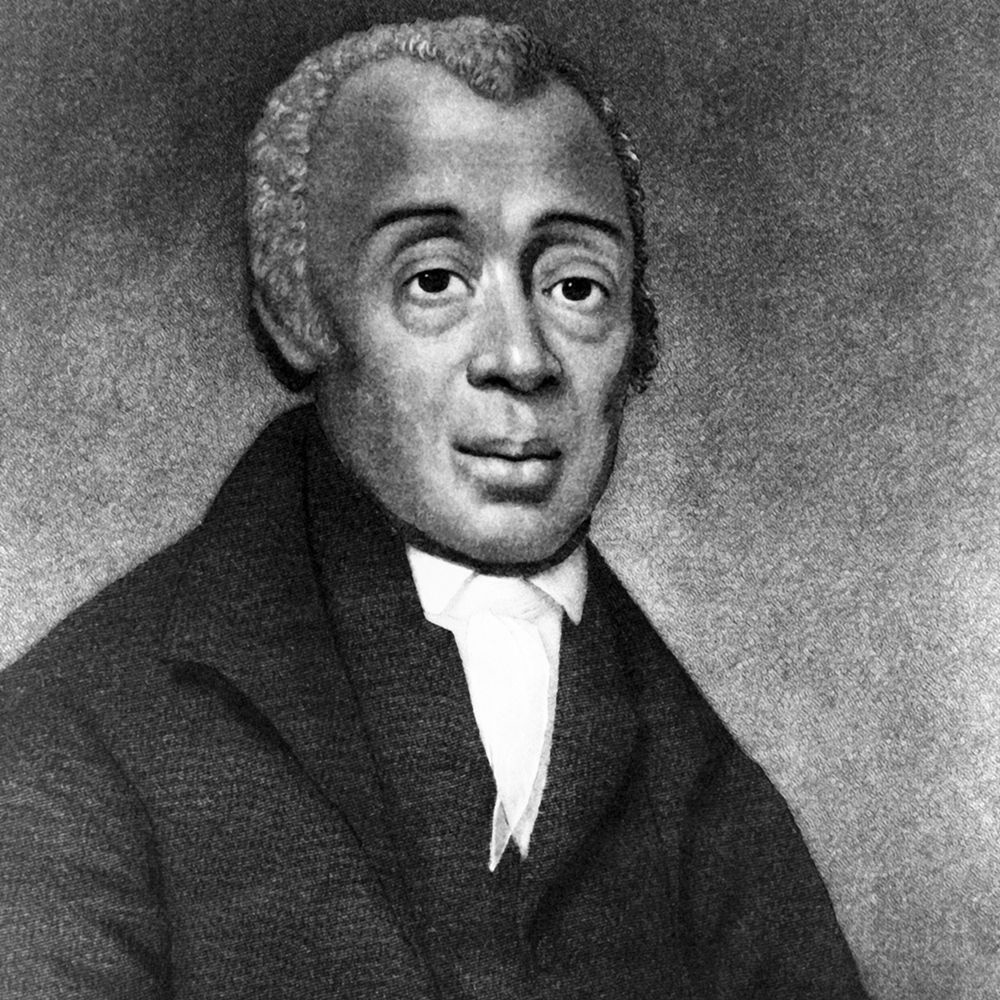
Richard Allen
American minister and educatorWikipedia
20
MENTIONS
6
EPISODES
6
PODCASTS
Search complete. 20 mentions across 6 episodes found for "Richard Allen".
Oct 20, 2026

Grant VenerableGUEST
And one of the original organized religions that those enslaved people adhered to was Methodist.
Grant VenerableGUEST
And when the first founder of the AME Church, Richard Allen, back in 1789 found it necessary to break away from the Methodist Episcopal Church, which did not keep black people and hard people out of the church.
Grant VenerableGUEST
They just had them sit in the back or up in the gallery upstairs.
Grant VenerableGUEST
And when it was time to take communion, they would come down to the altar and the ushers would usher them to the altar to kneel.
Grant VenerableGUEST
We should do something about that.
Grant VenerableGUEST
So the ushers at that point pulled the people off of their knees and said, you can't do this anymore.
Grant VenerableGUEST
And so the people went back to their seats and they left the church led by a member named Richard Allen.
Jill NicoliniHOST
Okay.

Lisa A. SmithHOST
And eventually she moved to Philadelphia and she became connected to a ministry, the African Methodist Episcopal Church.
Lisa A. SmithHOST
And that was ran by a guy named Richard Allen right now.
Lisa A. SmithHOST
Mind you, she was born in 1783.
Lisa A. SmithHOST
So by the time she got connected to this church as an adult, it was in the early 1800s, right? Early 1800s.
Lisa A. SmithHOST
So she set out on her journey and set out on her journey to begin preaching.
Lisa A. SmithHOST
But here was the issue.
Lisa A. SmithHOST
When she finally found kind of a church home that resonated with her, which was the African Methodist Church, she went to Richard Allen and she asked and she told him that I've been called to preach.
Lisa A. SmithHOST
And she asked him, you know, could she start preaching in the church? And Richard Allen told her at that time.

DylanHOST
Sadly, people have been treated differently because of their race throughout history, even by people who claim to follow Jesus.
DylanHOST
Richard Allen experienced that firsthand, but instead of letting it stop him, he trusted God and worked to make a place where African American Christians could worship freely.
DylanHOST
His story reminds us that Jesus doesn't divide people by race or status, He calls people from every nation to Himself.
DylanHOST
Today's devo tells Richard's story and is called Head Held High: The Legacy of Richard Allen by Abigail Osweggan.
DylanHOST
[gentle music] Richard Allen was born into slavery in 1760.
DylanHOST
As an adult, he put his trust in Jesus.
DylanHOST
He then asked his non-Christian slaveholder to invite preachers to come speak in their home, and he agreed.
DylanHOST
One of these sermons convicted Richard Allen's slaveholder that slavery was wrong, so he invited Allen to buy his freedom.

Stephen McDowellHOST
"Well, you've got to mention Reverend Jonathan Mayhew and Reverend Samuel Cooper, Reverend George Whitefield, Reverend Charles Chauncy." And so pastors were involved in civil duties, political duties, in education, in getting involved directly, in taking social action.
Stephen McDowellHOST
And it just wasn't these White European pastors, it was also, uh, African American pastors, like Reverend Absalom Jones, Reverend Richard Allen, Reverend John Merritt, Reverend Lemuel Hayes.
Stephen McDowellHOST
They also were on the forefront of, of training and educating what the Bible had to say about all of life.
Stephen McDowellHOST
Yes, about our relationship to the Lord, but then also about how do we bring about biblical transformation in society, in every aspect of, of, uh, society.

speaker_2NARRATOR
Suddenly a change came after Reconstruction.
speaker_2NARRATOR
The black man was either a faithful old before the war darky worshiping lordly white folk or a frolicking ape or a villain a sullen scoundrel a violator of women hood a low thief and misbirthed monster he was subnormal and congenitally incapable he was represented as an unfit survival of darwinian natural selection philanthropy and religion stood powerless before his pygmy brain and undeveloped morals in a thousand years perhaps but at present an upper beast out of this to-day he is slowly but tentatively almost apologetically rising a somewhat deserving often poignant but hopeless figure a man whose only proper end is dramatic suicide physically or morally his trouble is natural an inborn inferiority slight by scientific measurement but sufficient to make absolute limits to his possibilities save in exceptional cases and here we stand to-day as a normal human being reacting humanly to human problems the negro has never appeared in the fiction of the science of white writers with a bare half-dozen exceptions while to the white southerner who knows him best he is always an idiot or a monster and he sees him as such no matter what is before his very eyes and yet with all this the negro has held the stage in the south he is everything you cannot discuss religion morals politics social life science earth or sky god or devil without touching the negro it is a perennial and continuous and continual subject of books editorials sermons lectures and smoking-car confabs in the north and west while seldom in the centre the negro is always in the wings waiting to appear or screaming shrill lines off stage what would intellectual america do if she woke some fine morning to find no negro problem coming now to the slowly swelling stream of a distinct group literature by and primarily for the negro we enter a realm only partially known to white americans first there come the rich mass of negro folklore transplanted from africa and developed in america a white writer joel chandler harris first popularized uncle remus and brer rabbit for white america but he was simply the deft and singularly successful translator the material was negroid and appears repeatedly among the black peasants and in various forms and versions take for instance the versions of the celebrated tar-baby story of joel chandler harris c c jones took down a striking version apparently direct from negro lips early in the nineteenth century de b' wolf bun me broke me neck but don't trow me in de brier patch lemme dead one time don't terrify me no mo b' wolf you been know wha b' rabbit up dah and tink you been gwine tear b' rabbit hide off so wha a do a loose b' rabbit from de spackleberry bush and a take him by de hind leg and swing him round and a trow him way in de thick brier patch for tear it hide and crutch a yeah yeah out de minute b' rabbit drop in de brier patch a cock up his tail and jump and holler back to b' wolf good-by butter dis de place me mammy fatch me up dis de place me mammy fatch me up and he gone befo' b' wolf kin ketch him b' rabbit too schemy the harris version shows the literary touch added by the white man but the negro version told by jones has all the meat of the primitive tale next we note the folk rhymes and poetry of negroes sometimes accompanying their music and sometimes not a white instructor in english literature at the university of virginia says of all the builders of the nation the negro alone has created a species of lyric verse that all the world may recognize as a distinctly american production t w talley a negro has recently published an exhaustive collection of these rhymes they form an interesting collection of poetry often crude and commonplace but with here and there touches of real poetry and quaint humor the literary expression of negroes themselves has had continuous development in america since the eighteenth century it may however be looked upon from two different points of view we may think of the writing of negroes as self-expression and as principally for themselves here we have a continuous line of writers only a few of these however would we think of as contributing to american literature as such and yet this inner smaller stream of negro literature overflows faintly at first and now evidently more and more into the wider stream of american literature on the other hand there have been figures in american literature who happen to be of negro descent and who are but vaguely to be identified with the group stream as such both these points of view are interesting but let us first take up the succession of authors who form a group literature by and for negroes as early as the eighteenth century and even before the revolutionary war the first voices of negro authors were heard in the united states phyllis wheatley the black poetess was easily the pioneer her first poems appearing in seventeen seventy three and other editions in seventeen seventy four and seventeen ninety three her earliest poem was in memory of george whitefield she was honored by washington and leading englishmen and was as a writer above the level of her american white contemporaries she was followed by richard allen first bishop of the african methodist church whose autobiography published in seventeen ninety three was the beginning of that long series of personal appears and narratives of which booker t washington's up from slavery was the latest benjamin banneker's almanacs represented the first scientific work of american negroes and began to be issued in seventeen ninety two Coming now to the first decades of the nineteenth century, we find some essays on freedom by the African Society of Boston and an apology for the new Negro church formed in Philadelphia.
speaker_2NARRATOR
Paul Cuffe, disgusted with America, wrote an early account of Sierra Leone, while the celebrated Lemuel Haynes, ignoring the race question, dipped deeply into the New England theological controversy about 1815.
speaker_2NARRATOR
In 1829 came the first full-voiced, almost hysterical protest against slavery and the color line in David Walker's appeal, which aroused Southern legislatures to action.
37 MINS LATER
speaker_2NARRATOR
Encouragement because they did not want Negroes in their churches even when they occupied the back seats or in the gallery.
speaker_2NARRATOR
Objection when the church became, as it so often did, a center of intelligent Negro life and even of plotting against slavery.
speaker_2NARRATOR
There arose out of the church the first leaders of the Negro group, and in the first rank among these stands Richard Allen.
speaker_2NARRATOR
Richard Allen was born in 1760 as a slave in Philadelphia and was licensed to preach in 1782.

Lisa Sharon HarperGUEST
And many of the people who were writing the Constitution went to St. George's Church.
Lisa Sharon HarperGUEST
And Absalom Jones and Richard Allen were like deacons at this church.
Lisa Sharon HarperGUEST
And their congregation, the black congregation, was larger than the white one.
Lisa Sharon HarperGUEST
And they were forced to sit up in the galleries, which if you go, you can see it.