Return on equity
86
MENTIONS
15
EPISODES
13
PODCASTS
Search complete. 86 mentions across 15 episodes found for "Return on equity".
Sep 10, 2026

BhuvanHOST
market cap structure, it's not only large cap or mid cap.
Arvind ChariGUEST
And the ROEs are also, the Indian company ROEs are actually lower than its own previous historical average.
Arvind ChariGUEST
At the other end was the fact that despite these strengths of growth, lower growth, lower earnings growth, lower ROE, your valuations were supported by very large, strong domestic inflows.
Arvind ChariGUEST
So you had a situation when growth has been lower, valuations are higher.
59 MINS LATER
Arvind ChariGUEST
my team to research and then we'll select opportunities and invest in India.
Arvind ChariGUEST
Our total amount of money that we can pull into India depends on what the portfolio manager in London or Hong Kong thinks about what should their weight be in India.
Arvind ChariGUEST
And that you're likely so saying that I don't have AI, the ROEs are lower, the earnings growth is not
BhuvanHOST
good.

Alan KringHOST
Now let me take you up here.
Alan KringHOST
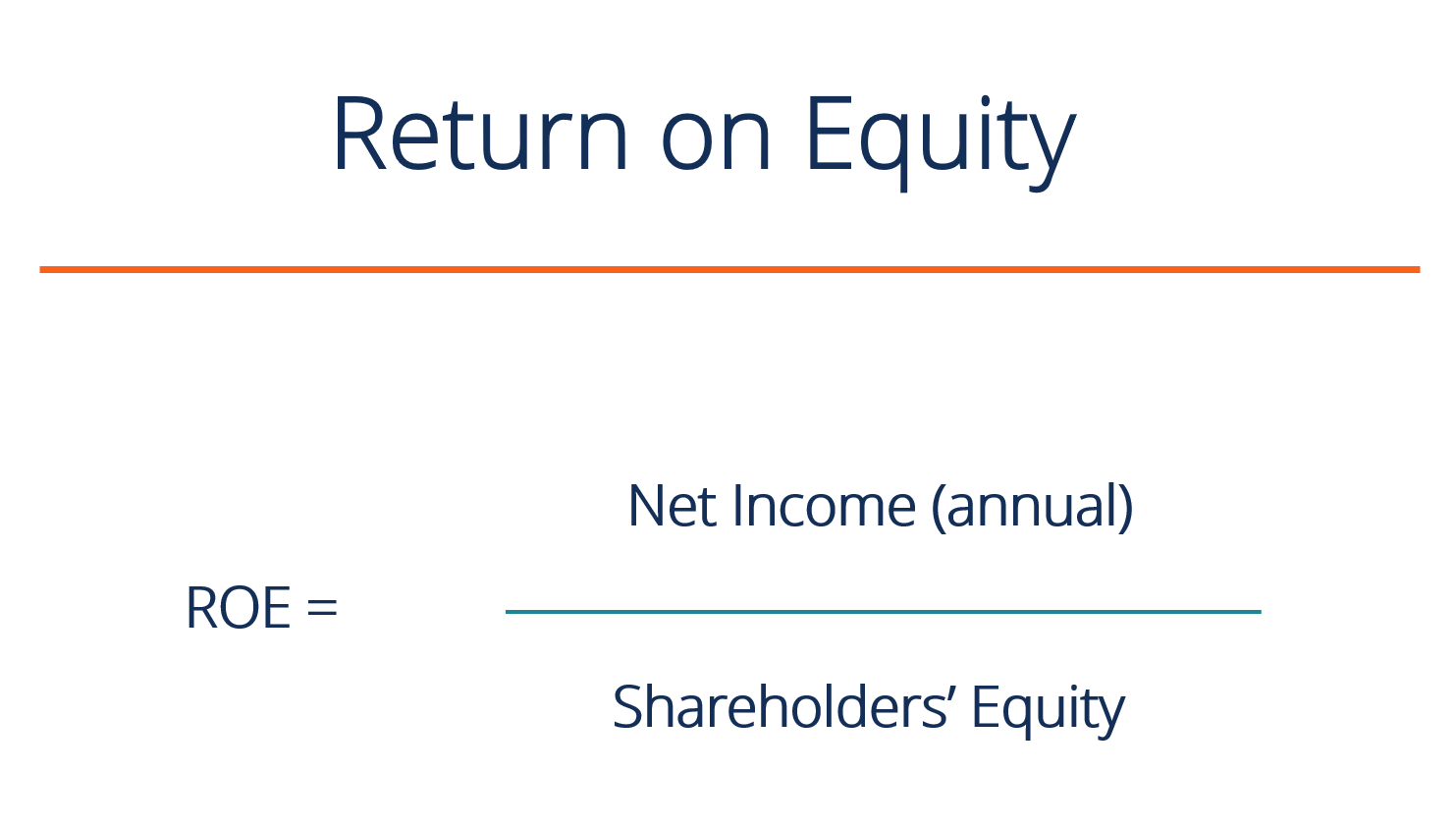
As you can see on that financial ratios sheet, there were a couple of other ones, ROA and ROE.
Alan KringHOST
Now ROA is net income over total assets.
Alan KringHOST
ROE is net income over shareholders' equity.
Alan KringHOST
First things first, remember that total assets is liabilities plus owner's equity.
Alan KringHOST
So this denominator will be smaller than that denominator, just mathematically.
Alan KringHOST
This one, shareholder's equity, is just that part of it.
Alan KringHOST
So this denominator is smaller than that denominator.

Aswath DamodaranHOST
How much you reinvest I'm going to measure by looking at your retention ratio, the percentage of the net income that you don't pay out as dividends.
Aswath DamodaranHOST
How well you reinvest I'm going to measure with a return on equity.
Aswath DamodaranHOST
So if you have a retention ratio of 80% and a return on equity of 30%, 80% of 30% is 24%, that becomes a growth in net income.
Aswath DamodaranHOST
If you're looking at operating income, the definitions of reinvestment and quality of returns become slightly different.
Aswath DamodaranHOST
You measure how much you reinvest with a reinvestment rate.
Aswath DamodaranHOST
2007 was a very good year for banks, and I was concerned that if I took those 2007 numbers and used them as my base case numbers in my evaluation, that I'd probably overestimate the growth rate at 13.04%, which is the product of those two numbers.
Aswath DamodaranHOST
You're saying, what choice do I have? The case of Deutsche, I looked at a five-year average, and the five-year average retention ratio gave me more reasonable numbers.
Aswath DamodaranHOST
I came up with a return on equity of 11.81%, much lower than the current return equity, and a retention ratio of 45.72%.

Masaki TaketsumeGUEST
yeah so if we move back to the pre-Abenomics era, because corporate governance reform started with Abenomics 2013.
Masaki TaketsumeGUEST
So before then, average return on equity for the Japanese corporation is something like 4% or 5%.
Masaki TaketsumeGUEST
But now, thanks to the corporate governance reform, average ROE of the Japanese company is now getting closer to the 10% or 9% to 10%.
Masaki TaketsumeGUEST
Yeah.
Andrew Van SickleHOST
Does that compare quite well with, say, European markets and the American market?
19 MINS LATER
Masaki TaketsumeGUEST
So Hitachi is a kind of a poster child for the corporate governance reform.
Masaki TaketsumeGUEST
So used to be the... a large low-return conglomerate, but their business portfolio is now more focused on a growing area like a railway or a power grid.
Masaki TaketsumeGUEST
And so that their ROE used to be the 2% to 3%, and now it's more than 10%.

Chua Tian TianHOST
Good afternoon and yatening into the Business Report with me, Chua Tien Tien, as we take you through the moves and views that matter to you in the world of business and finance as you navigate the end of your workday.
Chua Tian TianHOST
And at this, I will discuss the return on equity levels of small cap companies listed on the Singapore Exchange.
Chua Tian TianHOST
That's before turning our attention to China's latest factory activity numbers.
Chua Tian TianHOST
Starting with local news, a study has found that the average small-cap company on the SGX posts a return on equity of negative 4.44%, although that of a median small-cap company is a positive 1.58%.
Chua Tian TianHOST
The figures are based on five-year adjusted average ROE numbers from publicly available Bloomberg data.
Chua Tian TianHOST
Small caps mostly cluster in low single digits on negative territory.
David KuoSOUNDBITE_SPEAKER
And I have a look and there is a wide swathe of companies.
David KuoSOUNDBITE_SPEAKER
The mean or the average tells you that there are extremes.

Longacres FinanceHOST
And in my opinion, this is absolutely phenomenal free cash flow growth.
Longacres FinanceHOST
Next, let's switch over and look at the return on equity.
Longacres FinanceHOST
Normally, I like to look at the return on invested capital, but since W.R. Berkley is a financial stock, the return on equity makes more sense here.
Longacres FinanceHOST
And I can see that between two thousand and twelve and two thousand and twenty, the return on equity was pretty stagnant around ten to fifteen percent.
Longacres FinanceHOST
It actually bottomed out in two thousand and twenty at just eight point four percent.
Longacres FinanceHOST
But then in two thousand and twenty-one, it rose to fifteen point four percent.
Longacres FinanceHOST
And once again, it rose in two thousand and twenty-two, climbing above twenty percent.
Longacres FinanceHOST
And since two thousand and twenty-two, it has stayed consistently in that range of around twenty percent.

The Finance GhostHOST
Yes, it is a structurally more leveraged balance sheet than before the pandemic.
The Finance GhostHOST
And obviously that is affecting ROE positively here.
The Finance GhostHOST
But there's a modest uptick in return on assets as well.
The Finance GhostHOST
Another very important point I need to cover in this podcast is e-commerce.

Valentina OrduzHOST
Sin embargo, este cargo no es monetario, es un one-timer, es un evento aislado, por lo cual no refleja un deterioro como tal del negocio, sino es simplemente el-- la escisión de estos, de estos negocios que también tiene.
Valentina OrduzHOST
Cuando excluyes estos y haces otros ajustes, la utilidad neta tiene un crecimiento del diecinueve por ciento frente al año anterior y el EPS ajustado crece en general un veintidós por ciento frente al año anterior, donde ahí sí supera el consenso y el ROE o el return of equity, la rentabilidad por el patrimonio, también mejoró a un catorce por ciento frente a un do-doce por ciento.
Valentina OrduzHOST
Y aquí sale la dirección y dice: esta era una meta que teníamos al 2027, a finales de 2027, y ahorita en el 2026, en la mitad del año, ya lo logramos.
Ariel HuguetGUEST
Ya lo logramos, sí.
5 more episodes mention Return on equity.
Create an account to see the whole feed, search across every transcript, and follow the entities you care about.