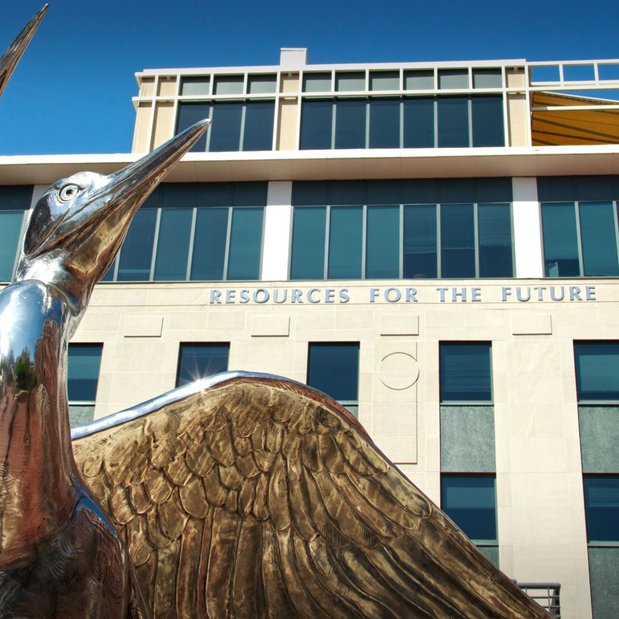
Resources for the Future
Nonprofit organizationWikipedia
18
MENTIONS
9
EPISODES
6
PODCASTS
Search complete. 18 mentions across 9 episodes found for "Resources for the Future".
Oct 14, 2026

Claire BrunelGUEST
So I concede that there's such possibility, right? Right now, like the EU, again, one of the most stringent, they're pricing carbon at about 90 euros per ton of carbon.
Claire BrunelGUEST
Uh, estimates from the, uh, Resources for the Future, which is a great think tank in, in DC doing awesome work on environmental and energy economics, they say the price of carbon should be at about 190.
Claire BrunelGUEST
That's because the cost of a ton of carbon on society in terms of health costs, mortality, um, agricultural production, like it, it represents $190.
Claire BrunelGUEST
And so if you want firms to produce at the level that they should be producing, you need to make them internalize the whole cost that their pollution has on society.

Daniel RaimiHOST
[upbeat music] Hello and welcome to Resources Radio, a weekly podcast from Resources for the Future.
Daniel RaimiHOST
I'm your host, Daniel Ramey.
Daniel RaimiHOST
Today, we talk with Dr. Susanna Berkouwer, assistant professor at the Wharton School at the University of Pennsylvania, and a faculty research fellow at the National Bureau of Economic Research.
27 MINS LATER
Susanna BerkouwerGUEST
Thanks so much for having me.
Susanna BerkouwerGUEST
[outro music]
Daniel RaimiHOST
You've been listening to Resources Radio, a podcast from Resources for the Future, or RFF.
Daniel RaimiHOST
If you have a minute, we'd really appreciate you leaving us a rating or comment on your podcast platform of choice.
Daniel RaimiHOST
Also, feel free to send us your suggestions for future episodes.
Margaret WallsHOST
[upbeat music] Hello, and welcome to Resources Radio, a weekly podcast from Resources for the Future.
Margaret WallsHOST
I'm your host, Margaret Walls.
Margaret WallsHOST
Today on the show, we're gonna talk about drinking water in the United States and why you might have turned on your tap this morning and had a drink without worrying about whether the water was safe.
33 MINS LATER
Margaret WallsHOST
Thanks, Margaret.
Margaret WallsHOST
A lot of fun.
Margaret WallsHOST
[outro music] You've been listening to Resources Radio, a podcast from Resources for the Future.
Margaret WallsHOST
If you have a minute, we'd really appreciate you leaving us a rating or a comment on your podcast platform of choice.
Margaret WallsHOST
Also, feel free to send us your suggestions for future episodes.

Bill HodgeHOST
EPA estimates the power plant repeal will save about 310 billion.
Bill HodgeHOST
Resources for the future puts the resulting health damage as high as 476 billion.
Bill HodgeHOST
And the Biden-era analysis had projected the standards would cut 1.38 billion metric tons of carbon through 2047.
Bill HodgeHOST
The Center for Biological Diversity expects the administration to issue a formal non-endangerment finding and believes it won't survive a court challenge.
Kristen HayesHOST
Hello, and welcome to Resources Radio, a weekly podcast from Resources for the Future.
Kristen HayesHOST
I'm your host, Kristen Hayes.
Kristen HayesHOST
My guest today is RFF's newest fellow, Jesse Gorovich, who's joined RFF in August of 2026.
Kristen HayesHOST
But in addition to that, in your case, I would like to ask you to say a little bit more about what drew you to working at RFF.
Jesse GourevitchGUEST
So
Kristen HayesHOST
who you are in general, and then what brought you to Resources for the Future?
Jesse GourevitchGUEST
Sure.
Jesse GourevitchGUEST
So I started at RFF at the beginning of August.

Dane WigingtonHOST
The conversation is shifting, shifting mostly behind closed doors.
Dane WigingtonHOST
That was the consensus at a September 11th solar geoengineering workshop in Washington organized by the environmental group Resources for the Future and Harvard University.
Dane WigingtonHOST
Question.
Dane WigingtonHOST
Should everyone in these groups with an email address be sent a link to the dimming documentary and asked why they are hiding in the shadows and lying? If you sent a link...

Matt SandsHOST
But then when you look at the societal benefits as a whole.
Matt SandsHOST
And so there was an interesting study that was done by this group called Resources for the Future.
Matt SandsHOST
And that is a nonpartisan energy and environmental thing.
Matt SandsHOST
tank.

Tom LyonGUEST
But, you know, when it comes to environmental think tanks, there's one that's really, really good.
Tom LyonGUEST
It's Resources for the Future.
Tom LyonGUEST
It's populated by serious researchers and scholars who produce very well worked out analyses.
Tom LyonGUEST
Then there are a lot of other think tanks that produce garbage, and I'm gonna point a finger right at the Competitive Enterprise Institute because they produced an ad, oh, now it's 20 years ago.
Daniel RaimiHOST
Hello and welcome to Resources Radio, a weekly podcast from Resources for the Future.
Daniel RaimiHOST
I'm your host, Daniel Ramey.
Daniel RaimiHOST
Today, we talk with Dr. Andrea Frenado and Patrick Heller from the Natural Resource Governance Institute.
31 MINS LATER
Daniel RaimiHOST
So one more time, Patrick and Andrea, thanks so much for joining us on the show.
Patrick HellerGUEST
Thanks so much, Daniel.
Daniel RaimiHOST
You've been listening to Resources Radio, a podcast from Resources for the Future, or RFF.
Daniel RaimiHOST
If you have a minute, we'd really appreciate you leaving us a rating or a comment on your podcast platform of choice.
Daniel RaimiHOST
Also, feel free to send us your suggestions for future episodes.