Resource Description Framework
FormatWikipedia
18
MENTIONS
9
EPISODES
7
PODCASTS
Search complete. 18 mentions across 9 episodes found for "Resource Description Framework".
Sep 11, 2026

Joe ReisGUEST
Right.
Joe ReisGUEST
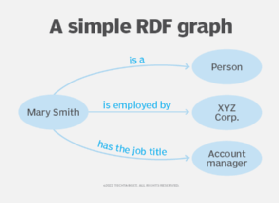
And so this you could directly translate this over to the RDF notation of subject, predicate and object.
Joe ReisGUEST
Right.
Joe ReisGUEST
And so which if you look at a graph, right, it's six normal form.

Artificial IntelligenceNARRATOR
Neo4j's query language, Cypher, lets you write patterns that look a bit like ASCII art.
Artificial IntelligenceNARRATOR
RDF triple stores.
Artificial IntelligenceNARRATOR
Tools like GraphDB, Apache Jena, and Virtuoso store data strictly as RDF triples and query it with SPARQL, a W3C standard.
Artificial IntelligenceNARRATOR
This is the model behind big public graphs like Wikidata and DBpedia.
Artificial IntelligenceNARRATOR
The rough rule: reach for a property graph when you want flexible, developer-friendly modeling, and for an RDF triple store when you need standards, interoperability, and formal semantics.
Artificial IntelligenceNARRATOR
Either way, the underlying idea never changes: it's triples all the way down.
Artificial IntelligenceNARRATOR
Where do we use knowledge graphs? Once you start looking, they're everywhere.
Artificial IntelligenceNARRATOR
This extraction step is where most of the real engineering effort goes.

Arthur BigeardGUEST
I think the Gen AI boom of the last two years has definitely benefited the graph database industry at large.
Arthur BigeardGUEST
And I think it's benefited both from the label property graph side of things, but then also the RDF side of things, interestingly, with ontology suddenly becoming a bit of a buzzword.
Matt HousleyHOST
You're listening to It's About Data.
Matt HousleyHOST
In episode 92, we're talking with Arthur Bichard, founder of G.V. Why don't you tell our audience a bit about yourself and a bit about your company?
Arthur BigeardGUEST
And over time, as interest picked up, And, you know, people like the tool have been able to basically transform this from just a little hobby project into an actual company and now into one that's funded and just really, really spreading our wings and just kind of touching graph databases, graph on relational engines, anything graph in general.
Arthur BigeardGUEST
We started out being, you know, on the batches, but now we support like 30 plus technologies across both label property graph.
Arthur BigeardGUEST
in RDF.
Arthur BigeardGUEST
So lots of fun, lots of work and generally an interesting space to be in, but possibly a shifting one as well.

Paul FrazeeGUEST
Way to accomplish that has been, you know, in the blog post I chart and I actually cut a segment that I had talking about the last 15 years of efforts to essentially create that user experience.
Paul FrazeeGUEST
This is kind of the thing that I think that a lot of the open web, open internet people have been trying to accomplish ever since, I would say, the RDF era, the semantic web era, when TBL and the rest of the W3C was trying to push on this.
Paul FrazeeGUEST
How do we get to the point of structured data getting published on the web? Not websites, these things that lead to walled gardens, but instead create an open database.
Paul FrazeeGUEST
And It's hard.

Jörg SchadGUEST
Very, very good question.
Jörg SchadGUEST
I think to start out, I think this is something you can encode in that, uh, curation process, right? So for example, when we talked about this first use case where we're trying to identify the entities, when we identify the entities, again, coming, coming back into knowledge graph, in an ideal world, like how I would imagine it, not exactly what we're for example doing right now, but I would imagine, uh, you can also generate constraints, right? In knowledge graphs, especially RDF, you're even separating that kind of schema layer from the fact layer.
Jörg SchadGUEST
In the first step, by generating the knowledge graph schema, by identifying the interesting entities, you can also generate the constraints around that.
Jörg SchadGUEST
In the RDF world, I don't think we wanna get into a discussion around, like, which representation is best, but there's like a long debate, SHACL, et cetera.
Jörg SchadGUEST
So you have a lot of options there, uh, to express constraints, but I would imagine this is probably that way.
Jörg SchadGUEST
Right now I said, like, I think you start at the easy part.

Patrick McGarryGUEST
And you're already starting to see those moments of clarity where the joint staff inside of the DoD are specifically asking for open graph standards compliance solutions by name.
Patrick McGarryGUEST
Like they're saying RDF and OWL and SPARQL and all of our favorite terms, right? They're using our million dollar words like ontology.
Patrick McGarryGUEST
Like, so you're starting to see people, and even on the Gartner side, right? I think they came out with a report three or four months ago that was like the ontology or semantic layer is a necessary brick if you want to succeed in the future or something.
Patrick McGarryGUEST
I forgot how they phrased it.

Patrick McGarryGUEST
And you're already starting to see those moments of clarity where the joint staff inside of the DoD are specifically asking for open graph standards compliance solutions by name.
Patrick McGarryGUEST
Like they're saying RDF and OWL and SPARQL and all of our favorite terms, right? They're using our million dollar words like ontology.
Patrick McGarryGUEST
Like, so you're starting to see people, and even on the Gartner side, right? I think they came out with a report three or four months ago that was like the ontology or semantic layer is a necessary brick if you want to succeed in the future or something.
Patrick McGarryGUEST
I forgot how they phrased it.
Juan SequedaHOST
little bit everything
Tim GasperHOST
You know, AI is pretty good at this RDF stuff.
Juan SequedaHOST
Well, everything.
Juan SequedaHOST
So here's the interesting thing, and I posted about it on LinkedIn and my sub-site yesterday, was we needed a website, but at the same time, I've been thinking about like, wait, we have all of this data and all this knowledge over the years that I want to start organizing and we should put it together.
Juan SequedaHOST
So I'm like, this was a perfect example to eat our own dog food, drink our own champagne, or drink our own cocktail, right? really showcase what this means so what i've been doing is in a nutshell is building out an entire knowledge graph of our podcast of our episodes of the guests about the topics eventually bring in all specific details about our transcripts and stuff that is a knowledge base right represented as a knowledge graph and i want to be able to do a bunch of stuff with that One of those things is to create a website.
Juan SequedaHOST
One of those things is to go create an MCP server.
Juan SequedaHOST
One of those things is to release my data so other people can consume it as raw files in JSON and RDF and CSV.
Juan SequedaHOST
Another thing is to create a chat with your data.
Juan SequeiraHOST
little bit everything
Tim GasperHOST
You know, AI is pretty good at this RDF stuff.
Juan SequeiraHOST
Well, everything.
Juan SequeiraHOST
So here's the interesting thing, and I posted about it on LinkedIn and my sub-site yesterday, was we needed a website, but at the same time, I've been thinking about like, wait, we have all of this data and all this knowledge over the years that I want to start organizing and we should put it together.
Juan SequeiraHOST
So I'm like, this was a perfect example to eat our own dog food, drink our own champagne, or drink our own cocktail, right? really showcase what this means so what i've been doing is in a nutshell is building out an entire knowledge graph of our podcast of our episodes of the guests about the topics eventually bring in all specific details about our transcripts and stuff that is a knowledge base right represented as a knowledge graph and i want to be able to do a bunch of stuff with that One of those things is to create a website.
Juan SequeiraHOST
One of those things is to go create an MCP server.
Juan SequeiraHOST
One of those things is to release my data so other people can consume it as raw files in JSON and RDF and CSV.
Juan SequeiraHOST
Another thing is to create a chat with your data.