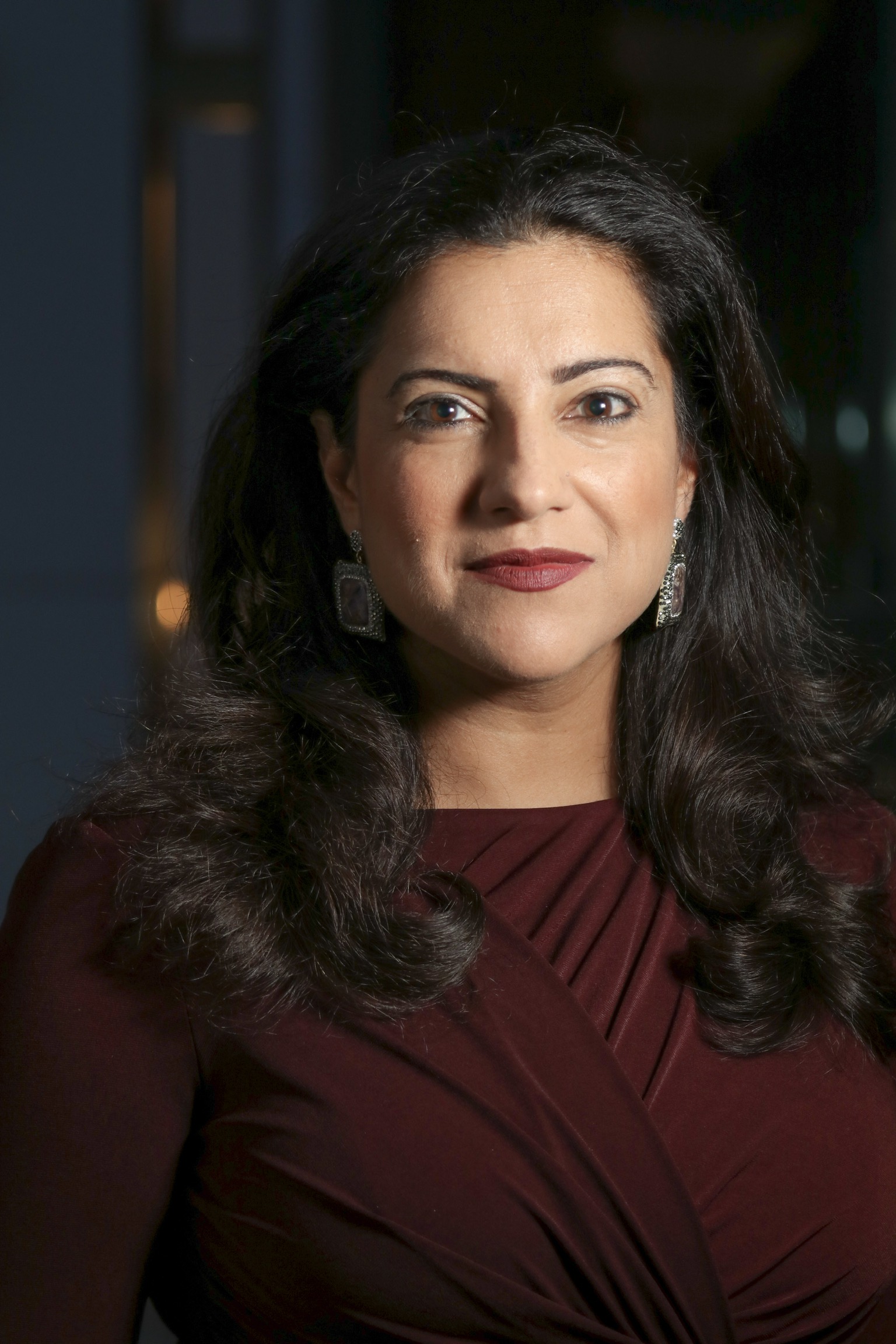
Reshma Saujani
American lawyer and activist
16
APPEARANCES
15
PODCASTS
Sep 8, 2026

1:19
[gentle music] The body relaxed, the body breathing, your senses open, your mind open, meeting the world.

Reshma SaujaniGUEST
[gentle music] The waiting room at my doctor's office in Downtown Manhattan is bright and white.
Reshma SaujaniGUEST
My body's here, but my mind is elsewhere, in my phone, knocking out work emails as usual.
11 MINS LATER


Marianne SchnallHOST
Can you share more about that? What are those penalties and how can we begin to build a system that is better for women?
Reshma SaujaniGUEST
Look, I think if you look at history, I believe that motherhood was the unfinished business of feminism.
Reshma SaujaniGUEST
One of my favorite speeches by Betty Friedan, she did at Smith College, really talks about how the separation between work and family.
Reshma SaujaniGUEST
And look, feminists were fighting for our right to vote, for our right to be in the workplace in the first place.
Reshma SaujaniGUEST
And so the work that's left to us now is to figure out the fact that most American women, they have to work and they have kids.
Reshma SaujaniGUEST
80% of women will have a child, right? And so we're constantly balancing our families and working.
8 MINS LATER
Marianne SchnallHOST
Who benefits from this sort of dysfunctional way it is now with when mothers feeling like they're individually failing rather than collectively unsupported? And like, and why is the United States like one of the last countries to implement these policies?

7:28
I'm interested, you know, what kind of inspired you to make this film? And, um, yeah, like where did this spawn from?
Reshma SaujaniGUEST
I mean, look, the film is like an investigation into like the lies we tell mothers to distract and divide them from, you know, getting the real supports that we need, like paid leave and childcare.
Reshma SaujaniGUEST
You know, it really inspired me as I was building this movement, I would go into like rooms of moms all across the country.
Reshma SaujaniGUEST
And I felt like they were looking at me like I was crazy, like Rushman, we can't have those things, you know, like that's somewhere else.
Reshma SaujaniGUEST
And it made me realize that like, You know, as I was building the movement, I nerded out and really tried to understand the history of motherhood.
6 MINS LATER
14:11
Was motherhood always a personal problem? Like, was this always an individual failure? I


Reshma SaujaniGUEST
In fact, the pandemic in some ways was a gift because it showed us what's possible.
Reshma SaujaniGUEST
We recognized that often most mothers are both working and they're caregiving, and they shouldn't have to hide either one of their identities.
Tan FranceGUEST
We'll sell this documentary and, and, uh, it will get seen by millions." However, after hearing the importance of doing this this way, where we're doing private screenings, we're a- we're encouraging people to do screenings with their communities, it's so that women aren't watching on their own in silos, thinking, "Am I the problem? What's the problem? How do we talk about this? How do I talk about this with my friends and family?" No, we want you to do screenings with your friends and family.

Reshma SaujaniGUEST
So I feel like you can relate to this, 'cause I read your book, and I so related to your story.
Reshma SaujaniGUEST
I think there's something about, like, when you come from nothing, you wanna build something.
Reshma SaujaniGUEST
Even though they were trained engineers, my mother sold cosmetics, my father worked as a machinist in a plant.
46 MINS LATER

Emma GredeHOST
Why are alarm bells not going off everywhere? If this is, i- i- if that's really true, because I think any woman listening to this would find that entirely shocking.

speaker_2UNKNOWN
People...
Reshma SaujaniGUEST
Cared about content, you know, people cared about documentaries, people, you know, like there was a, there was a, you know, like we weren't against DEI, right? There was like, there was a desire in the industry to tell these kinds of stories and all of that really shifted.
Reshma SaujaniGUEST
But for me, the inspiration was when I started my work at Moms First and I would talk about how, again, like, American motherhood is impossible by design, right? And that we've been getting cons since the ink dried on the constitution that we can get more, we deserve better.
Reshma SaujaniGUEST
We can be Norway and Sweden and we can have paid leave and we can have childcare.
Reshma SaujaniGUEST
Oftentimes people just look at me a little bit like, you're crazy because we had been so indoctrinated that we were the problem, right? That we actually can't ask our employer or our government or anybody.
9 MINS LATER

Shannon WattsHOST
What How do we get from and how did you get from that shift of like, this is my problem versus the system? And what are the problems they're recognizing?


Dana BashHOST
So you do believe that this is reversible with the right policies in the short term.
Reshma SaujaniGUEST
Like America has the most educated population of women with the least amount of labor market participation.
Reshma SaujaniGUEST
When you look at that chart and you study, why did 500,000 women leave the workforce in 2025? The number one reason was the cost of childcare.
Reshma SaujaniGUEST
Most American women come home, they look at their paycheck, they look at the cost of their childcare, and the math is not mathing.
Reshma SaujaniGUEST
And that means that every day we lose nurses, teachers, social workers, foundational workers to our country.


Hari SreenivasanCORRESPONDENT
I mean, those stats even each on their own would be pretty huge, but all of them are happening simultaneously in a place where we think that, well, you should be able to do both.
Reshma SaujaniGUEST
Like, they're one bad day away from financial ruin, right? A car breaking down, a health event, because all of their savings goes into childcare.
Reshma SaujaniGUEST
And so when you've seen states think, when they have a surplus or they have an opportunity to make an investment, and they look at, well, what are all the things that I can do for a family? H- what are all the, like, ways I can give them more resources? Oftentimes, policymakers come to the decision that if I can lower childcare costs, you know what I mean, if I can make it affordable and available, I actually can take families out of a precarious financial situation and put them i- on the path to the American dream.
Reshma SaujaniGUEST
And so childcare is the linchpin of affordability, and that's something that Moms First is, you, you know, you know we've been driving towards the past four years, of taking it out of something that has always been seen as a personal problem, this is your s- problem as a family that you have to fix, to it being an economic issue.
Reshma SaujaniGUEST
Workers can't work without childcare, you know, and, and, and businesses don't work without workers.
Hari SreenivasanCORRESPONDENT
Where should the solution come from? Should it be a federal policy, or as the administration says, this is a state by state issue?


Reshma SaujaniGUEST
You know, I think it is important that people like you and I connect the dots for folks, connect the Roe v- The minute we lost our reproductive rights, we- people saw us as less human.
Reshma SaujaniGUEST
Because if you can't control your body, you really can't control anything, and I think the minute that that happened in America, you actually start...
Reshma SaujaniGUEST
That- that's what's led us from there to The Rape Academy, and all of these things in between, the SAVE Act, the getting rid of DE&I, the NASA taking off like female scientists from...
Reshma SaujaniGUEST
Like, all of it is interconnected, and so now here we are, right? And I think as women have, as these things have happened, we haven't risen up in the way that we need to.
34 MINS LATER

Nick GillespieMODERATOR
Yes
Reshma SaujaniGUEST
so interesting, because I think you assume, and w- going back to class, that people who are barely trying to get by, and the vast majority of people in America don't have the economic luxury of actually thinking about these things.
Reshma SaujaniGUEST
They're just trying to get by, and I think my parents were in that position.
Reshma SaujaniGUEST
And so for me, having more resources, having more support, and looking at this as someone who's kind of, again, leading a movement of moms, I think it's so hard to have, like, these conversations about what your parenting style should beWhen we are living in a country that doesn't have structure, and we are living in a culture that shames moms-
6 MINS LATER
Nick GillespieMODERATOR
Like, where is that coming from?
Reshma SaujaniGUEST
Well, it's complicated, 'cause I, I think part of this, I think part, like you said, you know, as we've talked about, like, in the '70s there's a huge infusion of women in the workplace, and I think that there was, like, again, a culture movement about being a girl boss, you know what I mean? Working really hard, getting the corner office.


Kristen WelkerHOST
What is your message to lawmakers in Washington about how they can be a part of this solution?
Reshma SaujaniGUEST
You know, I asked President Trump a question about childcare when he was running for office, and he said, "Childcare is childcare.
Reshma SaujaniGUEST
We gotta have it." And then when he got elected, and about a month ago, um, he said, "We can't afford it.
Reshma SaujaniGUEST
I gotta spend money and resources, um, towards foreign wars." And I was surprised because the reality [laughs] is, is like things for American families have not gotten better.
7 MINS LATER
Reshma SaujaniGUEST
I was just speaking to, you know, uh, Governor Moore, and we know that this has gotta happen because childcare is the linchpin of affordability.
Reshma SaujaniGUEST
And so that is the one thing that we can do as a country to reduce people's costs.


Reshma SaujaniGUEST
I do think when I talk to Republicans today and I say, "Hey, like, what's going on here? Like, you guys are talking about the birth rate.
Reshma SaujaniGUEST
Like, and everything that I see in the polling and the focus groups that we've done is, like, Republicans want them to fix childcare.
Reshma SaujaniGUEST
Why don't you do it? You know? Why don't you do something about childcare and paid leave?" And, like, what I have heard over and over again is that, like, Ivanka was a big champion in the administration, and they just don't have that person, you know what I mean, in the administration right now.
14 MINS LATER


Julia BoorstinHOST
But why does it make sense to make a movie, and then what does it mean to have 2,500 producers?
Reshma SaujaniGUEST
I was like, I don't recommend anyone to be like, you know what I mean, a documentary film producer, like, in a moment where, quite frankly, like, the, the, the business is really hard, right? And, um, I wanted to make it because as I went out there talking about this issue four years ago, I would look into audiences, and women would look at me, or moms would look at me kind of like I was crazy.
Reshma SaujaniGUEST
Like, "Wait a minute, I could have that?" Like, we had convinced moms for so long that like, "This is your fault.
18 MINS LATER
Julia BoorstinHOST
How much do you think women are in a vulnerable position because of the risk AI poses to jobs and in general?

Andee TagleCORRESPONDENT
Reshma Sajjani is a lot of things: a lawyer, an author, an activist, a founder of two major non-profits working towards gender equality, and a working mom of two on top of all of that.
Reshma SaujaniGUEST
Like, at the end of the day, what matters is my family, is my friends, is, like, my spiritual life.
Reshma SaujaniGUEST
And I think that you have to be able to evaluate, what do I really need to get done? And what is the sense of like, I'm doing this because I have to prove that I have to be productive?
Andee TagleCORRESPONDENT
So the next time you feel overcome by guilt when you have to drop off your little one at daycare, or you drop the ball at work because the baby didn't sleep or got sick, remember, you're not struggling simply because you're not trying hard enough.
Reshma SaujaniGUEST
Not because we need more confidence, not because we have to color-code our calendar.
Reshma SaujaniGUEST
We don't have the structural support in order to both be a mother and actually participate in the workforce.


Reshma SaujaniGUEST
Right? Like, everything shifted 'cause nobody was there left, and I had not learned, and I still don't know.
Reshma SaujaniGUEST
And if I was honest too, I just also, like, had a little bit of judgment around it.
Reshma SaujaniGUEST
And I remember I was reading my mentor Hillary Clinton's book, and she wrote in there, like, that she makes a new friend every year.
11 MINS LATER