Reggio Emilia approach
21
MENTIONS
11
EPISODES
8
PODCASTS
Search complete. 21 mentions across 11 episodes found for "Reggio Emilia approach".
Sep 9, 2026

Nikki MillerHOST
Mm-hmm
Emma RattiganGUEST
... well, was our drama specialist, and she is, um, a real advocate of the creative arts in education and the, what we'd say in Reggio- ... uh, speak the hundred languages of children.
Emma RattiganGUEST
We talk about the arts being all of these languages for self-expression.
Emma RattiganGUEST
So we don't, we're not a school that, um, prepares children to go on the X Factor or teaches them how to sing beautifully in the opera.

Amy MooreHOST
I love reading your stuff.
Amy MooreHOST
Um, and so I love that you write about Reggio Emilia.
Amy MooreHOST
I've actually been there.
Amy MooreHOST
I did a two-week study tour, immersed myself in their school system back in 1994-ish.

Jill LermanHOST
Number three, the environment matters more than we think.
Jill LermanHOST
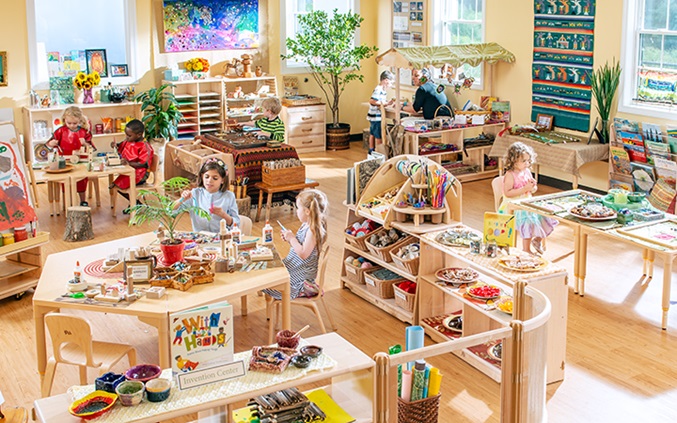
So In my background and one of my biggest influences, which is Reggio, the educational philosophy, Reggio Emilia, they talk about the environment being the third teacher.
Jill LermanHOST
If you're familiar with Montessori, environment is a really big part of that educational philosophy too.
Jill LermanHOST
We spend a lot of time in professional development that I was leading talking about what children need to do, but we don't always spend a lot of time asking the question, well, what is the environment in my classroom, or if you're a parent listening, my home, asking of this child, okay? Because the environment can either support children or it can make things harder, and So when you think about this from the perspective of a classroom, it's like, OK, well, where are the materials? Can children reach them? And this is true really in your play space as well.

Misty PatersonGUEST
So my work typically spans working with children ages three to 13.
Misty PatersonGUEST
And it was so interesting because Reggio inspired Ron and I was there for particular reasons because I'm steeped in that inspiration from the Reggio approach.
Misty PatersonGUEST
And my son, so we came in with my daughter and my son's five years younger and there was a lot that happened and I won't go into details, but there were parents who were deeply questioning the readiness of their children for kindergarten.
Misty PatersonGUEST
And they were having some experiences of maybe the children didn't know the colors that the parents thought were important or didn't have the legibility of the writing or, you know, various things.
Paige WernickGUEST
And that's more or less infant room, infant care, right? deeply relational.
Paige WernickGUEST
Ron talked about the dance and I love that because Carolyn Edwards and Helen Rakes wrote the book, Extending the Dance.
Paige WernickGUEST
And this is all focused on being with infants and toddlers and And of course, we all know Carolyn Edwards connection to Reggio, etc, etc.
Paige WernickGUEST
So very much steeped in some of that pedagogical tradition that Ron was even describing is still seen in infant and toddler rooms.

ChazzHOST
Okay.
ChazzHOST
So you were inspired by the, the things that you saw in Europe, the, how they invest in the, in childcare and in the environment, and I know that Reggio was a big piece of, um, the curriculum that you were, that was, you were inspired by and that was over there.
ChazzHOST
Um, and so then you, you and Matt...
ChazzHOST
And by the way, the reason why Matt is not here is he is sick, and we are, at Birdhouse we are very big on, you know, take care of yourself.

Sandy LanesHOST
This is Sandy Laines.
Sandy LanesHOST
Join us as my guest today invites us to listen more deeply, remain open to the unknown, and consider how careful attention to children's ideas can reshape our teaching and help us all become Awakened to Reggio.
Sandy LanesHOST
My guest today, Susan Stacey, has spent over 35 years joyfully immersed in the world of early childhood education As an educator, director, author, and presenter, Sue makes her home in beautiful Nova Scotia, Canada, and is known for her deep curiosity and her gift for helping others see the beauty and complexity in children's thinking.
Sandy LanesHOST
She enjoys partnering with early years educators across North America and beyond to think together about inquiry, documentation, and the Reggio approach.
Sandy LanesHOST
Sue's work, through her five books and countless collaborations, has inspired so many of us to slow down, listen closely, and see children's thinking with new eyes.
Sandy LanesHOST
I'm sure that most of you studying the Reggio approach, like I, have been inspired by her books and articles.
Sandy LanesHOST
It's just so cool to have you here.
Sandy LanesHOST
Welcome, Sue.

Hayley PeacockGUEST
And that's what my programs help people develop really.
Carla WardHOST
Now, is playoneering aligned with Reggio-inspired learning?
Hayley PeacockGUEST
Yes, absolutely.
Hayley PeacockGUEST
So playoneering is born from 16 years of professional and personal dedication to the Reggio approach from me, basically.
ChazzHOST
A part of Safe Keeper Week is learning about conscious discipline.
ChazzHOST
It's learning about Reggio Emilia.
ChazzHOST
It's learning...
ChazzHOST
It's, it's, it's taking time to clean out our space, uh, and really go through, like, what do we have, what was, what was thrown in the pack in moments of, like, just, it was stress and just trying to do things quickly.
Cheryl DalyGUEST
I had my kids like make a little journal and, you know, they just kind of drew a picture of each day, something bigger, you know, that happened though the eggs are here today okay that's day eight and they just kind of draw a nest with some eggs in it so they journaled this whole process and I'm like man if I were in my cubicle and they were in daycare right now we would have missed this whole thing so I'm like what else goes on in this crazy house here that we just miss when we're we're all out you know for our whole lives it's not so that really inspired me too and that was just in my own home
Amy MooreHOST
Yeah, that's the whole foundation of the Reggio Emilia approach to learning, right? That the curriculum emerges from the environment, from the children's interests.
Amy MooreHOST
And so it was funny, my mom ran a Reggio Emilia inspired day school.
Amy MooreHOST
And that was my first teaching job.
Amy MooreHOST
And so everything was project learning.

Sherritta HughesHOST
All right, so that wraps up my pragmatism.
Sherritta HughesHOST
And remember, just let's touch on Montessori, Waldorf, and Reggio Emilia.
Sherritta HughesHOST
So that core belief, this is, I don't touch too much on it because it's based on K through 12, right? We're not seeing a lot of this teaching philosophy in higher ed.
Sherritta HughesHOST
And this is based on higher ed.
1 more episode mentions Reggio Emilia approach.
Create an account to see the whole feed, search across every transcript, and follow the entities you care about.