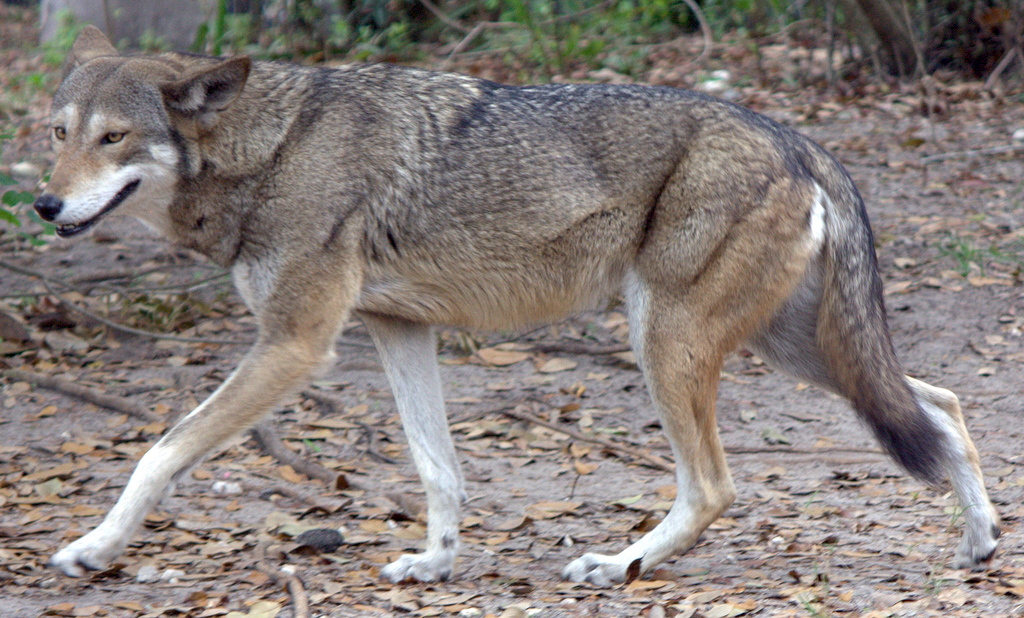
Red wolf
AnimalWikipedia
53
MENTIONS
9
EPISODES
9
PODCASTS
Search complete. 53 mentions across 9 episodes found for "Red wolf".
Oct 22, 2026

Emily PrinceCORRESPONDENT
He said a favorite among kids is this blind possum, Violet.
Emily PrinceCORRESPONDENT
And there are also rare breeds too, like American Red Wolves.
John PolpeterSOUNDBITE_SPEAKER
The only two American Red Wolves that you'll find here in the state of Kentucky are here at the Woodlands Nature Station, part of our captive breeding program, which we've had about 14 puppies born here and then placed in other breeding facilities all throughout the country.
Emily PrinceCORRESPONDENT
So how do the animals wind up at the Land Between the Lakes site?
John PolpeterSOUNDBITE_SPEAKER
We do a lot of adoption of animals and give them forever homes.

Andrew MooreGUEST
Yeah
EliHOST
... well, we have these endangered species and we need to restore them, and one of those endangered species was the red wolf.
EliHOST
And what, what happens is you sort of...
EliHOST
This story finds itself at the nexus between ideals and pragmatism where people...
Andrew MooreGUEST
They would probably be extinct.
Andrew MooreGUEST
Americans very slowly were realizing we had red wolves in the 1960s.
Andrew MooreGUEST
Most Americans did not know that there was such a thing as a red wolf, that it was a different species than the gray wolf.
Andrew MooreGUEST
Most Americans w- uh, would not have cared much, and even today most people don't even know that this species exists.

Stephanie MankaHOST
Today is another fantastic episode.
Stephanie MankaHOST
I invited Aspen S or better known as at wildlife with Aspen on Instagram to talk to me about her career as an ethical red wolf guide in North Carolina.
Stephanie MankaHOST
This podcast is all about wildlife, specifically research or work, whether that is professional or personal, so that you can have an impact in your community, and together we can change the world by helping people, animals, and nature.
Stephanie MankaHOST
I like to help people of all ages, from kids to people who are older, in their 50s, career changers.
Stephanie MankaHOST
Aspen is a fancy scientist.
Stephanie MankaHOST
And in the podcast, we talk about some of the animal jewelry that she's wearing and her apartment decor.
Stephanie MankaHOST
But professionally, she is a red wolf guide, which I was intrigued by.
Stephanie MankaHOST
I know that a lot of my audience is really interested in ecotourism.

Aaron KincaidHOST
Mm.
Aaron KincaidHOST
And that's, you know, in Eastern North Carolina, you've also got the red wolves.
Aaron KincaidHOST
Do you know anything about those? The-
Bill SmithGUEST
So we...
Bill SmithGUEST
They're native to coastal South Carolina, and there's actually a place, um, it's up around Pawleys Island, Georgetown, Char- a little north of Charleston where they have like a red wolf, uh, sanctuary, like an enclosure.
Bill SmithGUEST
Few hundred acres, thousand acres, I don't know how big it is.
Bill SmithGUEST
But they've actually got, I don't know, like eight or 10 red wolves in this enclosure.
Bill SmithGUEST
And, uh, I mean, they all got, you know, GPS tracking collars and stuff on them like that, but they're-

Barbara GibbsHOST
Coming up all new here at 4:00, new faces at the Durham Museum of Life and Science.
Amber RupintaHOST
The pair of wolves who took the place of the endangered red wolves who recently made a move up north.
Amber RupintaHOST
We'll introduce you.
Amber RupintaHOST
[upbeat music]
Barbara GibbsHOST
Amber, back to you.
Amber RupintaHOST
I think so.
Amber RupintaHOST
And new this afternoon, Durham's Museum of Life and Science welcoming two red wolves this week.
Amber RupintaHOST
The museum shared these photos of their new wolves.

Jeff WillardGUEST
The US Fish and Wildlife Service makes that determination, along with many other partner facilities, and the pups and young offspring that are products of that breeding activity are candidate, potential candidates for release into the wild.
Jeff WillardGUEST
Real quick example is we had an American red wolf who was born at Wolf Haven in 2016, lived here for seven years.
Jeff WillardGUEST
He exhibited really great aversive behavior, which made him a really good candidate for release in the wild.
Jeff WillardGUEST
He wasn't habituated.

Beth ShapiroGUEST
The dire wolves, when we announced the dire wolves, we announced that we had cloned red wolves, which is the most endangered species of wolf in North America, an endemic wolf that, again, is living in a very small population, captive breeding in the Carolinas.
Beth ShapiroGUEST
We had colleagues, Bridget von Holtz, um, who works at, who's at Princeton, who had discovered a population of coyote-like animals that have a bunch of red wolf ancestry, some on the order of more than 75% red wolf ancestry.
Beth ShapiroGUEST
And so we've cloned these wolves as a means to introduce new red wolf genetic diversity into the existing red wolf population using the same toolkit that we used to be able to clone and generate our dire wolves.
Beth ShapiroGUEST
Have you heard about our red wolves?
Andrew HubermanHOST
Mm-mm.

Bill BrownGUEST
Remember seeing them on TV out on Horn Island? Mm-hmm.
Bill BrownGUEST
All right, and we still got Red Wolf now with his coach.
Bill BrownGUEST
They still in there in the woods.
Bill BrownGUEST
But I've trapped one after I got him right to my lounge down here several years ago.

Sam JonesHOST
I'm Sam Jones, and I'm joined by my co-host, Deboki Chakravarti.
Sam JonesHOST
And today, we're talking with scientists about what it takes to conserve animals, particularly the red wolf, harlequin frogs, and of course, the cheetah.
Sam JonesHOST
[music]
Deboki ChakravartiHOST
When you think about conservation, there are some major things that have to be addressed at a systemic level, but there's also a lot of science.
7 MINS LATER
Adrienne CrosierSOUNDBITE_SPEAKER
They don't have normal cyclicity.
Adrienne CrosierSOUNDBITE_SPEAKER
It's kind of all over the place, but they're not seasonal.
Sam JonesHOST
And so with an animal whose oocyte readiness is hard to predict, some scientists are asking what if you could have those oocytes develop outside of the body, which brings us to our next conservation story, the red wolf.
Adrienne CrosierSOUNDBITE_SPEAKER
These are truly America's wolf.