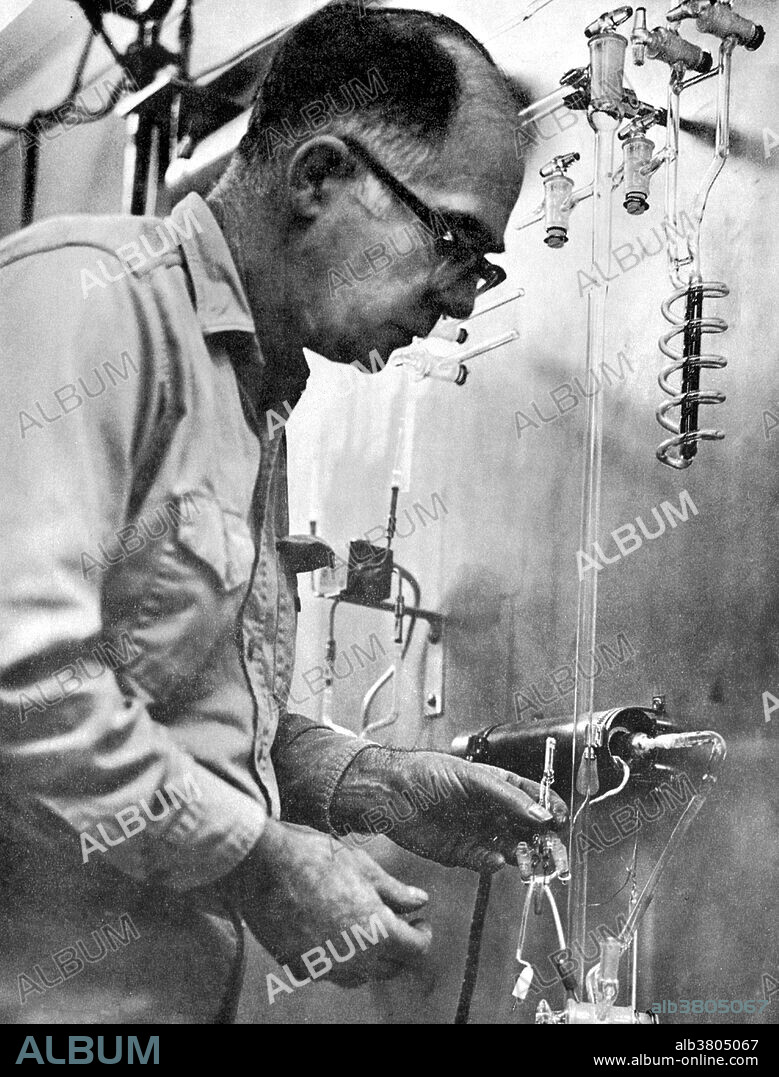
Raymond Davis Jr.
American chemist and physicistWikipedia
9
MENTIONS
7
EPISODES
7
PODCASTS
Search complete. 9 mentions across 7 episodes found for "Raymond Davis Jr.".
Oct 22, 2026

speaker_2HOST
Exactly.
speaker_2HOST
And to look through that window, a physicist named Raymond Davis Jr. built a massive detector in the 1960s.
speaker_2HOST
He went deep underground into the Homestake gold mine in South Dakota.
speaker_1HOST
Using the miles of rock overhead to shield his experiment from cosmic rays and background radiation.

Ian WoolfHOST
In 2013, the research team reported the first evidence to support that they really had found cosmic neutrinos, and a couple of years later, they gathered so much data they could be certain of their discovery.
Ian WoolfHOST
Neutrino astronomy started on a small scale back in the 1960s when Raymond Davis Jr. observed neutrinos from the sun.
Ian WoolfHOST
This was confirmed by the research team at the Kamiokande Neutrino Observatory in Japan, led by Masatoshi Koshiba, as they were able to determine the neutrinos' path and trace their origin.
Ian WoolfHOST
In 1987, Kamiokande captured a shower of neutrinos that could be linked to an exploding star, a supernova, in the Large Magellanic Cloud, which is our neighboring galaxy.
Ian WoolfHOST
Raymond Davis Jr. and Masatoshi Koshiba were awarded the Nobel Prize in Physics in 2002 for these breakthroughs, which demonstrated that neutrinos could be used to study phenomena in space.
Ian WoolfHOST
The path of protons in space is curved by the magnetic fields they travel through because of their charge, making it impossible to track the direction they took.
Ian WoolfHOST
However, the processes that accelerate the protons will also produce neutrinos, which are not affected by magnetic fields, so it should be possible to work out where the cosmic ray protons are accelerated by tracing back along the straight line path of the highest energy neutrinos.

Lester NareHOST
Okay.
Krishna ChoudharyHOST
And one of the famous experiments done by the, the Nobel Prize winners that discovered the neutrinos, Raymond Davis, he discovered that, you know, there's only a third of the neutrinos that we see from the sun showing up in my detector.
Lester NareHOST
Hmm.
Krishna ChoudharyHOST
Right?

Chuck TomasiHOST
Great invention there, Yosef.
Chuck TomasiHOST
We also remember Nobel Prize winning American chemist and physicist Raymond Davis born 100, oh, junior, sorry, Raymond Davis Jr.
Chuck TomasiHOST
You can call me Ray or you can call me Jay.
Chuck TomasiHOST
Remember that sketch? Yes, I do remember that.

AveryHOST
It also fits a lineage.
AveryHOST
Raymond Davis and Masatoshi Koshiba shared a Nobel in 2002 for catching neutrinos from the sun, and from Supernova 1987A, the explosion in the Large Magellanic Cloud we talked about just a few weeks ago, still the only supernova whose neutrinos we've ever detected.
AveryHOST
In 2015, it was Takaaki Kajita and Arthur McDonald for showing neutrinos change flavor.
AnnaHOST
The next step is bigger ice.

AveryHOST
It also fits a lineage.
AveryHOST
Raymond Davis and Masatoshi Koshiba shared a Nobel in 2002 for catching neutrinos from the sun and from Supernova 1987A, the explosion in the Large Magellanic Cloud we talked about just a few weeks ago, still the only supernova whose neutrinos we've ever detected.
AveryHOST
In 2015, it was Takaaki Kajita and Arthur McDonald for showing neutrinos change flavor.
AnnaHOST
The next step is bigger ice.

Kirsty DuffyGUEST
Up until about the year 2000, um, we thought there were three types of neutrinos and those are three different particles.
Kirsty DuffyGUEST
Um, there was an ongoing mystery in, um, an experiment conducted by someone called Ray Davis, um, which was one of these Nobel Prizes that we'd talked about, um, who was measuring neutrinos produced in the sun.
Kirsty DuffyGUEST
Um, and the reason he was doing that actually was not to study neutrinos, but rather to study the sun.
Kirsty DuffyGUEST
Um, there were different models of what was going on in the sun at the time, and people realized that, uh, you know, the various nuclear reactions that were happening inside the sun would produce neutrinos, and those neutrinos would come to Earth and we could measure them, and then we could test these models.
Kirsty DuffyGUEST
Um, but it was discovered by two experiments, um, around the year 2000, I think Super-Kamiokande in 1998 and SNO+ in Canada in 2001, um, that actually what is happening is much more interesting.
Kirsty DuffyGUEST
And so neutrinos, uh, being produced in the sun are all electron neutrinos because of the types of nuclear reactions that produce them.
Kirsty DuffyGUEST
Um, and Ray Davis' experiment looked for electron neutrinos, and he only saw half the amount that he expected to see.
Kirsty DuffyGUEST
Um, what SNO+ showed is that if you measure all three types of neutrinos, you actually do get the correct amount.