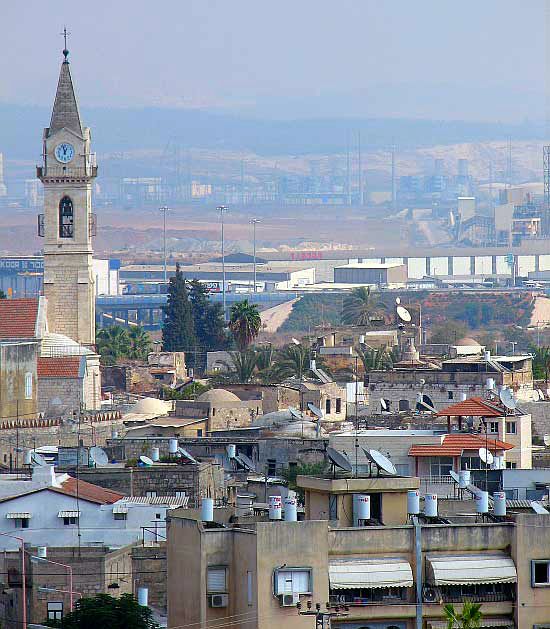
Ramla
City in IsraelWikipedia
19
MENTIONS
12
EPISODES
10
PODCASTS
Search complete. 19 mentions across 12 episodes found for "Ramla".
Oct 20, 2026

speaker_8SOUNDBITE_SPEAKER
[chanting]
speaker_7CORRESPONDENT
At the covered market in Ramla's old city, Itamar Ben-Gvir chases votes, half-hidden in a pack of security guards and fresh-faced young fans waving the giant blue flags of his far-right party, Jewish Power.
speaker_7CORRESPONDENT
[chanting] Israel's national security minister is a divisive figure in a divided country.
speaker_7CORRESPONDENT
As a teenager, he was judged too politically extreme to serve in Israel's army.

Rajini VaidyanathanHOST
So could they boost support for Israel's far right parties? Our Middle East correspondent Lucy Williamson reports.
Lucy WilliamsonCORRESPONDENT
[upbeat music] At the covered market in Ramla's old city, Itamar Ben-Gvir chases votes, half hidden in a pack of security guards and fresh faced young fans waving the giant blue flags of his far right party, Jewish Power.
Lucy WilliamsonCORRESPONDENT
Israel's National Security Minister is a divisive figure in a divided country.
Lucy WilliamsonCORRESPONDENT
As a teenager, he was judged too politically extreme to serve in Israel's army.
speaker_16UNKNOWN
[chanting]
Lucy WilliamsonCORRESPONDENT
At the covered market in Ramle's old city, Itamar Ben-Gvir chases votes half-hidden in a pack of security guards and fresh-faced young fans waving the giant blue flags of his far-right party, Jewish Power.
Lucy WilliamsonCORRESPONDENT
[chanting] Israel's National Security Minister is a divisive figure in a divided country.
Lucy WilliamsonCORRESPONDENT
As a teenager, he was judged too politically extreme to serve in Israel's army.

Ruth EglashHOST
And now we're in this stage where Ben-Gurion is kind of attacking Netanyahu from the right.
Ruth EglashHOST
And one thing that I, you know, I covered, I was out in the field last week and I covered Ben-Gurion's, you know, jaunt through the marketplace in Ramleh, Arab Israeli city.
Ruth EglashHOST
And what was interesting is that Ben-Gurion, even though he was in the government, in the government on October 7th, and he was part of the failure that allowed, you know, this disaster, this terror attack to happen.
Ruth EglashHOST
He has kind of kept himself clean.

CornHOST
He was very nice.
CornHOST
He said he had the logs, but they were in a storage unit in Ramle, and his brother had the key, and the brother was in Cyprus for the season, and he'd sort it when he got back.
DanielHOST
So at this point, there's a man in Beit Shemesh, a storage unit in Ramle, and a brother in Cyprus.
CornHOST
And a lift that's still running.
CornHOST
I ride it every day.
CornHOST
It's that the man who has the file doesn't work there anymore.
DanielHOST
Which is the finding, actually.
DanielHOST
The strong law meets the storage unit in Ramle.

Amir AviviGUEST
We really need to focus much more on what's going on inside Israel and be much, much more proactive in preventing such scenarios from happening.
Moshe DavisHOST
Okay, so General, could we connect those two issues? If there was an all-out war with the PA in Judean Samaria, what does that mean for those mixed cities like Ramla or in the Galil or in the Negev? Would Israel be facing a scenario where the Israeli Arabs somehow become partners and facilitators of what's happening in the Judean Samaria and there's like all-out war across the country?
Amir AviviGUEST
When Hamas attacked on the 7th of October, they were expecting the Israeli Arabs to rise and attack also, as it happened in Operation Guardians of the Wall.
Amir AviviGUEST
We saw an operation against Hamas, and at the same time, we saw riots in mixed cities, in the Negev, in the Galil, and so on.

Zachary FosterGUEST
And you can find that word Philistine, the Arabic translation of the English word Palestine, in y- you could probably find that, uh, a word in almost every single decade in a, published in a text or written in a text in every single decade consistently in the Arabic language over the past 1400 years.
Zachary FosterGUEST
Arabs are using that word to describe the place, uh, that today we call Palestine m- more or less continuously without any interruptions over the past 1400 years, and in particular, in the, in the city of Ramle, what is today in central Israel.
Zachary FosterGUEST
It is my argument based on multiple sources from the, uh, 11th and 12th century, from the, the 14th and 15th centuries, from the 16th, 17th, and 18th centuries, and 19th centuries, that people in that city were calling the place Palestine, uh, continuously for the past 1400 years.
Zachary FosterGUEST
Um, and that, you can find all of the evidence for that argument in chapter two of my PhD dissertation titled The Invention of Palestine.

Yosef MizrachiHOST
Why? It's a reincarnation of a wicked Jew who probably used to eat in the fast days.
Yosef MizrachiHOST
One time when they became religious, they move from Ramle to Jerusalem.
Yosef MizrachiHOST
Ramle you have some religious people, but it's not considered a religious town.
Yosef MizrachiHOST
Jerusalem, most of it is religious, most, not all.
Yosef MizrachiHOST
So they ask, [coughing] "Should we move to Jerusalem?" The answer was yes, move to Jerusalem.
Yosef MizrachiHOST
My uncle, he didn't know what to do.
Yosef MizrachiHOST
He did not know what to do.
Yosef MizrachiHOST
So, [lip smack] he decided to give the dog to his son that lives still in Ramle.

Mujamma HaraketGUEST
Yayal Sinvar, following a series of shorter occupation detentions in 1982 and an eight-month imprisonment beginning in 1985 for his activities with the predecessor formation of what became Al Majd, which targeted collaborators, was imprisoned from January 20, 1988 until October 18, 2011, again due to his leadership within Al-Majd and his efforts squelching these collaborator networks within Gaza.
Mujamma HaraketGUEST
And he spent time not only in one prison, but in Ashkelon, Ramla, Nafha, Hadarim, Beersheba prisons before his release through the Wafa al-Arhar exchange, the Gilad Shalit exchange, which served as the precedent to the Tufan al-Aqsa exchange.
Mujamma HaraketGUEST
While in the occupation's carceral system, Sinvar served as the chair for the Supreme Leadership Committee for Hamas Prisoners for two organizational terms, and he fraternized with prisoners from not only Hamas, but from myriad political factions.
Mujamma HaraketGUEST
There's a very famous photograph of him from his imprisonment where he is standing next to Marwan al-Baruti, for instance.
13 MINS LATER
Mujamma HaraketGUEST
to maintain, he said, the organic relationship between prisoner and jailer.
Mujamma HaraketGUEST
These were his words.
Mujamma HaraketGUEST
He and his comrade, the aforementioned Ruhi Mushtaha, retaliated when they were in Ramla prison by pouring hot water on the guards in response to ill treatment, and they instructed their comrades to throw soap and oil on the floor to hinder the advances of the other guards.
Mujamma HaraketGUEST
They, from within the walls of the Hadarim prison, a different prison, planned abduction or capture of occupation soldiers for exchange with Palestinian prisoners.
Amir AviviGUEST
The big danger is from the inside.
Moshe DavisHOST
And just to clarify, when you say the inside, are you referring to Judea and Samaria or even broader Israel, the mixed cities of Lod and Ramleh, the Galilee? What do you mean by the
Amir AviviGUEST
inside? I'm talking about all of Israel, from the Mediterranean Sea all the way to the Jordan Valley, or as people like to say, from the river to the sea.
Amir AviviGUEST
It includes all of Israel.
2 more episodes mention Ramla.
Create an account to see the whole feed, search across every transcript, and follow the entities you care about.