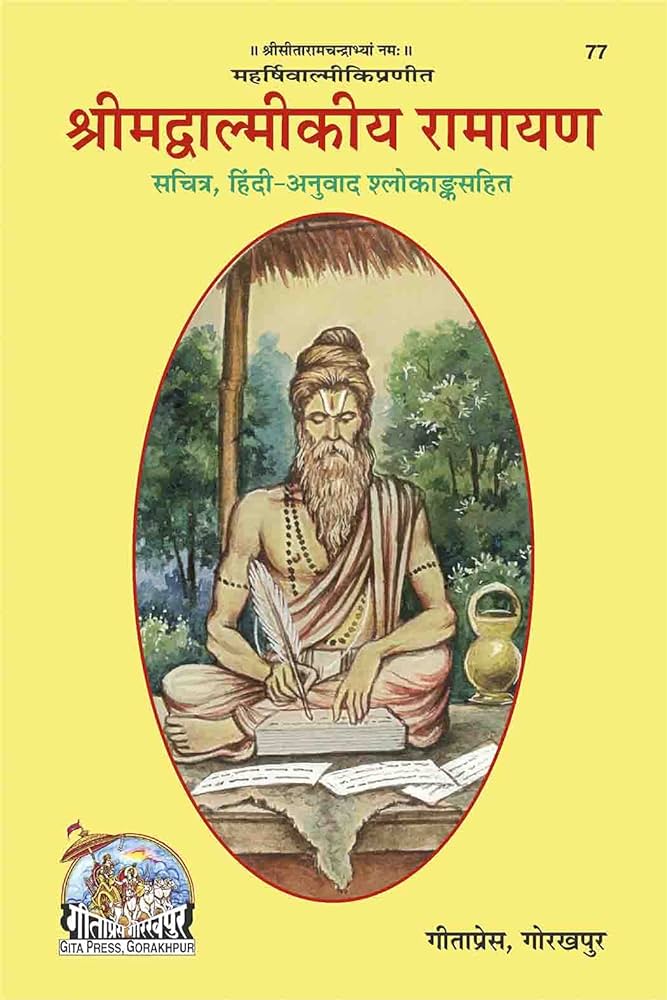
Ramayana
Book by ValmikiWikipedia
291
MENTIONS
99
EPISODES
79
PODCASTS
Search complete. 291 mentions across 99 episodes found for "Ramayana".
Sep 12, 2026

Alok PandeyHOST
So my conclusion was very simple.
Alok PandeyHOST
In Ramayana it says, I said this is too complicated to remember all these things.
Alok PandeyHOST
Already in my medical school I have read so many useless things.
Alok PandeyHOST
Now if I start remembering this WhatsApp Gyan, so I said the key is remember the divine always and when you remember the divine, You can, like Agastya Rishi took meat and when those demons who had fed him meat, they were actually demons whose meat he had eaten.

Andrew M. HenryHOST
Within Hinduism, it refers to a divine descent, when a deity manifests in a new form on earth in order to restore order, defeat evil, and protect the virtuous.
Andrew M. HenryHOST
As a quick example, Rama, the hero of the epic called the Ramayana, is understood to be an avatar of the god Vishnu in several Hindu versions of the Ramayana.
Andrew M. HenryHOST
In this story, Rama is the crown prince of the city of Ayodhya and defeats the main antagonist of the story, the multi-headed king Ravana.
Andrew M. HenryHOST
Now, Avatara is often translated as incarnation, though this sometimes leads to surface level comparisons with Jesus and the doctrine of incarnation according to Christianity.
Andrew M. HenryHOST
When he says he comes into being through my creative power, Krishna is explaining that he can spontaneously manifest in the physical world by his own divine will.
Andrew M. HenryHOST
And he does this with a purpose, in order to restore dharma, or social and cosmic order, that would otherwise collapse without his intervention.
Andrew M. HenryHOST
Generally, this means defeating some sort of antagonist that has thrown the world into chaos, like the King Ravana and the Ramayana.
Andrew M. HenryHOST
Notice that Krishna explicitly says that he's unborn and imperishable.

Mark SmithNARRATOR
Dandyakya is said to have abducted from the forest the daughter of a Brahmin named Bhargava, and being cursed by the Brahmin, was buried with his kingdom under a shower of dust.
Mark SmithNARRATOR
The place was called after his name the Dandyakya forest, celebrated in the Ramayana, but now unknown.
Mark SmithNARRATOR
Ahalya was the wife of the sage Gautama.
Mark SmithNARRATOR
Indra caused her to believe that he was Gautama, and thus enjoyed her.
Mark SmithNARRATOR
Kichaka was killed by Bhima, who assumed the disguise of Draupadi.
Mark SmithNARRATOR
For this story the Mahabharata should be referred to.
Mark SmithNARRATOR
The story of Ravana is told in the Ramayana, which with the Mahabharata form the two great epic poems of the Hindus.
Mark SmithNARRATOR
The latter was written by Vaisya, and the former by Valmiki.

Jyoti TharavanathNARRATOR
Vishnu at once cut off the head of the venturous devil, and as the amrit drink had rendered him immortal, the head and tail retained their separate life and were placed in the stellar sky.
Jyoti TharavanathNARRATOR
rahu therefore still mindful of the injury done him by the sun's interference loses no opportunity of enclosing his ancient enemy in his jaws nineteen can a golden deer c An allusion to an episode in the great poem of the Ramayana, Manisha takes the form of a golden river in pursuing which Rama is led away insensibly from his abode and Ramana comes as a beggar and carries off Sita in his absence.
Jyoti TharavanathNARRATOR
20.
Jyoti TharavanathNARRATOR
The Three Wide Worlds Heaven, Earth and the Lower Regions twenty one the king of the mice the mouse as vehicle of ganesha is an important animal in hindu legend twenty two sickness anguish bens and woe spring from wrongs wrought long ago by this theory of a series of existences continued until the balance is just and the soul has purified itself the hindu accounts for the origin of evil every fault must have its expectation and every higher faculty its development pain and misery being signs of and ordeals in the trial which is to end in the happy reabsorption of the emancipated spirit twenty three champak grove the champak is a bushy deciduous tree bearing a profusion of white star-like blossoms with golden centre and of the most pleasing perfume twenty four fig tree sanskrit parkti a large handsome tree with leaves curiously weaved 25.

Anusha IyerNARRATOR
Preface.
Anusha IyerNARRATOR
The stories of this book are, for the most part, drawn from the two great Indian epics, the Ramayana and the Mahabharata.
Anusha IyerNARRATOR
I have tried to tell them simply, and to this end have rigidly kept down the number of proper names, as experience tells me that the popularity of Hawthorne's stories from the Greek classics is largely due to this characteristic.
Anusha IyerNARRATOR
It is also out of consideration for the youth of my readers that I have omitted accents which mean less than nothing to most of them, and have simplified the proper names as much as possible.

Swami SwaroopanandaHOST
Kumbhakarnās.
Swami SwaroopanandaHOST
In Ramayana, you have Ravana's brother Kumbhakarna, who only gets up to eat and then goes back to sleep.
Swami SwaroopanandaHOST
So na ca, na ca ati swapnaśīlasya jāgrata na evaca.
Swami SwaroopanandaHOST
What? What is not there? Yogaḥ is not there for such a person.
Alok PandeyHOST
So these are the Shrutis, and then we have Smritis, Smriti Puranas are Smriti, and then we have the Itihas.
Alok PandeyHOST
Itihas is Ramayana and Mahabharata.
Alok PandeyHOST
Primarily, why they are Itihas? They are history, but what kind of history? It's history that repeats itself.
Alok PandeyHOST
So even today we can understand any conflict.
Alok PandeyHOST
If we really understand Ramayana and Mahabharata in its essence, any conflict we'll understand.
Alok PandeyHOST
The entire Second World War, Sri Aurobindo explains one of them is on the basis of the Mahabharata.
Alok PandeyHOST
Because the disciple says, but you see people who are fighting for the allies, they are also bad guys.
Alok PandeyHOST
But the goal, the purpose for which a group or civilization is fighting, that's what is important.

Anusha IyerNARRATOR
Preface.
Anusha IyerNARRATOR
The stories of this book are, for the most part, drawn from the two great Indian epics, The Ramayana and The Mahabharat.
Anusha IyerNARRATOR
I have tried to tell them simply, and to this end have rigidly kept down the number of proper names, as experience tells me that the popularity of Hawthorne's stories from the Greek classics is largely due to this characteristic.
Anusha IyerNARRATOR
It is also out of consideration for the youth of my readers that I have omitted accents which mean less than nothing to most of them, and have simplified the proper names as much as possible.

Radhe JaggiGUEST
This is how we kind of were introduced to it.
Radhe JaggiGUEST
So you would read Mahabharata and Ramayana.
Radhe JaggiGUEST
all in this short form.
Radhe JaggiGUEST
So each comic would cover one story.
89 more episodes mention Ramayana.
Create an account to see the whole feed, search across every transcript, and follow the entities you care about.