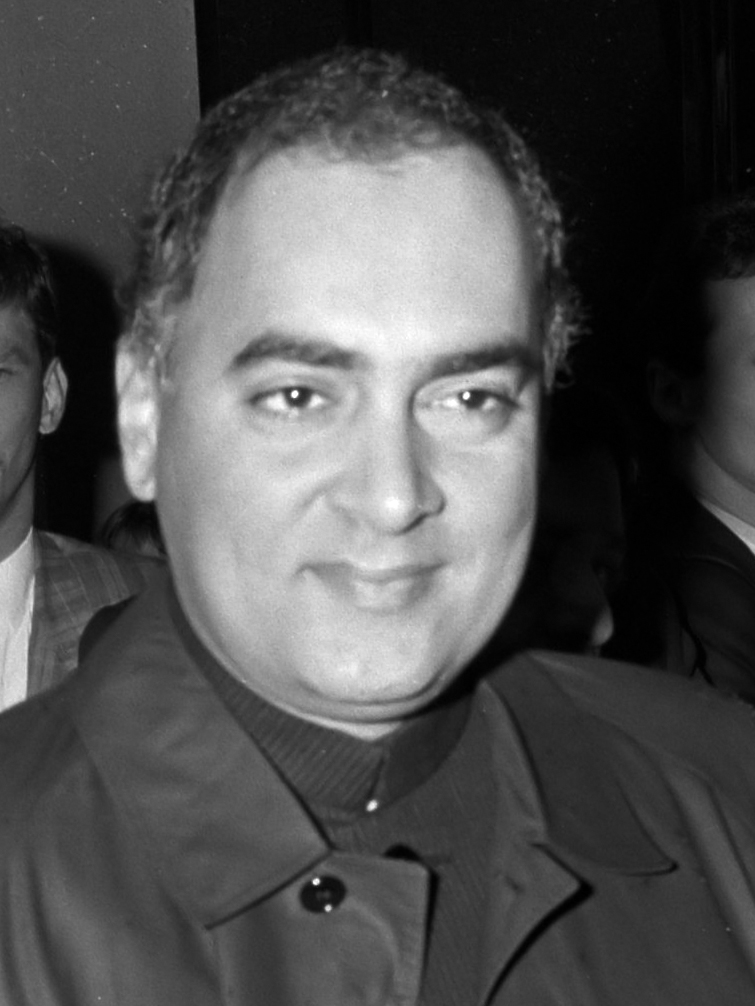
Rajiv Gandhi
Aircraft pilot and former Prime Minister of IndiaWikipedia
25
MENTIONS
7
EPISODES
5
PODCASTS
Search complete. 25 mentions across 7 episodes found for "Rajiv Gandhi".
Oct 5, 2026

Shekhar GuptaHOST
Before that, let me raise an eternal question, or let me remind you of an eternal question.
Shekhar GuptaHOST
Is India a soft state chronically suffering from that Gandhian offer-the-other-cheek brainwash, or is it among the hardest post-colonial democracies only cynically invoking the Gandhian pretense when convenient? My view, obviously, is the latter.
Shekhar GuptaHOST
Mahatma Gandhi's birth anniversary when this column was written gives us a moment to lean back and examine the widespread belief that cuts across party lines.
Shekhar GuptaHOST
All parties have argued at various points of time that India is a soft state and has conceded too much to the enemies outside and within.
Shekhar GuptaHOST
If only we had followed Sardar Patel, Netaji, Savarkar, we would have been a harder state.
Shekhar GuptaHOST
The overwhelming Gandhian indoctrination, this argument goes, was worsened by Nehru's pacifist internationalism.
Shekhar GuptaHOST
This thrived under most governments that followed.
Shekhar GuptaHOST
It continues even now with Donald Trump's humiliations going unanswered and unilateral outreach to repair Chi- ties with China at the cost of a dollar hundred twen- twelve billion trade deficit and no de-escalation even following the disengagement at LAC.

Vinamre KasanaaHOST
unfortunate.
Vinamre KasanaaHOST
You're talking about Rajiv Gandhi or Rahul Gandhi? I'm talking about
Yashovardhan AzadGUEST
Rajiv Gandhi.
Yashovardhan AzadGUEST
It's unfortunate that we lost a man like Rajiv Gandhi.
Yashovardhan AzadGUEST
He was a harbinger of technology.
Yashovardhan AzadGUEST
He talked about automation.

Linda FreemanGUEST
Canada's involvement in the struggle to end apartheid was linked primarily but not exclusively through the Commonwealth.
Linda FreemanGUEST
And under the active involvement of Prime Minister Brian Mulroney, there had been previous efforts of one kind or another, soft sort of sporting sanctions and things like that, but it wasn't until Mulroney came to power and then in the mid-'80s got together with several other Commonwealth leaders like Rajiv Gandhi of India, Bob Hawke of Australia, President Kounda of Zambia, President Mugabe of Zimbabwe, that they really began to focus on concrete sanctions, and this was entirely new.
Linda FreemanGUEST
Ironically, Trudeau is often thought as the internationalist, indeed believe in the importance of ending apartheid, but did almost nothing.
Linda FreemanGUEST
The action was really in the mid-80s from the Conservative government.
Shekhar GuptaHOST
So Narsimha Rao also wanted to clip his wings, and that's how these two were brought in.
Shekhar GuptaHOST
But even before that, Rajiv Gandhi, in his last weeks, had also tried to expand the Election Commission, and the Election Commission at that point, one member, R.V.S. Parashastri, he was the Chief Election Commissioner, the only one.
Shekhar GuptaHOST
Rajiv Gandhi, towards the end of his term, had added S.S. Dhanoa and V.S. Sehgal as members.
Shekhar GuptaHOST
But new government came in after the elections on January one, nineteen ninety, by a presidential notification.
Shekhar GuptaHOST
This was again restored to a b- one member commission.

Srikrishna IyengarGUEST
I mean, I teach Indian politics and policy, you know, and I do try to draw a narrative that makes sense.
Srikrishna IyengarGUEST
I mean, why did we shift from, uh, planning in the '50s and '60s to, uh, sort of Indira Gandhi? And then why did we lurch in a different direction under Rajiv Gandhi in modernization? And then why do we lurch towards a thing? But it's a combination of many...
Srikrishna IyengarGUEST
I mean, you know, uh, many countries didn't...
Srikrishna IyengarGUEST
It, it's not an exceptional story.
1 HR 35 MINS LATER
Amit VarmaHOST
Like what did, what aspects of the previous framework, the ideational framework, did not fit the Indian populists you looked at? And then how did you eventually go deeper and, you know, arrive at this?
Srikrishna IyengarGUEST
I, for one, the one clear sort of reason is that I, you know, which I think I wrote in an earlier paper, was that I don't think we have such a, how do you call, antagonistic relationship with populists.
Srikrishna IyengarGUEST
I mean, in India, I, I mean, in, even in that first book actually, Mahatma Gandhi, the Earls, you know, Mahatma Gandhi is one of the first populists in our country.
Srikrishna IyengarGUEST
So I think over time, because they have widened and deepened political participation against elite.

Malcolm NanceHOST
I taught a course on the history of terrorism.
Malcolm NanceHOST
And some of the biggest people who were killed by terrorists, Rajiv Gandhi, Indira Gandhi, the Indians, I use as an example, all killed by like Indira Gandhi was killed by her two most trusted bodyguards.
Malcolm NanceHOST
They were Sikhs and they had authorized weapons.
Malcolm NanceHOST
They were protecting her.
Shekhar GuptaHOST
That's why Xi has taken a time out on the border with India.
Shekhar GuptaHOST
In nineteen eighty-eight, Deng Xiaoping had famously told Rajiv Gandhi in Beijing that since our generation probably don't have the wisdom to resolve the border issue, let's leave it to a wiser generation in the future.
Shekhar GuptaHOST
For Xi, that future of a wiser generation hasn't arrived yet.
Shekhar GuptaHOST
He'd rather buy more time until the gap between China and India widens further, in his view, and China's negotiating position on the border becomes even stronger.