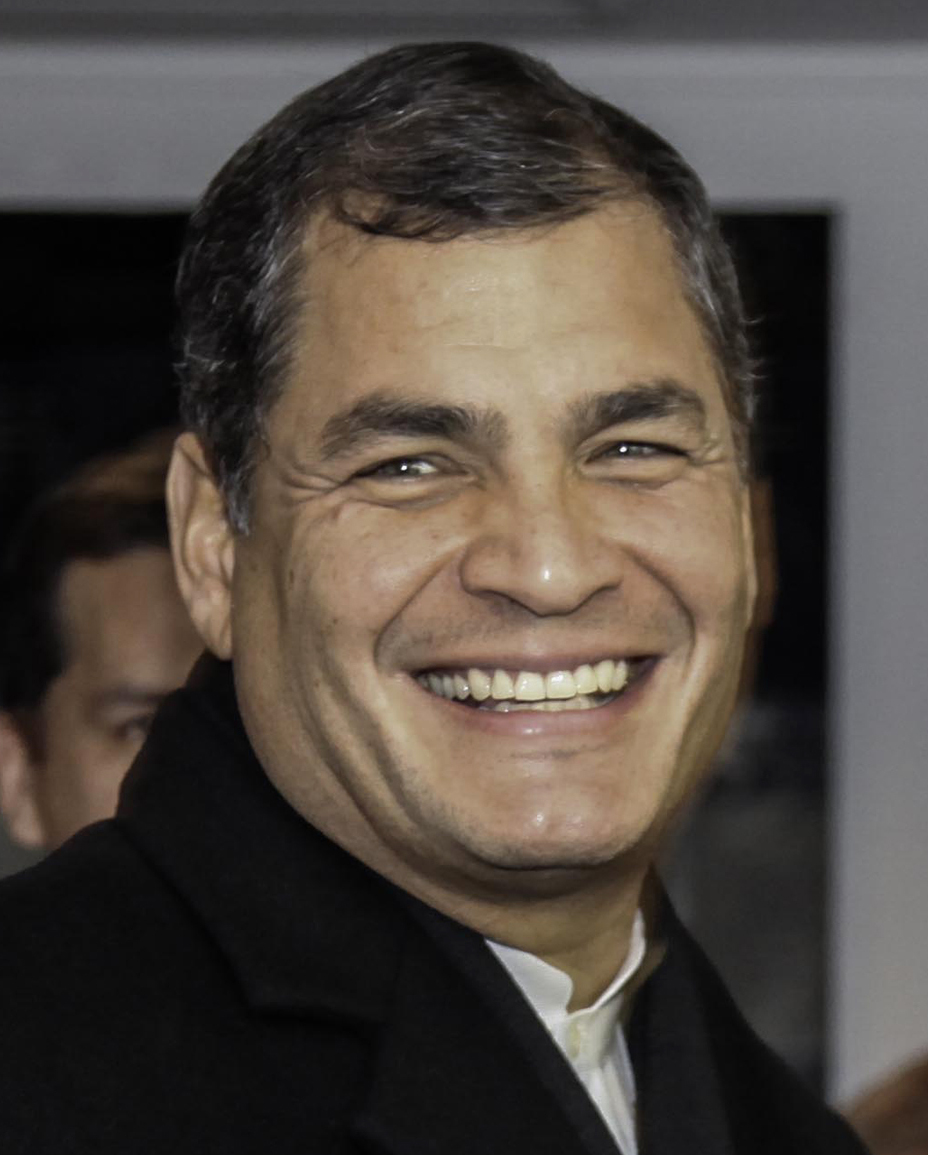
Rafael Correa
Ecuadorian PoliticianWikipedia
24
MENTIONS
14
EPISODES
13
PODCASTS
Search complete. 24 mentions across 14 episodes found for "Rafael Correa".
Sep 25, 2026

Glenn GreenwaldHOST
And then, you know, I was talking to his wife, Stella, a lot.
Glenn GreenwaldHOST
hearing from julian as well you know we've talked a lot over the years and then when he went to belmarsh prison was called like guantanamo uh the british guantanamo because of its treatment and their their tendency to put the worst people on their terrorists and whatever i just i couldn't believe it and he just sat there for for years and by the way it was because the trump administration indicted him and so and then bullied ecuador out of into uh pulling out his his uh And let me just quickly insert, last month, this is one of the things I traveled for, last month in Sao Paulo in Brazil, the 10-year president of Ecuador, Rafael Correa, was in Sao Paulo.
Glenn GreenwaldHOST
He has a show on RT in Spanish and Portuguese.
Glenn GreenwaldHOST
He invited me to be interviewed by him.
Glenn GreenwaldHOST
I had other things I had to do that day anyway, and I'll always travel for Rafael Correa because I have a lot of respect for him.
Glenn GreenwaldHOST
So I went, we talked, and we did this interview.
Glenn GreenwaldHOST
It just came out this week.
Glenn GreenwaldHOST
And Rafael Correa, president of this tiny little country in Ecuador, stood up to the United States and to the UK and then ultimately to Spain because Spain hated Julian Assange because he was advocating for the separatist movement of Basque separatists while in the embassy and they were complaining to the UK that he was being allowed to do this.

Julie ShawNARRATOR
The former official, Jose Serrano, is being held in a maximum security prison in Ecuador where he was told that video of him stripped naked would be shared with the Ecuadorian president, Daniel Noboa, according to his lawyers.
Julie ShawNARRATOR
Ecuadorian officials have denied that Mr. Serrano, charged with orchestrating the 2023 assassination of a presidential candidate, had been mistreated.
Julie ShawNARRATOR
Mr. Neboa, a crucial ally in President Trump's crackdown on drug trafficking, seemed to take credit on social media for Mr. Serrano's August 28th deportation almost in real time.
Julie ShawNARRATOR
We said it, we did it, Mr. Neboa boasted in Spanish on social media just 15 minutes after records show U.S. officials had placed Mr. Serrano on a small charter plane bound for Ecuador.
8 MINS LATER
Julie ShawNARRATOR
From the United States, Mr. Serrano remained active on social media, frequently commenting on Ecuador's worsening drug cartel-related security problems and criticizing Mr. Neboa.
Julie ShawNARRATOR
His asylum case moved slowly through U.S. immigration courts, where a backlog of claims grew sharply during the Biden administration.
Julie ShawNARRATOR
Back in Ecuador, prosecutors were building a criminal case against Mr. Serrano, saying he had planned from afar the 2023 assassination of the presidential candidate Fernando Villavicencio, who was gunned down in Quito.
Julie ShawNARRATOR
Mr. Villavicencio had been a muckraking journalist helping to expose a bribery scandal that led to the conviction of Mr. Correa.

Kurt HackbarthHOST
I
José Luis Granados CejaHOST
remember Rafael Correa used to always say the part I hate most about politics is this, is the candidate selection.
José Luis Granados CejaHOST
Candidate selection.
José Luis Granados CejaHOST
Because people start trading favors, asking, charging back the things, the alliances, right? Yeah.

Camila Lourdes GalarzaGUEST
we saw the assassination of Fernando Villavicencio, what we now know was an FBI and DEA informant turned presidential candidate.
Camila Lourdes GalarzaGUEST
When he was gunned down, chats that were obtained by the drop site actually showed that the attorney general at that time had been cozy with the U.S. ambassador in Ecuador and that she was trying to orchestrate pinning this assassination on on the Revolucion Ciudadana Party, the party of the former left-wing President Rafael Correa, who took a very strong opposition to U.S. military presence.
Camila Lourdes GalarzaGUEST
He actually expelled all of the U.S. military bases in Ecuador explicitly because the U.S. had on the record at the U.N., proudly and unashamedly, said that they were in fact sinking civilian fishing ships off the coast of Manta.
Camila Lourdes GalarzaGUEST
And so, you know, this is the context for which now we see a lot of political lawfare, not just against functionaries of the government, which they have.

Frances MartelGUEST
And Ecuador has had a pretty fierce battle against organized drug trafficking gangs that are aligned with leftists that previously ran the country.
Frances MartelGUEST
And so, you know, he was there and he was also trying, he made comments that I think were really important about explaining how because Ecuador was run by a far-left radical government for so long under Rafael Correa, that directly led to the gang problem and the drug problem, that this isn't, that those are related.
Frances MartelGUEST
It's not a coincidence that whenever you have you know, a pro-crime leftist socialist government that you have this eruption of organized violence.
Frances MartelGUEST
So I think that was the objective.

Evan EllisGUEST
And just a reminder of the political tumult and perceived corruption.
Evan EllisGUEST
That eventually led to, in 2005, Rafael Correa, the populist anti-U.S. president taking power.
Evan EllisGUEST
And so that, you know, essentially closing of that chapter is also a reminder of some of the persistent problems in Ecuador with public corruption and frustration with the performance of the democratic political system.
Evan EllisGUEST
which even now, if Daniel Noboa does not produce results, a reminder that some of the same things that led to political tumult and change back in the 1990s could once again limit the ability of pro-U.S. governments such as the current one to continue in power and supporting the United States.

Wagner MouraGUEST
Bolsonaro and Trump, they are also a response to a very liberal moment that we lived in a state, in the United States, in a way, under Obama, but especially in Brazil and in the whole South America with Lula in Brazil or...
Wagner MouraGUEST
Rafael Correa in Ecuador, Evo Morales in Bolivia.
Wagner MouraGUEST
So all these, we are living a conservative backlash of a progressive moment that the world, especially South America, lived.
Wagner MouraGUEST
And I could say the same about what we're going through now.

John PerkinsGUEST
Yeah, he's out now.
John PerkinsGUEST
But, you know, one of the dilemmas is I was – I got to know very well the president of Ecuador for 10 years, Rafael Correa, who now lives in Belgium.
John PerkinsGUEST
He's married to a Belgian woman.
John PerkinsGUEST
How old is he?

Carlos MartinezGUEST
And when it was brought down by a CIA-sponsored coup, then many of the fighters, the defenders of that process in Chile, found refuge in Cuba.
Carlos MartinezGUEST
The Cubans later embraced Chavismo, they later embraced Lula and the Workers' Party's progressive governance in Brazil, Evo Morales in Bolivia, Rafael Correa in Ecuador, and they considered them not as a betrayal of some kind of deeply held revolutionary principles that you have to come to socialism by following a particular path, but as a continuation of a global path towards socialism, which will have many different tributaries running alongside it, but which will run ultimately in the same direction.
Radhika DesaiHOST
Yeah, that's so important to recall, I think, as well.
Radhika DesaiHOST
This is part of the internationalism, but also, I think, part of Fida's very deep understanding of the worldwide progress, shall we say, of socialism.

Alejandro WernerGUEST
And then the last wave that is the most recent one that is currently ending that started in the early 2000s on the back of huge income windfalls from commodity prices.
Alejandro WernerGUEST
And that was mostly left wing populist governments, Nicolás Maduro, the Kirchners in Argentina and Rafael Correa in Ecuador are some of these regimes.
Tim PhillipsHOST
So we have a pretty large data set here, but there have been populists all over the world in recent years.
Tim PhillipsHOST
Is there something distinctive about the policy priorities of Latin American populist leaders?
16 MINS LATER
Tim PhillipsHOST
Can we say anything consistently about what happens to inflation?
Alejandro WernerGUEST
Well, nothing is consistent in social sciences and nothing is consistent with populist regimes because they also inherit some institutions or de facto institutions based on legal institutions that are very hard to break.
Alejandro WernerGUEST
For example, Rafael Correa in Ecuador, he was a populist leader.
Alejandro WernerGUEST
However, Ecuador was a dollarized economy and dollarization was ingrained in society and was very popular.
4 more episodes mention Rafael Correa.
Create an account to see the whole feed, search across every transcript, and follow the entities you care about.