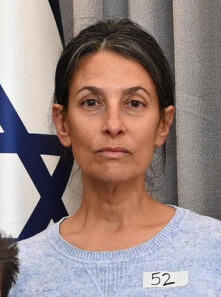
Rachel Goldberg-Polin
American-Israeli activist
36
APPEARANCES
24
PODCASTS
Sep 6, 2026


14:32
It has to be from a kosher animal and hollow, but we don't use a bull or a cow.
14:39
And the shofar has three specific sounds, four if we're being sticklers, 'cause one of the sounds is elongated at the end, and so it becomes...
10 MINS LATER

Elliot CosgroveHOST
So I'm just wondering if you could speak to what time, the passage of time means for And the passage of time perhaps doesn't mean in the context of having lost a son.
22:26
So it's this confusing sort of oxymoronic existence of I'm feeling starving, starving for Hirsch.
10 MINS LATER
Elliot CosgroveHOST
I think every rabbi that I know of at some point invoked Hirsch and you and your family at that


Anderson CooperCORRESPONDENT
When we met her earlier this year, Rachel Goldberg-Polin told us that now, like so many others, she's trying to figure out how to live after her child has died.
16:19
To know that your child is being tortured, tormented, starved, abused, is maimed, and that's an excruciating form of suffering.
16:33
And then what's so fascinating to me is that when they came to tell us that Hersh had been executed, then I realized that those three hundred and thirty days had been the good part because he was alive.
9 MINS LATER
25:42
Yeah, and I said, "He heard on the news I had spoken to the Secretary of State" and he said, "No, he heard you on the news." And it was like all the sudden, thank God.


16:48
I always had this idea that my mother sort of shared with me when I was really, really little, that there is this very big force that has created everything that's driving the bus, and we're not gonna always understand everything.
17:12
And my mother had a lot of hardship in her life when she was younger.
17:18
My grandmother, her mother, also had a lot of challenging hands dealt to her.
34 MINS LATER

18:27
And the overwhelming tone of 10 out of the 12 spies is complete fear.
23 MINS LATER

Dan SenorHOST
There are these other days, but yet it does feel like all those other days are subordinated to Tisha B'Av.
24:55
And the loss of an easy button for connection, as your, your son's teacher was saying.
25:01
And so what's interesting is that the question is asked in another Gemara, in another part of the Talmud.
25:08
It's asked, "Well, why did this happen?" Because what happened, Babylonia, led by Nebuchadnezzar, comes in and conquers Jerusalem, destroys the temple.
25:22
There's always some debates with dates, but we're gonna say it's around that time.
25:26
And the question is asked, why? Why did this happen to us? And the Talmud explains, well, honestly, starting at the very top down, we had horrific corruption and horrific immorality from the kings, the nobles, the judges, the priests, the Kohanim, the people who were running the temple were being corrupt.
16 MINS LATER
Gabe SilversteinADVERTISER
There are these other days, but yet there, it does feel like all those other days are subordinated to Tisha B'Av.


David IngberHOST
And so can you give us some Hershey tonight, some of your precious cookie, as you called it?
35:32
I think one of the things that is so wonderful about Hirsch is that he was completely ordinary.
35:53
And as every mother in this room or anyone who's ever had a mother, Who's in this room? That's my way of saying everybody.
36:12
That's part of what's so glorious about being human is that I think that we are in love with each other.
22 MINS LATER
David IngberHOST
Can you talk about how you came to be given the light and the sense that you could frame the after with if you have a why to live for? Where does that come from?


Caroline MarcusHOST
I spoke to Rachel Goldberg-Pollen for her first Australian interview about the book and began by asking her about why she felt called to write
28:20
It's such a reasonable question, and it doesn't have a really tidy, compact answer.
28:34
My soul was buckling from the pain of so much love that was waiting for Hirsch to come home alive, that I had been sort of compartmentalizing for the 330-day struggle of us trying to get him and these other hostages home.
28:53
And then to have this absolutely unimaginable heartbreak that He was coming home actually in a bag after being executed.
29:10
It was choking me, the grief and the mourning and the pain and the loss and the suffering, which anyone goes through.
Caroline MarcusHOST
How important was it for you to find out that he would have known how hard you and his father fought for him?

30:50
Innocent is, is innocent, you know, and there's no competition of whose tears are the saltiest.
31:00
When we have these conflicts and we don't use any sort of profound creativity, all we do is cause more suffering to everybody, and it seems so obvious to us.
31:12
But we were steeled walking out onto that stage with 25,000 people in the arena that evening at the DNC.
7 MINS LATER

David RemnickHOST
Why do you remain where you are? What's the nature of your commitment to living where you are?

6:53
And so talking about him, and showing pictures of him, and talking directly to him publicly, was trying to get people to care, to care enough to galvanize them to actually take action and do something.
7:10
And, um, when Hersh was murdered and our quest to get him home alive was over, we still had over 100 hostages who were being held.
7:26
And after the traditional Jewish, uh, mourning period, Jon and I said, "Well, we have still over 100 people who are there, and we have work to do." Until more than 500 days later, when the final hostage came home on day 843.
7:47
Then there was this scaffolding, the emotional, loving scaffolding that so many millions of people around the world had given to all of us hostage families, continued, and is still needed.
8:06
You know, when people make the mistake and say, "You've, you went through so much," we think, "No, no. We're still here.
32 MINS LATER


Marco WermanHOST
Rachel, would you mind just touching on the main points of Hirsch's abduction on October 7th, 2023? What happened? Remind us where he was.
33:46
So Hirsch had gone to the Nova Music Festival, which was advertised as being for love, unity, and peace.
33:56
He and his best friend Aneur went together and the music festival came under attack.
34:06
Pershing on air ran into a bomb shelter that was five feet by eight feet with 27 other young people who were these like crunchy granola kind of music lover people.
Marco WermanHOST
If I may ask, Rachel, how do you carry the knowledge of the way Hirsch perished?

Aviva KlompasHOST
Hir- Hirsh's fate was sealed, and there was nothing that anybody could have done.
15:38
So I think that my only issue is I try to be very careful that it's not giving anyone a pass, meaning we still have to do everything we can in this life that is right and is justice and is the elusive truth that is getting, you know, less and less popular and less and less tangible and less and less recognizable as every single moment passes in our current reality.
16:10
We still have to do every single thing and work extremely hard, and, you know, we're not B'nei Chorin, L'chiva, Tell me, Mena.
16:21
Like, you know, when, when Rabbi Tarfon says, "Yes, the world is this massive, murky, sticky, confusing, filled with, with challenge place, that doesn't mean you can't do your part.
13 MINS LATER
Aviva KlompasHOST
So I don't know if that's the word inspiring, but you're sh-certainly showing us how to move through something that most of us would think would just incapacitate us.


20:04
It really sort of starts the night before, because on the evening of Friday, October 6th, Hersh and my daughters and Jon and I all walked to synagogue together.
20:15
We're a family that goes to synagogue both Friday night and Shabbat Saturday morning.
20:19
And Hersh had said to us, after we go to synagogue, and we were going to friends for Shabbat dinner, he said, "Aner and I are gonna go do something fun." Aner Shapira was Hersh's best friend.
18 MINS LATER


Jake TapperHOST
It nestles and entangles itself in for the long haul." How are you doing now? How, after writing this book and putting it all out there?
29:04
It's a really reasonable, innocuous question to ask how, how anyone's doing or how I'm doing.
29:12
I always have this very unfortunate sort of reflex of I don't know how to answer this very simple, kind, normal, civilized question.
29:26
There are millions of people all over the world who have buried their children.
29:30
Um, but there is something that when you put part of your DNA into the ground, I think it actually changes who you are in this world.
6 MINS LATER

Dana TaylorHOST
Where is the world?" What should the world know about what those 330 days did to a person and did to a family?
8:22
Well, I think what's important, when we were speaking at the UN, originally the hostage cohort of those 251 who were taken on October 7th, there were already four being held in Gaza before that, that they comprised more than 30 different nationalities.
8:52
And for us, what it did, I think honestly, I think the world was looking at this as, I'll just speak for myself, you know, they would look at Hersh and think, "This is one boy in the whole wide world." And of course, we were looking at it as this is the whole wide world in one boy, and that is what each family felt, as they should.
Dana TaylorHOST
What has it been like being a vessel for the pain of others while carrying your own?


Noam WeissmanHOST
And I wanna know from your perspective writing it, did it feel like a spiritual experience writing it for you?
8:21
So first, I just want to thank every single person in this room for carving out the time to be here with, with us, with all of us, all of us together.
8:34
Um, I would love to say that it felt really spiritual to write this book, because I think that would sound extremely cool.
8:45
But really, what this book was, was intense suffering that I couldn't do very well anymore, and it was just taking out wrapping paper and putting packages of pain and wrapping them up a- and putting them to the side.
9:07
The writing came fast and furious because there was so much surplus of agony and angst and misery and loss and grief and love, and I didn't know what to do with all of that.
9:25
And thankfully, Jon said, "You need to start to write." And when it, when you have so much, when...
45 MINS LATER


Bianna GolodrygaHOST
And so my question is: how did you decide to come about writing a book that's not a memoir, that's not specifically about Hersh, it's not specifically about October 7th? It weaves together your story, your childhood, your family life, some quite frightening premonitions, and also introduces us to your beautiful son.
17:07
So the real origin of this was simply that my soul was buckling from the weight of the pain of this loss that is very, um, universal.
17:27
All of us are going to suffer loss and suffering and grief and mourning at different points in our lives.
17:35
This is part of the hu- human enterprise when we come to this, this world, this strange, mysterious, messy place that's also full of beautiful joy and blessing, and there are going to be points that are challenging for all of us.
17:54
And I was having real-Um, a real crisis of shouldering the weight of this loss of my only son, Hersh, and it started to pour out in these packages of words.
18:14
And I thought actually this morning about how effective giving over our words can be in alleviating tremendous suffering.
18:26
And my husband, Jon, said, "Start writing it," because he saw I was actually drowning.
Bianna GolodrygaHOST
Are you still wearing a costume right now? And, and how exhausting was that, having to put on that invisible costume for the outside world?

Shaun LeyHOST
In When We See You Again, just published in the United States and elsewhere, Rachel has attempted to put into words what the last two and a half years have been like for Hersh's family.
34:23
In many ways, I realized that those 330 days, Hersh was killed on day 328 of his captivity, but we didn't know about it until, until day 330.
34:35
So we had this sort of container of 330 days of this arduous, purgatory-esque intermission of falling through the sky trying to save him.
34:51
And in doing so, we spoke to everyone that we possibly could, including you and your listeners.
34:58
And on the one hand, that was an exceptionally strange brand of torment, torture, anxiety, misery, and on the other hand, it gave us an opportunity to share Hersh.
35:13
And so now in this after, unlike many people who lose children, we had the blessing of people got to know Hersh for those 330 days.
35:26
That is unusual because normally when a child is lost, you don't have a precursor to get everyone around you to know them, and that again is that dissonance that pronounces the pain so much more intensely.


44:04
But I'll say that he made it easy because number one, it was in Hebrew, which is really still hard for me to read, to understand.
44:14
But number two is his handwriting was atrocious, so even if I read Hebrew, I couldn't read his Hebrew.
44:22
So but I thought, here he had written three entries, and then the rest of the journal was empty.
44:28
And I thought, "I don't know what he's saying here, but I'm not throwing out his words." So I tore out the entries, the three entries, folded them up, and I put them in an envelope in my closet that said in English, private, and I put it in the back left corner of my closet.
15 MINS LATER

5:08

But yeah, I wanted to hear from you when and how or however you want to answer that.
5:18
They are hostages, former hostages, human beings who endured, um, really indescribable challenges.
38 MINS LATER


Hugh HewittHOST
Orri calls you and says, "Come see me in the hospital." Do you wanna tell people why?
55:27
Hersh, for people who, who may not know, was at a music festival that had been advertised for love, unity, and peace.
55:38
And, um, on that morning of October seventh, at that music festival, uh, terrorists descended upon the festival, and the young people who were there were hiding in all sorts of places.
55:52
Hersh was in a, in a bomb shelter where there were twenty-eight young people smashed into a five foot by eight foot shelter.
56:01
So that's-- think of a small bathroom, and there are twenty-eight people smashed in.
56:06
The terrorists ended up throwing in hand grenades and then spraying the room with machine gun fire.
Hugh HewittHOST
But I-I don't know that the joy is the right word, but, uh, meaning comes from that, certainly.

Jon Goldberg-PolinGUEST
It's deep longing to smiling as I remember something as simple as sitting on the couch and talking to him, but it's always there.
2:46
I really start my day, the first words out of my mouth are to him while I'm still in bed, before I start my morning prayers, and there's a lot of dialogue throughout the day, and he's very present, and his presence is really a comfort, and it's a reminder of this delicious blessing of having had him.
3:14
I don't associate him with the sadness, but then there's this longing.
3:22
Like, I am thirsty for him, and this craving that I think intensifies.
3:30
There are people who say, "Well, if you're still grieving after X amount of time, then you have a disorder." Yes, I do, and I'm really proud of it, and I thought the etymology of disorder, dis from the Latin means opposite.
29 MINS LATER

12:01

"The set design of how things unfold for each of us varies, but loss is loss, so your suffering is like mine." And when I read that I thought-That's a very human gesture to say that to the reader, but surely it can't be true that your experience is so unlike that of people, even those people who have experienced tremendous grief and loss in their life that surely they can't see blue the way you saw blue
12:27
I think that what led to the day that we had the angels of death come to our door to tell us that Hersh had been executed is same, same.
12:39
I think what was different for us was the three hundred and thirty days before, and we were on this very circuitous rabbit hole of journeying along with two hundred and fifty other families.
13:05
You know, we call them the beautiful six, Ori, Alex, Almog, Eden, and Carmel, and Hersh.
13:11
Um, the truth is, they're the only five entities on this planet who have any idea of what we actually felt and feel, but loss is actually loss.
13:28
I really have understood that, and I don't think it's a competition of tears or misery.
6 MINS LATER

Yonit LeviHOST
I mean, obviously, for, for English speakers, we should also say, and you say this in the book, that Or actually means light, so that is in his name really.
20:23
So after the Seder on the first night of Passover, and it was horrible.
20:31
It was a horrific Seder where we did the bare bones minimum with the most loving, compassionate, caring, merciful people you've ever met in your life.
20:40
And still it was like my skin was being burned off of me and John and our girls and everyone at the table was weeping and We were in agony.
20:58
And we always had our phones with us from when Hirsch was stolen until he was killed.
8 MINS LATER
Dan SenorHOST
I will be forever sorry we failed him, but he knew we were trying." What did he know?
29:30
So on the evening of four ninety-six is when we met the tremendously benevolent Or Levy, who was released from captivity on day four ninety-one and found out his wife Einav had been killed in that bomb shelter, and he was finally being reunited with his young son.
29:48
And yet his brother, Michael, had become friends with us through this journey of trying to get them free.
29:56
And Michael called John right after Shabbat on day four ninety-one and said, "I just have to tell you that it's very strange." Or came home, you know, we're like reuniting.
30:14
And he asked us how Hersh is.And we were thinking, they didn't know each other.
speaker_2ADVERTISER
My first question is, what do you mean by that?
Scroll for more appearances