Quiet Revolution
14
MENTIONS
10
EPISODES
10
PODCASTS
Search complete. 14 mentions across 10 episodes found for "Quiet Revolution".
Nov 17, 2026

E. Michael JonesGUEST
So what I'm saying, the rule is every civil war leads to a, I'm sorry, every revolution leads to a civil war.
E. Michael JonesGUEST
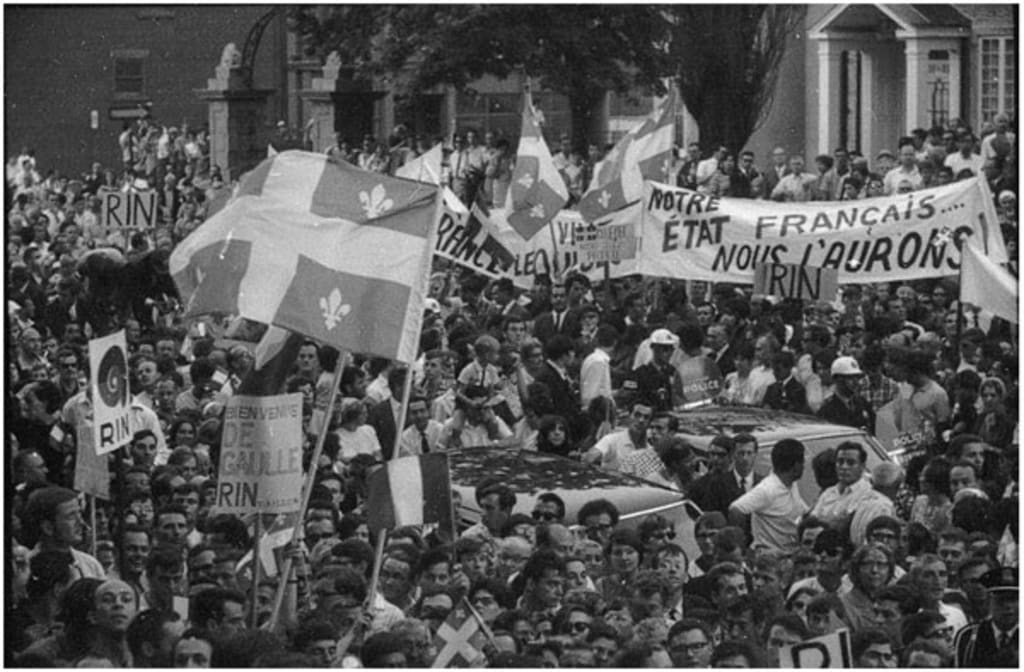
So the successful revolution in France is called, I'm sorry, in Quebec, it's called the Quiet Revolution.
E. Michael JonesGUEST
They called it La Lévolution Tranquille.
E. Michael JonesGUEST
It was called a revolution that was destruction of the church, and it immediately led to a civil war between the Francophone Canadians and the English-speaking Canadians.

speaker_37SOUNDBITE_SPEAKER
René Lévesque is still seen by many francophones, particularly as the, quote, father of the nation still today.
Kelly GreggCORRESPONDENT
Political analysts say the PQ was born of the Quiet Revolution.
Kelly GreggCORRESPONDENT
Its left-of-center policies included creating the Youth Protection Program, the SAAQ, and the adoption of Bill 101, the Charter of the French Language.
Kelly GreggCORRESPONDENT
But at its heart was, and still is, sovereignty.

Andrew BurtchGUEST
albeit there was also some of the underlying tension between the rest of Canada and Quebec that manifested in different ways throughout the war.
Andrew BurtchGUEST
And just as those kind of background tensions were available and present, so too as Quebec underwent a rather dynamic political change through the 1960s and into the 1970s, as the independentist movement rose and separatist sentiment arose and questions about the Quiet Revolution and Métro Chez Nous and looking at the British colonial impact, there was a narrative that became a little bit more widespread, which suggested that these veterans who had served were not perhaps heroes, but maybe dupes.
Andrew BurtchGUEST
of that system, that they were basically cannon fodder.
Andrew BurtchGUEST
And there's a great description and discussion in Serge's chapter about especially the narrative surrounding the Dieppe raid, where the Fusiliers de Montréal were present and who were very badly affected through there, basically being blithely sent off by British and Canadian generals to shed blood for the country as cannon fodder.

Julian VigoHOST
It's the exact antithesis of what de Beauvoir meant.
Julian VigoHOST
And worse, it's saying, instead of what feminists in the 50s, 60s and 70s were doing, and I'm thinking also of Quebec's Révolution Tranquille, which is a far less examined feminist movement by Anglophones, But it was very much about saying a woman is not wearing fantasy-colored dresses and running through a field of lilacs.
Julian VigoHOST
A woman is anything she wants to be, and she can certainly work in the factory, have a partner, be heterosexual, be asexual, whatever.
Julian VigoHOST
But now we're back to if you are a human who likes making cookies, you're a woman.

Ben RogerPANELIST
Euh, j'ai, j'ai, j'ai revécu carrément l'agonie des Expos, l-l-la fin des Nordiques.
Ben RogerPANELIST
Et je me suis dit : « C'est, c'est comme l'échec de la Révolution tranquille.
Ben RogerPANELIST
» T'sais, les années où-- t'sais, avant, avant la Révolution tranquille, au Québec, on était né pour un petit pain, on faisait pas de sandwich pour tout le monde.
Ben RogerPANELIST
Là est arrivée la Révolution tranquille, les grands rêves, Expo 67, les Olympiques, les Expos.
Ben RogerPANELIST
E-et, et là, ben tout ça est en train de partir.
Ben RogerPANELIST
On va encore perdre une équipe de sport professionnel.

Tim CookGUEST
That's a major theme in the book.
Tim CookGUEST
And of course, that is very prevalent in French Canada and the rise of French Canadian nationalism with the Quiet Revolution, the FLQ crisis, that has a profound
David BorysHOST
impact
Tim CookGUEST
on the memory of the war.

Aaron WherryGUEST
Mark Kearney loves a good historical reference, and Masters of Our Destiny is...
Aaron WherryGUEST
A bit of a twist on Maitre Chenu, the masters in our own house, the sort of rallying cry from the quiet revolution in Quebec in the 1960s.
Aaron WherryGUEST
He's been using that phrase a fair bit, actually, going back to when he was first running for liberal leader.
Aaron WherryGUEST
I think it, you know, it speaks to kind of a moment.

Jon Vennevale-RauCORRESPONDENT
John Vannevale-Rao, CTV News, Burlington, Ontario.
Omar SachedinaHOST
As you might have seen, the budget document this year was titled Masters of Our Destiny, and in French, Mettre Chez Nous, a slogan that belonged to former Quebec Premier Jean Lesage, the father of the so-called Quiet Revolution, a period of rapid modernization and reform in the province in the 1960s.
Omar SachedinaHOST
It's been adapted by the federal liberals for this budget.
Omar SachedinaHOST
CTV's Quebec Bureau Chief Geneviève Beauchemin spoke to a family to see whether they feel it will make any difference to them.

Chantal HébertPANELIST
And It was, you know, it's something you borrow from Quebec history.
Chantal HébertPANELIST
The first person who actually used the expression, from what I understand, was Premier Maurice Duplessis before the Quiet Revolution.
Chantal HébertPANELIST
And then it was updated by the Liberal Party during the Quiet Revolution of the 60s.
Chantal HébertPANELIST
And it basically means what it says.
Chantal HébertPANELIST
So there is that borrowing by Mark Carney is so far... worked in Quebec.

Trudie MasonCORRESPONDENT
Labor organizers were met with vicious state violence when striking.
Trudie MasonCORRESPONDENT
Du M, the Conservative Party leader, claimed that Du Plessis developed Quebec's economy and gave us the means to carry out the Quiet Revolution movement.
Trudie MasonCORRESPONDENT
after he left office but donald gill says that's farcical a cursory glance at history makes it clear that the political artistic and economic energy unleashed during the quiet revolution had been bubbling under the surface in opposition to the de plessis regime not stimulated by it
Andrew CarterHOST
okay all right what do you think about that trudy
Trudie MasonCORRESPONDENT
I think he's right.