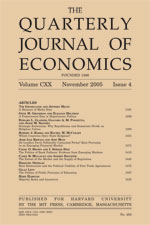
The Quarterly Journal of Economics
Peer-reviewed journalWikipedia
20
MENTIONS
17
EPISODES
16
PODCASTS
Search complete. 20 mentions across 17 episodes found for "The Quarterly Journal of Economics".
Nov 12, 2026

Craig DowdenHOST
Natalia is a research economist and Emma is a professor of economics at the University of Virginia.
Craig DowdenHOST
Their work has been published in top journals, including Science, the Quarterly Journal of Economics and American Economic Journals.
Craig DowdenHOST
The research has been featured in the BBC, the New York Times, the Wall Street Journal, The Economist, The Atlantic, Good On Paper Podcasts, and NPR's Planet Money, among others.
Craig DowdenHOST
You know, small, small publications.

MikeHOST
The best evidence I've seen on this is a study of 5,000 customer support agents.
MikeHOST
This was published last year in the Quarterly Journal of Economics.
MikeHOST
When they got an AI assistant, the number of problems they solved per hour went up 15% on average, but the gains weren't spread evenly.
MikeHOST
The newest and least experienced people got faster and their work got better.

speaker_4NARRATOR
In layman's terms this means that the additional price burden faced by consumers was larger than the tariff itself at least in the year or two that followed.
speaker_4NARRATOR
The complete pass-through of the 2018 tariffs onto consumers was also evidenced in reports from the American Economic Association and the Quarterly Journal of Economics.
speaker_4NARRATOR
In effect, this meant that tariffs were just a sneakier, more convoluted way to tax consumers without having to actually call it a tax.
speaker_4NARRATOR
In total, the 2018-2019 tariffs imposed around $80 billion worth of indirect taxes on Americans, which amounted to one of the largest tax increases in decades.
speaker_7NARRATOR
This is all done in the space of microseconds, but it adds up.
speaker_7NARRATOR
Research in the Quarterly Journal of Economics found that high-frequency trading costs the equities market alone $5 billion a year.
speaker_7NARRATOR
This represents a tax for all other market participants and is literally automated rent extraction.
speaker_7NARRATOR
In the case of consumers, information asymmetry could be in the form of insurance products that you overpay for because there are subtle details in the terms and conditions that reduce the size or chance of a payout.

Michael PetersGUEST
But this being said, I think there are very good reasons to believe why this particular form of reallocation from agriculture to manufacturing in particular in the first phase increases overall productivity.
Michael PetersGUEST
And the two reasons that I think are very plausible to me is, first, there's a very large literature, starting with Arthur Lewis' early Nobel Prize-winning work on what's called the agricultural productivity gap.
Michael PetersGUEST
This idea, or this fact, really, that workers might just be less productive in agriculture than in other parts of the economy.
Michael PetersGUEST
And so as you start allocating labor from agriculture into the industries, that has direct productivity effects through gains from reallocation.
22 MINS LATER
Tim PhillipsHOST
If we get this wrong, this could be very bad news indeed.
Michael PetersGUEST
I think so.
Michael PetersGUEST
To be honest, I can't really tell you much yet about what such optimal policy mix should look like because we are just so early in the type of research that I think could fill in the gaps here.
Michael PetersGUEST
It's an exciting time to do this type of research.

Tanya Prewitt-WhiteHOST
There is some interesting research that helps us explain why this happens.
Tanya Prewitt-WhiteHOST
A 2022 study by economists Christine Exley and Judd Kessler published in the Quarterly Journal of Economics examined gender differences in self-promotion.
Tanya Prewitt-WhiteHOST
They found that women were less likely than men to promote their own performance, even when their actual performance was comparable.
Tanya Prewitt-WhiteHOST
Think about that.

speaker_3NARRATOR
Illusion two, the promotion illusion.
speaker_3NARRATOR
In 2019, three economists, Alan Benson, Danielle Lee, and Kelly Hsu, published a paper in the Quarterly Journal of Economics.
speaker_3NARRATOR
They studied roughly 40,000 sales workers across 131 firms, and they tracked two things.
speaker_3NARRATOR
who got promoted into management, and what happened to their teams afterward.

Tauseef RahmanGUEST
You can read it, and the words that you use can describe the same exact thing very differently.
RobHOST
And to be clear, in the paper, you cite this study from the Quarterly Journal of Economics, so something from last year, which was looking at customer support agents.
RobHOST
And so the folks...
RobHOST
Very specific study, the most experienced folks were able to have some performance gains, but the less experienced and lower skilled workers were able to greatly improve their performance and skills, right? So what organizations should think about is the extent

Jack RussoHOST
Yes.
Jack RussoHOST
David Autor and his colleagues published a landmark study recently in the Quarterly Journal of Economics.
Jack RussoHOST
They analyzed census data and occupational classifications over decades.
Jack RussoHOST
Their central finding is astounding.

Andrey FradkinHOST
Whatever taste is, right? And so there's a way to potentially...
Andrey FradkinHOST
Well, one is like AI could eventually have its own taste that we might value, but you can design a review system that focuses on concerns, atomic concerns, without making a judgment about, well, is this a big enough contribution for the QJE? Only Larry Katz can make that decision.
Andrey FradkinHOST
Right.
Seth BenzellHOST
So it's distinguishing between a technical review and a judgment.
7 more episodes mention The Quarterly Journal of Economics.
Create an account to see the whole feed, search across every transcript, and follow the entities you care about.