Quartering Acts
45
MENTIONS
12
EPISODES
11
PODCASTS
Search complete. 45 mentions across 12 episodes found for "Quartering Acts".
Sep 6, 2026

speaker_5NARRATOR
By its provisions duties were imposed on practically all papers used in legal transactions.
speaker_5NARRATOR
Deeds, mortgages, inventories, writs, bail bonds, on licenses to practice law and sell liquor— on college diplomas playing cards dice pamphlets newspapers almanacs calendars and advertisements the dragnet was closely knit for scarcely anything escaped the quartering act seventeen sixty five The ministers were aware that the Stamp Act would rouse opposition in America.
speaker_5NARRATOR
How great they could not conjecture! While the measure was being debated, a friend of General Wolfe, Colonel Barre, who knew America well, gave them an ominous warning in the Commons.
speaker_5NARRATOR
Believe me, remember I this day told you so, he exclaimed, the same spirit of freedom which actuated that people at first will accompany them still, a people jealous of their liberties, and who will vindicate them, if ever they should be violated.
speaker_5NARRATOR
The answer of the ministry to a prophecy of force was a threat of force.
speaker_5NARRATOR
Preparations were accordingly made to dispatch a larger number of soldiers than usual to the colonies, and and the ink was hardly dry on the Stamp Act when Parliament passed the Quartering Act, ordering the colonists to provide accommodations for the soldiers who were to enforce the new laws.
speaker_5NARRATOR
We have the power to tax them, said one of the Ministry, and we will tax them.
speaker_5NARRATOR
COLONIAL RESISTANCE FORCES REPEAL popular opposition.

speaker_2NARRATOR
The dragnet was closely knit, for scarcely anything escaped.
speaker_2NARRATOR
The Quartering Act, 1765.
speaker_2NARRATOR
The Ministers were aware that the Stamp Act would rouse opposition in America.
speaker_2NARRATOR
How great they could not conjecture! While the measure was being debated, a friend of General Wolfe, Colonel Barre, who knew America well, gave them an ominous warning in the Commons.
speaker_2NARRATOR
Believe me, remember I this day told you so, he exclaimed, the same spirit of freedom which actuated that people at first will accompany them still, a people jealous of their liberties, and who will vindicate them, if ever they should be violated.
speaker_2NARRATOR
The answer of the ministry to a prophecy of force was a threat of force.
speaker_2NARRATOR
Preparations were accordingly made to dispatch a larger number of soldiers than usual to the colonies, and and the ink was hardly dry on the Stamp Act when Parliament passed the Quartering Act, ordering the colonists to provide accommodations for the soldiers who were to enforce the new laws.
speaker_2NARRATOR
We have the power to tax them, said one of the Ministry, and we will tax them.

speaker_4NARRATOR
The dragnet was closely knit, for scarcely anything escaped.
speaker_4NARRATOR
The Quartering Act, 1765.
speaker_4NARRATOR
The ministers were aware that the Stamp Act would rouse opposition in America.
speaker_4NARRATOR
How great they could not conjecture! While the measure was being debated, a friend of General Wolfe, Colonel Barre, who knew America well, gave them an ominous warning in the Commons.
speaker_4NARRATOR
Believe me, remember I this day told you so, he exclaimed, the same spirit of freedom which actuated that people at first will accompany them still, a people jealous of their liberties, and who will vindicate them, if ever they should be violated.
speaker_4NARRATOR
The answer of the ministry to a prophecy of force was a threat of force.
speaker_4NARRATOR
Preparations were accordingly made to dispatch a larger number of soldiers than usual to the colonies, and the ink was hardly dry on the Stamp Act when Parliament passed the Quartering Act, ordering the colonists to provide accommodations for the soldiers who were to enforce the new laws.
speaker_4NARRATOR
We have the power to tax them, said one of the Ministry, and we will tax them.

Atul SinghHOST
Obviously, slaves were used as labor.
Atul SinghHOST
The Caribbean, as I said earlier, was a revenue generator for Britain, and we could go on, but we'll move on now to the 1765 Quartering Act, which required colonies to provide housing and supplies for British troops.
Atul SinghHOST
Now, obviously-
Glenn CarleHOST
Which is explosive
11 MINS LATER
Glenn CarleHOST
And now that's gone.
Atul SinghHOST
Exactly.
Atul SinghHOST
And there's a new Quartering Act that expands troop housing requirements.
Atul SinghHOST
Another pinprick.

speaker_3NARRATOR
The dragnet was closely knit, for scarcely anything escaped.
speaker_3NARRATOR
the quartering act seventeen sixty five the ministers were aware that the stamp act would rouse opposition in america how great they could not conjecture while the measure was being debated a friend of general wolfe colonel barre who knew america well gave them an ominous warning in the commons Believe me, remember I this day told you so, he exclaimed, the same spirit of freedom which actuated that people at first will accompany them still, a people jealous of their liberties, and who will vindicate them, if ever they should be violated.
speaker_3NARRATOR
The answer of the ministry to a prophecy of force was a threat of force.
speaker_3NARRATOR
Preparations were accordingly made to dispatch a larger number of soldiers than usual to the colonies, and and the ink was hardly dry on the Stamp Act when Parliament passed the Quartering Act, ordering the colonists to provide accommodations for the soldiers who were to enforce the new laws.
speaker_3NARRATOR
We have the power to tax them, said one of the Ministry, and we will tax them.
speaker_3NARRATOR
COLONIAL RESISTANCE FORCES REPEAL popular opposition.
speaker_3NARRATOR
Aristocratic colonial Whigs, who had long grumbled at the administration of royal governors, protested against taxation without their consent, as the Whigs had done in old England.
speaker_3NARRATOR
There were Tories, however, in the colonies, as in England, many of them of the official class, who denounced the merchants, lawyers, and Whig aristocrats as seditious, factious, and republican.

speaker_18NARRATOR
In 1764, the Sugar Act was enacted by the British Parliament and became the first law with the specific goal of raising money from the colonies.
speaker_18NARRATOR
This law was followed by the Currency Act, which prohibited the colonies from issuing their own currency, the Quartering Act, which required the colonies to provide housing and supplies to British troops, and the Stamp Act, which directly taxed the colonies by requiring all documents and packages to obtain a stamp showing that the tax had been paid.
speaker_18NARRATOR
Violations of these acts often led to harsh judgments by British-appointed judges without the consent of local juries.
speaker_18NARRATOR
American colonists responded to these acts with organized protest, arguing against taxation without proper representation in Parliament.

speaker_3NARRATOR
CHAPTER I.
speaker_3NARRATOR
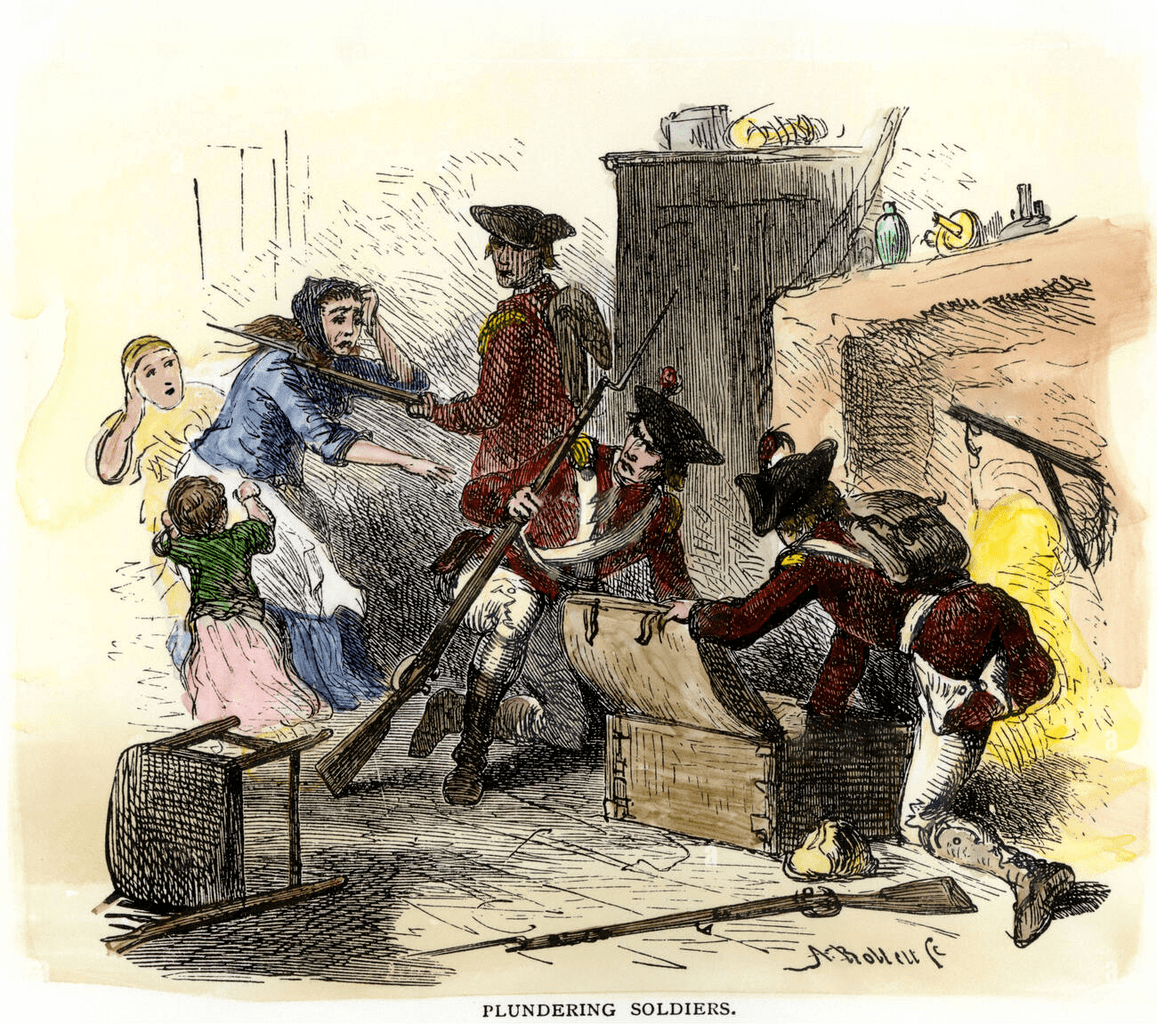
A Lady of Old New York the year seventeen seventy four marks an epoch in the history of the united states scarcely less memorable than the one which gave to the world the declaration of independence the events of seventeen seventy four prepared the way for the heroic deeds of seventeen seventy six the boston tea party of seventeen seventy three had made the english government realize that the colonies must be cowed or that an appeal to arms was the only outcome the intolerable acts of seventeen seventy four attempted to accomplish the first purpose one closed the port of boston until the town should pay for the tea so summarily thrown overboard from the english ships a second the regulating act remodeled the charter of massachusetts and attempted to destroy those free institutions which were so dearly prized by the people a third the administration of justice act provided that any british soldier accused of murder in putting down riots or while enforcing the revenue laws might be taken for trial to another colony or to great britain A fourth, the Quartering Act, imposed English soldiers as unwelcome guests on American householders.
speaker_3NARRATOR
and the fifth or quebec act extended the boundaries of that province southward to the ohio river thus as the colonists claimed ignoring the rights of massachusetts connecticut new york and virginia and doing away within that territory with such cherished institutions as the popular meeting and the freedom of the press the intolerable acts rouse the spirit of the people from virginia in reply came the suggestion for a general congress to deliberate on those measures which the united interests of america may from time to time require at the call of massachusetts the first continental congress assembled at carpenter's hall philadelphia september fifth seventeen seventy four Fifty-five delegates from every colony, Georgia excepted, answered the summons.
speaker_3NARRATOR
Massachusetts sent John and Samuel Adams, Connecticut, her shoemaker statesman Roger Sherman, Pennsylvania, John Dickinson, New York, John Jay, South Carolina was represented by Christopher Gadsden and John Rutledge, while Virginia sent Richard Henry Lee, Patrick Henry, and the man who was a host and a congress in himself, the incomparable Washington.

Martin LussonHOST
The British forces which had come over to maintain law and order were quartered in their homes, as those living in the colonies were generally regarded as second-class citizens.
Martin LussonHOST
This was all legislated through the Quartering Acts which were passed by Parliament in 1765 and 1774.
Martin LussonHOST
This latter one is one of the, quote, intolerable acts which precipitated the American Revolution.
Martin LussonHOST
Is it then surprising that when the Framers found this law enshrined in British jurisprudence, that they adopted it for their own? It's not one that has come up often in American jurisprudence, but three cases in particular stand out.
speaker_2NARRATOR
The dragnet was closely knit, for scarcely anything escaped.
speaker_2NARRATOR
the quartering act seventeen sixty five the ministers were aware that the stamp act would rouse opposition in america how great they could not conjecture while the measure was being debated a friend of general wolfe colonel barre who knew america well gave them an ominous warning in the commons Believe me, remember I this day told you so, he exclaimed, the same spirit of freedom which actuated that people at first will accompany them still, a people jealous of their liberties, and who will vindicate them, if ever they should be violated.
speaker_2NARRATOR
The answer of the ministry to a prophecy of force was a threat of force.
speaker_2NARRATOR
Preparations were accordingly made to dispatch a larger number of soldiers than usual to the colonies, and and the ink was hardly dry on the Stamp Act when Parliament passed the Quartering Act, ordering the colonists to provide accommodations for the soldiers who were to enforce the new laws.
speaker_2NARRATOR
We have the power to tax them, said one of the Ministry, and we will tax them.
speaker_2NARRATOR
COLONIAL RESISTANCE FORCES REPEAL Popular Opposition The Stamp Act was greeted in America by an outburst of denunciation.
speaker_2NARRATOR
Aristocratic colonial Whigs, who had long grumbled at the administration of royal governors, protested against taxation without their consent, as the Whigs had done in old England.
speaker_2NARRATOR
There were Tories, however, in the colonies, as in England, many of them of the official class, who denounced the merchants, lawyers, and Whig aristocrats as seditious, factious, and republican.

speaker_2NARRATOR
The dragnet was closely knit, for scarcely anything escaped.
speaker_2NARRATOR
The Quartering Act, 1765.
speaker_2NARRATOR
The ministers were aware that the Stamp Act would rouse opposition in America.
speaker_2NARRATOR
How great they could not conjecture.
speaker_2NARRATOR
A people jealous of their liberties and who will vindicate them if ever they should be violated.
speaker_2NARRATOR
The answer of the ministry to a prophecy of force was a threat of force.
speaker_2NARRATOR
Preparations were accordingly made to dispatch a larger number of soldiers than usual to the colonies, and the ink was hardly dry on the Stamp Act when Parliament passed the Quartering Act, ordering the colonists to provide accommodations for the soldiers who were to enforce the new laws.
speaker_2NARRATOR
We have the power to tax them, said one of the ministry, and we will tax them.
2 more episodes mention Quartering Acts.
Create an account to see the whole feed, search across every transcript, and follow the entities you care about.