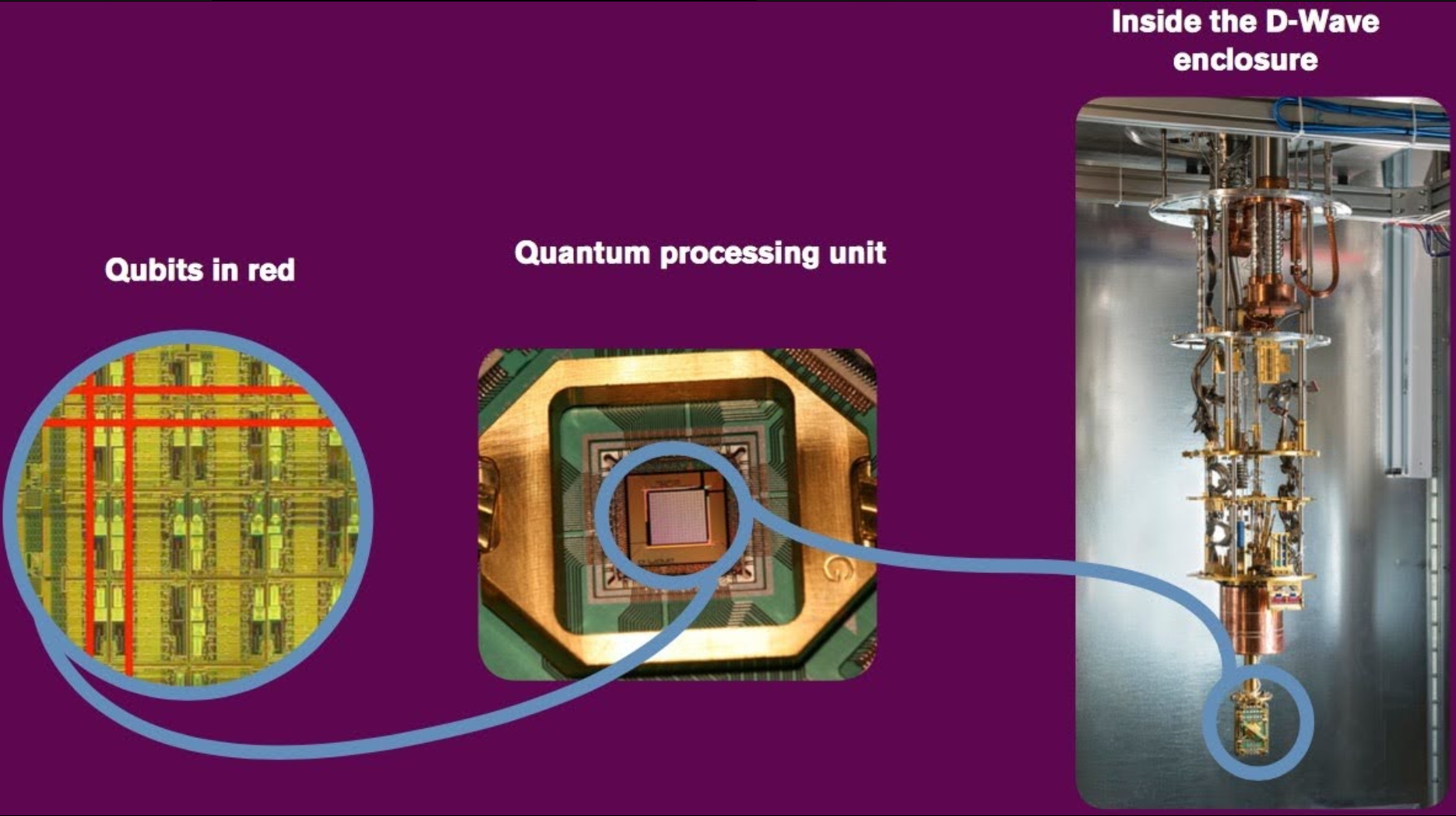
Quantum processing unit
30
MENTIONS
6
EPISODES
5
PODCASTS
Search complete. 30 mentions across 6 episodes found for "Quantum processing unit".
Nov 19, 2026

Michelle SimmonsGUEST
So in such a way, you have full atomic resolution in all X, Y, and Z.
Michelle SimmonsGUEST
But the key essence is in the whole QPU, the quantum processing unit that we make, there are only two atoms, phosphorus and silicon.
Michelle SimmonsGUEST
And the hydrogen basically segregates out and goes to the surface as you grow.
Hamish JohnstonHOST
And is that something that you make in-house? Is that what SQC does, make these devices? Or do you have somebody else do it for you?
8 MINS LATER
Michelle SimmonsGUEST
And so we've been very excited recently that in our field, there's been a massive along the side of us advancements in the GPUs and GPUs for companies like Nvidia.
Michelle SimmonsGUEST
They've basically been 3D packaging them so that they can fit lots of them together.
Michelle SimmonsGUEST
And so we now can use those kind of 3D packaging techniques to connect to our QPU layers.
Michelle SimmonsGUEST
And so we've been waiting, honestly, for the silicon industry to develop that technology alongside us to bring their pitch size down so that it now is compatible with the sizes that we get in our QPU.

Kirk BresnikerGUEST
So even there, it took a little time, but understanding how we adapt the physical data center environment, how we make teams productive, safe, productive, secure, all those things.
Kirk BresnikerGUEST
I think there's great lessons to be drawn from the introduction of accelerated computing in GPUs and how we see accelerated computation as we now look to the potential of having multi-physics be everything from Newton and Galileo to Schrodinger and Dirac, because now we have CPUs, GPUs, QPUs, all these other accelerators all being put to purpose and part of that enabling again is AI driven transcoding and coding that will lower that barrier to just the amount of code that we need to generate across all these diverse devices to make them efficiently render up their efficiency.
Kevin JacksonHOST
You're pointing to the future here, and I think I'll finish on these two questions.
Kevin JacksonHOST
Let's just say we're looking forward to relatively soon, 2030, 31, 32, relatively soon.

Steve LaBarberaHOST
But first, let's set the table for our listeners, because HPE's role in this industry is a little bit different from some of the others.
Steve LaBarberaHOST
When you arrived at HPE, you made an assessment about where the company should position itself, and the answer was more of a quantum system integrator rather than a QPU vendor.
Steve LaBarberaHOST
Can you walk us through that reasoning and why that's the right fit for HPE? What were some of the arguments for staying out of the qubit building business?
Masoud MohseniGUEST
I believe that HPE has the legacy, know-how, and the capability to use advanced processors and make them available in enormous computing infrastructures that work at this scale.
Steve LaBarberaHOST
My understanding is that HPE is coming at it from the other end.
Steve LaBarberaHOST
Can you explain this top-down approach and what actually changes architecturally when you do it that way?
Masoud MohseniGUEST
Yeah, so this is also related to your previous question, why we do not even build QPU in-house, why we are not going to be just another QPU vendors.
Masoud MohseniGUEST
So the general history of quantum computing has been beyond the early academic days is to build QPUs given certain capabilities of certain modality, let's say a neutral atom, trapped ion system, superconducting qubits or spin-based qubit, could be photonic.

speaker_2HOST
Okay, standard stuff.
speaker_3GUEST
And physically adjacent to them, connected by ultra-fast fiber optics, you have the dilution refrigerators housing the quantum processing units, or QPUs.
speaker_2HOST
And the orchestrator of all this is artificial intelligence.
speaker_2HOST
You submit a massively complex problem to the cloud.

Chris CassinGUEST
And so we're going to see the same thing with quantum computers.
Chris CassinGUEST
Quantum computers have something called a QPU, a quantum processing unit.
Chris CassinGUEST
So what we'll see is I believe we'll see data centers with CPUs, GPUs, and QPUs working in concert to solve really complex problems.
Chris CassinGUEST
And so what does that mean for us as a cryogenics company? We are really building the critical infrastructure that supports and enables this technology.
Chris CassinGUEST
And so, you know, we will have hundreds of millions of dollars worth of infrastructure at a single data center and we will scale with them and support the uptime of their systems.
Claire Le GallGUEST
And we address a huge gap in the market because this solution will be part of any future fault-tolerant quantum computing system.
Steve LaBarberaHOST
So how mature would you say quantum networking is compared to computing itself? QPUs are already being sold and deployed today in the market.
Steve LaBarberaHOST
Where would you say the networking side sits relative to that? And what has to happen to bring these networks to market?
Claire Le GallGUEST
Right, so now the field of quantum networking for compute is smaller and earlier.
21 MINS LATER
Steve LaBarberaHOST
New Quantum has another product or device called the Quantum Networking Unit.
Steve LaBarberaHOST
The first generation product is out now.
Steve LaBarberaHOST
In practical terms, how does this help someone looking to operate several QPUs as part of a quantum network?
Claire Le GallGUEST
Right.