Quantum key distribution
26
MENTIONS
10
EPISODES
9
PODCASTS
Search complete. 26 mentions across 10 episodes found for "Quantum key distribution".
Nov 1, 2026

speaker_3HOST
While we wait for the physical hardware to mature, we are actually using the fragility of quantum states to our advantage.
speaker_3HOST
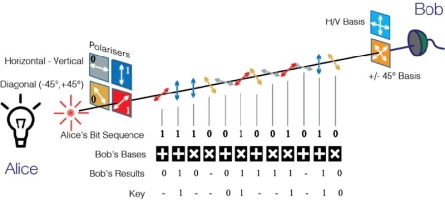
In quantum key distribution, or QKD, two parties use individual entangled photons of light to generate a shared secret encryption key.
speaker_2HOST
And the brilliant part is how it reveals tampering.
speaker_2HOST
Because of the rules of quantum mechanics, if a hacker tries to intercept and measure those photons while they are traveling through a fiber optic cable, their very observation forces the photons to collapse into a definite state.

Konstantinos KaragiannisHOST
you're in real trouble.
Konstantinos KaragiannisHOST
Should quantum key distribution have a seat at the PQC discussion table? Some kind of combination of physics and math-based solutions working to protect against the quantum computing threat, perhaps? Toshiba thinks so.
Konstantinos KaragiannisHOST
Find out about their just-released system for making it all possible in this episode of the Post-Quantum World.
Konstantinos KaragiannisHOST
I'm your host, Konstantinos Karagiannis.

Maya CollinsHOST
But here's the twist.
Maya CollinsHOST
Agencies like the NSA in the U.S. and the NCSC in the U.K., France and Germany too, keep warning against broad QKD rollouts.
Liza ClarkHOST
Seriously? The folks who need the strongest lock are saying maybe not to the strongest lock?
Maya CollinsHOST
Because it solves only part of the problem.
Maya CollinsHOST
QKD gives you secrecy for transport, but it doesn't tell you who you're actually talking to.
Maya CollinsHOST
No built-in authentication.
Liza ClarkHOST
Right.
Maya CollinsHOST
Exactly.

Vincent CelindroGUEST
And the main thing that is math-based quantum resistance.
Vincent CelindroGUEST
The next one is QKD, which is quantum key distribution.
Vincent CelindroGUEST
And that's physics-based.
Vincent CelindroGUEST
key material.
Vincent CelindroGUEST
A couple of weeks back, you had Janet, the CEO of EPB, talk about how to secure quantum communications.
Vincent CelindroGUEST
And she had mentioned that once, if I'm sending a secure transmission to you, if there's an eavesdropper using quantum key distribution, we'd know that there's an eavesdropper and terminate those conversations so that no one can hear us talk.
Vincent CelindroGUEST
And this is where I'm going to go into this on how you fiber providers would be able to leverage QKD as newer services and why you guys are primed for this.
Vincent CelindroGUEST
One thing that we had mentioned as well is CRQC, a cryptographical relevant quantum computer.

Anders IndsetHOST
It's moved from 10 years away to the last estimates that I read, 2029.
Anders IndsetHOST
So when you look at 2020-30 to have a secure communication, are we at risk that we are forced to implement QKD or some post quantum cryptography prior to building a secure communication network? Or is that the incorrect question to ask?
Stephanie WehnerGUEST
I think, I mean, it's a good question, but indeed, I think there's a refinement that is even better.
Stephanie WehnerGUEST
Because I think what one should look at is the secrets that I have.

Yuval BogerHOST
You mentioned KMS.
Yuval BogerHOST
So it begs the question, how do you feel about QKD, quantum key distribution? Is that useful or is that a distraction from real PQC work?
Joel Van DykGUEST
I think Q, I mean, for me as a physicist, you know, I could pull out my physics book and show you the chapter and verse where we studied this way back when in grad school.
Joel Van DykGUEST
So it's tremendously interesting to me.
Joel Van DykGUEST
There's lots of SISOs, some very influential in the field who say QKD is a distraction and we should get the rest of the house in order all the way over to some who are leading, you know, very innovative programs and say, hey, we need to look at this now.
Joel Van DykGUEST
I tend to come down in the middle.
Joel Van DykGUEST
I don't see how we can do it today.
Joel Van DykGUEST
However, things are moving so fast.
Liza ClarkHOST
Okay, let's ground it.
Liza ClarkHOST
Start with quantum key distribution.
Liza ClarkHOST
The way I explain it on Red Team Briefings, Alice tries to share a key with Bob using single photons.
Maya CollinsHOST
The prepare and measure family.

Charlie LewisGUEST
What is gonna happen once you get to this? And it's how do you think about transitioning? And so, one, large cryptographic migrations can take years, right? So you need to start thinking about what do I apply post-quantum cryptography to? How do I think about readying myself for that? That seems to be the faster.
Charlie LewisGUEST
And if I am in the type of organization that needs to reinvest and invest heavily within QKD or quantum key distribution, where am I going to do that? What is the lifespan of that technology, and is it worth investing now, or do I have to wait? And how do I prioritize all of that now? And then start thinking about your broad credentials and all of your certificates and starting to map that and build the foundations that you should have anyway.
Sean BrownHOST
Okay, so does quantum just raise the bar then for the ways that companies need to execute their security? For example, just making sure that encrypted data stays within their organizations, or is this really changing the fundamental landscape of security?
Charlie LewisGUEST
I think it raises the bar.

Eva GalantHOST
In fact, a couple of weeks ago I had the chance to, um, speak with Bill Vass, who's CEO of Booz Allen Hamilton and he even said very bluntly like quantum sensing is the industry already that exists.
Eva GalantHOST
Um, so a lot of experts, a lot of people are putting this as a contrary to, um, quantum computing where they're saying, "Hey, um, quantum sensing is, is much closer, uh, and is more defensible than QKD." Do you agree with that framing? Um, and if so, where do you think the timeline's actually realistic?
Karsten PykaGUEST
Look, if at all maybe this, this statement comes a bit, comes out a bit short, um, I would say, right? And, and then, yeah, so it, it's just saying yes, no, it's, it's maybe a bit limiting for the whole thing, right? Obviously we know that quantum computing is a, is a large field where there's a lot of development going on and, um, you find, uh, different, different claims being made and you find, yeah, you, you find, uh, you find a lot of, uh, great work being done and, and being published.
Karsten PykaGUEST
What I can say is yes, uh, quantum sensing is, is, it's very close to being, uh, also maybe it's a broad statement, right? But of course you, you will find, uh, you will find, uh, a whole range of, of startups and also larger companies that are already investing and even, uh, really actively building, building, building, um, quantum sensors that are, that are close to, close to being right, right? But you also find a lot of companies that are building, uh, um, QKD systems that are also very close to being, uh, being ready products that are being actively sold, right? Uh, so you, you can find all this already.
Karsten PykaGUEST
You can, in the computing space you will also find a lot of companies or small, smaller companies that are like supporting the supply chain, right? And you find a lot of companies that are, um, collaborating, uh, collaborating with, uh, with the research facilities, uh, in order to, to really push the development.
Eva GalantHOST
That's correct.