Qin dynasty
DynastyWikipedia
79
MENTIONS
28
EPISODES
27
PODCASTS
Search complete. 79 mentions across 28 episodes found for "Qin dynasty".
Sep 14, 2026

Erin PauletteHOST
It, it makes me think Chinese just because, you know, Q-I, um, in the name.
Erin PauletteHOST
'Cause, 'cause like, okay, we spell it China C-H-I-N-A, but it's actually from the, the, the, the Qin or the Qin dynasty, and one way of spelling that is Q-I-N.
Weird BeardHOST
Mm-hmm.
Erin PauletteHOST
So that's why I say it.

Pamela NagamiNARRATOR
It was then, in 1206, at the age of forty-four, that he assumed the name and title of Genghis Khan, which is given by historians almost as many meanings as spellings, the Chinese, Jingsei, that is, perfect warrior, being the most appropriate at least.
Pamela NagamiNARRATOR
In 1213 he overran the Qin Empire in China by a concentric attack by three armies.
Pamela NagamiNARRATOR
With his borders now firmly established, as far as the river barrier of the Honghou, his base was secure for an advance towards the west.
Pamela NagamiNARRATOR
Here lay the rich and fertile empire of the Shah of Khwarizm, Kharizmi and Empire, which embraced what is today Turkestan, Persia, and northern India.
21 MINS LATER
Pamela NagamiNARRATOR
The schemes of European conquest were suspended for a generation owing to the death of Genghis Khan in 1227.
Pamela NagamiNARRATOR
Disputes over the succession, for which Genghis had designated his second surviving son, Ogdai, retarded further expansion to the west.
Pamela NagamiNARRATOR
Genghis Khan had called to his aid in the administration of the immense newly gained empire Yelu Jutsai, a statesman of the former Qin Empire.
Pamela NagamiNARRATOR
The natural result was to give a Chinese complexion to the policy of the Mongol Empire and to discourage adventures in Europe.

Ross PetrasGUEST
But with China, there also are other explanations, too.
Ross PetrasGUEST
For example, with China, it comes from the Qin Dynasty, who ruled
Kathy PetrasGUEST
China.
Kathy PetrasGUEST
Oh, no, no, I know.
Ross PetrasGUEST
There's also just like... linguistic or conventional reasons, historical reasons.
Ross PetrasGUEST
For example, we just said, I mentioned China.
Ross PetrasGUEST
China at the time it entered into the Western world, which would then come into English, was ruled by the Qin dynasty, which came into Latin as, you know, Qin, and then China, obviously, and then the English speakers took up China.
Ross PetrasGUEST
That's one way.

Wei ChenHOST
Sitting there, sipping the coffee, I thought about the history of this land.
Wei ChenHOST
This was once the homeland of Empress Xiaozhuang, a figure of immense importance in Qin Dynasty history.
Wei ChenHOST
Her birthplace is marked by a park further west, but her legacy is woven into the fabric of this region.
Wei ChenHOST
The Mongolian identity here is strong, proud, and deeply connected to the land.

Laszlo MontgomeryHOST
If any of you had never heard of Xiangyang, then for sure you'd never heard of Fan Ju.
Laszlo MontgomeryHOST
These two, more than anyone else, made the Qin dynasty.
Laszlo MontgomeryHOST
Xiangyang, with his two waves of reforms, put the Qin house in order and put them on a war footing.
Laszlo MontgomeryHOST
Fan Ju was someone of high repute as a politician and strategist, and like Shang Yang, he also originally hailed from Wei State.
16 MINS LATER
Laszlo MontgomeryHOST
King Zhao Xiang of Qin, as I mentioned, he reigned a good 55 years, 306 to 251 BC.
Laszlo MontgomeryHOST
Over on the other side of the world, This was the start of the Punic Wars.
Laszlo MontgomeryHOST
I know I said this last time, but as far as the Qin Dynasty and all the systems of government and national administration that got passed down through the ages, don't give all the credit to Qin Shi Huang.
Laszlo MontgomeryHOST
It was this king, Zhao Xiang, and also Duk Xiao, Duk Mu, Shang Yang, Fan Ju, Bai Qi, and a whole other cast of lesser-known characters who put the Qin on a solid foundation.

KaiGUEST
Yeah, yeah, yeah, yeah, yeah.
Chi TongGUEST
So, so during Qin Shi Huang era, when during the Qin dynasty-
JoeyHOST
Yeah
Chi TongGUEST
... is when he changed things.

John GreenHOST
But first, let's see an example of the Mandate of Heaven in action.
John GreenHOST
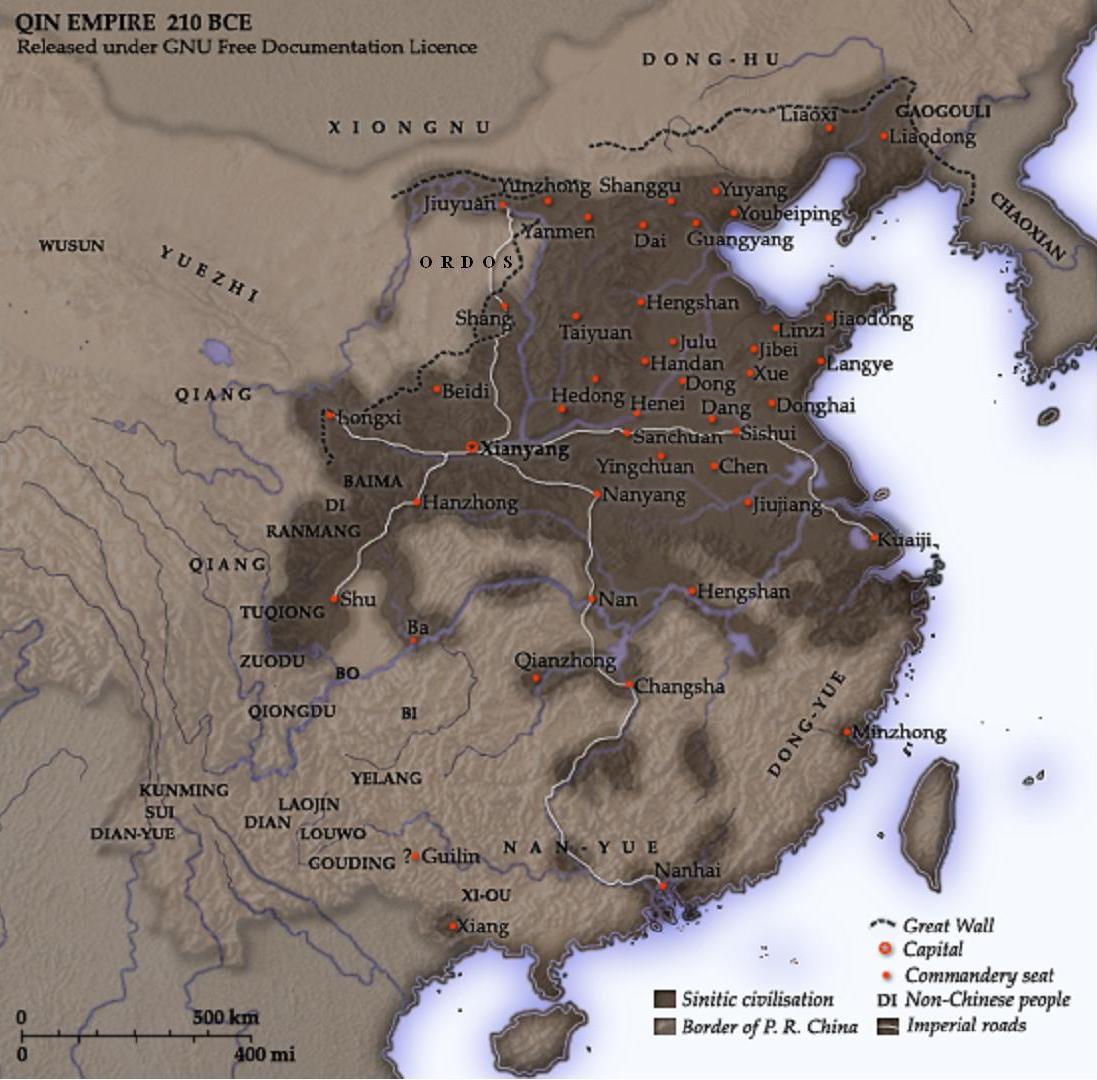
So the Qin Dynasty only lasted 38 years, but it's one of the most important dynasties in Chinese history.
John GreenHOST
So important, in fact, that it gave the place its name, Qin.
John GreenHOST
Can I just tell you guys that we literally just spent 20 minutes on that shot? We shot it like 40 times.

John D. PhanGUEST
And on that last note, you've got to remember that he was trying to make moral sense of history.
John D. PhanGUEST
There was this incredible upheaval in the history of China, right? The first empire had risen, the Qin Dynasty, Dendubang, if you know him.
John D. PhanGUEST
And then it fell because of various reasons, and then the Han rose.
John D. PhanGUEST
So he was trying to make sense of all these huge changes in history.

Giselle KiralyHOST
In true ancient Chinese style, this find was absolutely monumental.
Giselle KiralyHOST
Just over a mile south of the Qin Dynasty Great Wall, or the original Great Wall of China, never heard of it, Archaeologists found a network of 183 tombs.
Giselle KiralyHOST
By the way, did you know that the Great Wall of China is actually 19 different walls, all built and added to at different times? Should we do a video on that? Probably.
Giselle KiralyHOST
But for now, we're talking beer.
Giselle KiralyHOST
According to the Journal of Archaeological Science, the bottle was double sealed.
Giselle KiralyHOST
It had a textile plug inside and a mud daub seal on the outside.
Giselle KiralyHOST
It was dated to the Warring States period, just before the Qin Dynasty unified China.
Giselle KiralyHOST
So this bottle of beer dates from 547 to 221 BCE.
18 more episodes mention Qin dynasty.
Create an account to see the whole feed, search across every transcript, and follow the entities you care about.