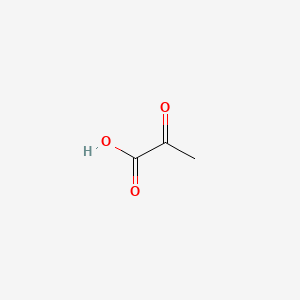
Pyruvic acid
Chemical compoundWikipedia
8
MENTIONS
3
EPISODES
3
PODCASTS
Search complete. 8 mentions across 3 episodes found for "Pyruvic acid".
Nov 2, 2026
From Sept 2024: Dr. Richard Frye, M.D., Ph.D., on Mitochondria, Autism & the Environment
R
17:28Richard FryeGUEST
And glucose, the major source we think of is carbohydrates in the form of glucose going down the glycolysis and making pyruvate.
R
17:45Richard FryeGUEST
So we can see pyruvate here.
R
17:48Richard FryeGUEST
Pyruvate, the next step is to go into the mitochondria.
R
17:54Richard FryeGUEST
If this machinery in here isn't working, what's going to happen? pyruvate is going to get backed up and pyruvate if it gets backed up has to go somewhere and it's either made into lactate or alanine so these are three of the biomarkers that we use to just tell us in general that the mitochondria is not working also Let's say pyruvate does come into the mitochondria and goes to acetyl-CoA and then into the citric acid cycle.
R
18:35Richard FryeGUEST
But you can see there's many little offshoots here and a lot going on.
P
Unknown podcast
Nine Metabolic Pathways Explained: A Visual Guide to How Your Body Converts Food to Energy
Oct 26 · 6 Mentions
S
1:14speaker_0NARRATOR
The ability to switch between carbohydrate, fat, and protein metabolism is essential for survival during fasting and nutrient scarcity.
S
1:23speaker_0NARRATOR
The nine core metabolic pathways, biochemical routes for converting glucose, fatty acids, and amino acids into ATP and biosynthetic precursors glycolysis, glucose pyruvate, anaerobic energy TCA cycle, acetyl-CoA oxidation, aerobic energy electron transport chain ATP synthesis, Pentose Phosphate Pathway NADPH Plus Ribose Anaerobic Glycolysis Lactate Emergency Energy Gluconeogenesis Fasting Glucose Lipogenesis Fat Storage Energy Storage Beta Oxidation Fat Breakdown Fasting Fuel Amino Acid Catabolism Protein Metabolism Source Standard Biochemistry Education Framework Georgian Medical Journal News Pathway 1-3 The Glucose-to-ATP Cascade The first three metabolic pathways form the central engine of cellular energy production.
S
2:11speaker_0NARRATOR
Glycolysis, the conversion of glucose to pyruvate, is the most universal metabolic route occurring in nearly every human cell.
S
2:19speaker_0NARRATOR
According to standard biochemistry education, this anaerobic pathway generates two net ATP molecules and two NADH cofactors from a single glucose molecule, providing immediate energy without requiring oxygen.
S
2:33speaker_0NARRATOR
When oxygen is available, the second pathway activates, pyruvate enters the mitochondrion and is converted to acetyl-CoA, which then enters the TCA cycle.
S
2:43speaker_0NARRATOR
The TCA cycle oxidizes acetyl groups and generates NADH and FADH2, electron carriers that power the third pathway, the electron transport chain.
S
2:54speaker_0NARRATOR
This chain uses the electrons from NADH and FADH2 to pump protons across the inner mitochondrial membrane, creating an electrochemical gradient that drives ATP synthase, producing approximately 30 to 32 ATP molecules per glucose molecule under optimal conditions.
S
7:19speaker_0NARRATOR
Beta-oxidation is the primary fuel source during prolonged fasting and endurance exercise and it accounts for the metabolic rate increase observed during caloric restriction.
C10E9: Fermentation
K
2:17KellyHOST
Humans have taken advantage of these for food production throughout history.
K
2:24KellyHOST
In the first process, lactic acid fermentation Pyruvate is converted into lactic acid or lactate.
K
2:31KellyHOST
This process is what happens in humans, but we can use the bacterial species that do it to produce foods like yogurt and cheese.
K
2:40KellyHOST
In alcoholic fermentation, pyruvate is converted into ethanol and carbon dioxide.