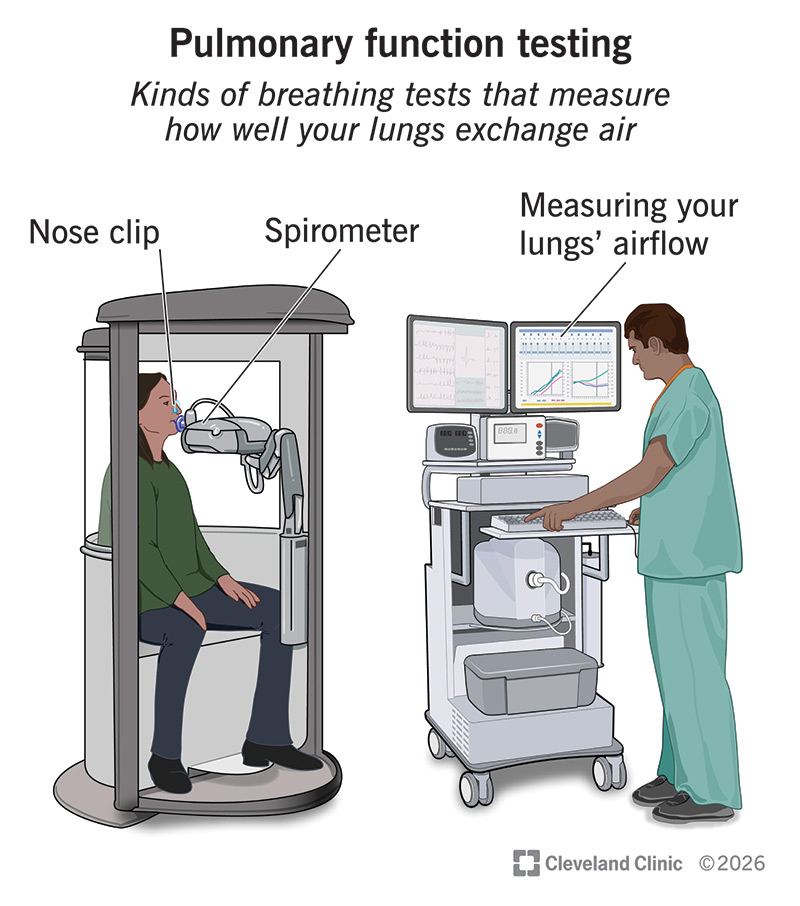
Pulmonary function testing
Diagnostic testWikipedia
26
MENTIONS
20
EPISODES
19
PODCASTS
Search complete. 26 mentions across 20 episodes found for "Pulmonary function testing".
Sep 11, 2026

Aaron DaltonHOST
You look at the chart and you can tell if you have the lab numbers to meet the listings.
Aaron DaltonHOST
And so to get into that a little bit more specifically, I think the most common one that I see is the FEV1 or spirometry testing.
Aaron DaltonHOST
So essentially it's the breath test.
Aaron DaltonHOST
You go in, you blow, and they measure how much forced air you can exhale.
7 MINS LATER
Chad BrownHOST
So we establish the diagnosis, which can be established multiple ways.
Chad BrownHOST
Sometimes it's based on symptoms that you provide to the doctor, but usually it's going to be based on some level of objective testing.
Chad BrownHOST
It may not be the full spirometry testing that we have with – a full COPD case.
Chad BrownHOST
There are other breathing-based tests that they can use.

DivineHOST
So remember, before you start a person on amiodarone, it's probably helpful to get PFT.
DivineHOST
It's like baseline, um, periodic PFTs, LFTs, and, uh, and TFTs, right? And then, uh, what if they give you a question about a patient and they tell you that this patient, um, is started on a class I antiarrhythmic, you know, for some class Ia antiarrhythmic for some kind of arrhythmia, right? And then, uh, you're told, uh, prior to initiating pharmacotherapy, which of the following is the most appropriate next step in management? Well, remember, um, uh, class Ia antiarrhythmics, right? They, uh, the-these are, uh, drugs like, uh, quinidine, right? Um, these are drugs like quinidine, right? I know you may be like, "There's no way they test these things on exams." No, they definitely do test them on exams.
DivineHOST
And the thing is, they're sodium channel blockers, right? So they're gonna basically slow down depolarization of, uh, of your cardiac myocytes, right? So the thing is, if you slow down depolarization, um, you can certainly get into trouble with, uh, prolonging the QT interval, right? Prolonging the QT interval, right? Prolonging the QT interval.
DivineHOST
So you should get a baseline EKG before you start these drugs, right? Monitor these people's QT interval.

Charles RudinGUEST
The things to look out for in those patients, do they have underlying evidence of pneumonitis or pulmonary limitation? I wouldn't necessarily not treat a patient if they had poor pulmonary function.
Charles RudinGUEST
The truth is muscle lung cancer, the vast majority of our patients are not going to have great PFTs, but I would be really cautious and watch closely in patients who we think might have increased risk.
Mark A. SocinskiHOST
Yeah, I agree.
Mark A. SocinskiHOST
It's an exciting time.

Kenneth Patrick SeastedtGUEST
And so where, you know, our goal is to make it a much more personalized kind of risk assessment for that particular patient.
Kenneth Patrick SeastedtGUEST
Because, you know, a lot of our patients are in the same age range, you know, 70 to 75, have similar PFTs.
Kenneth Patrick SeastedtGUEST
You know, you can get very generic outputs from risk calculators as to what the morbidity and mortality is going to be.
Kenneth Patrick SeastedtGUEST
But we want much more, you know, all of our patients are very different.
DivineHOST
Almost no myelosuppression, right? In fact, again, our friends at the NBMEs, they know that many of you have memorized that bleomycin causes pulmonary fibrosis, right? So what is the way they will go about this exact same question these days on the USMLE exams? They'll say prior to initiating therapy, right? Or they'll say which of the following is the most appropriate next step in management.
DivineHOST
Uh, go ahead and get PFTs.
DivineHOST
Go ahead and get PFTs.
DivineHOST
Go ahead and get pulmonary function testing, right? And again, try to limit the cumulative dose because again, as I've said-- I said this in the previous podcast, many of these chemotherapeutic drugs, the way they cause issues for people is the accumulative dose.
DivineHOST
The cumulative dose over time is what causes problems.

Njira LugogoGUEST
[laughs] 'Cause, you know, sometimes the patients will come to our specialty clinic and report that they failed everything, all biologics.
Njira LugogoGUEST
They're like, "None of them worked." And you can't find PFTs anywhere.
Njira LugogoGUEST
You can't find PROs.
Njira LugogoGUEST
You can't find labs.

Njira LugogoGUEST
They're like, none of them worked.
Njira LugogoGUEST
And you can't find PFTs anywhere.
Njira LugogoGUEST
You can't find PROs.
Njira LugogoGUEST
You can't find labs anywhere.

Njira LugogoGUEST
They're like, none of them worked.
Njira LugogoGUEST
And you can't find PFTs anywhere.
Njira LugogoGUEST
You can't find PROs.
Njira LugogoGUEST
You can't find labs anywhere.

Njira LugogoGUEST
They're like, none of them worked.
Njira LugogoGUEST
And you can't find PFTs anywhere.
Njira LugogoGUEST
You can't find PROs.
Njira LugogoGUEST
You can't find labs anywhere.

Njira LugogoGUEST
They're like, none of them worked.
Njira LugogoGUEST
And you can't find PFTs anywhere.
Njira LugogoGUEST
You can't find PROs.
Njira LugogoGUEST
You can't find labs anywhere.
10 more episodes mention Pulmonary function testing.
Create an account to see the whole feed, search across every transcript, and follow the entities you care about.