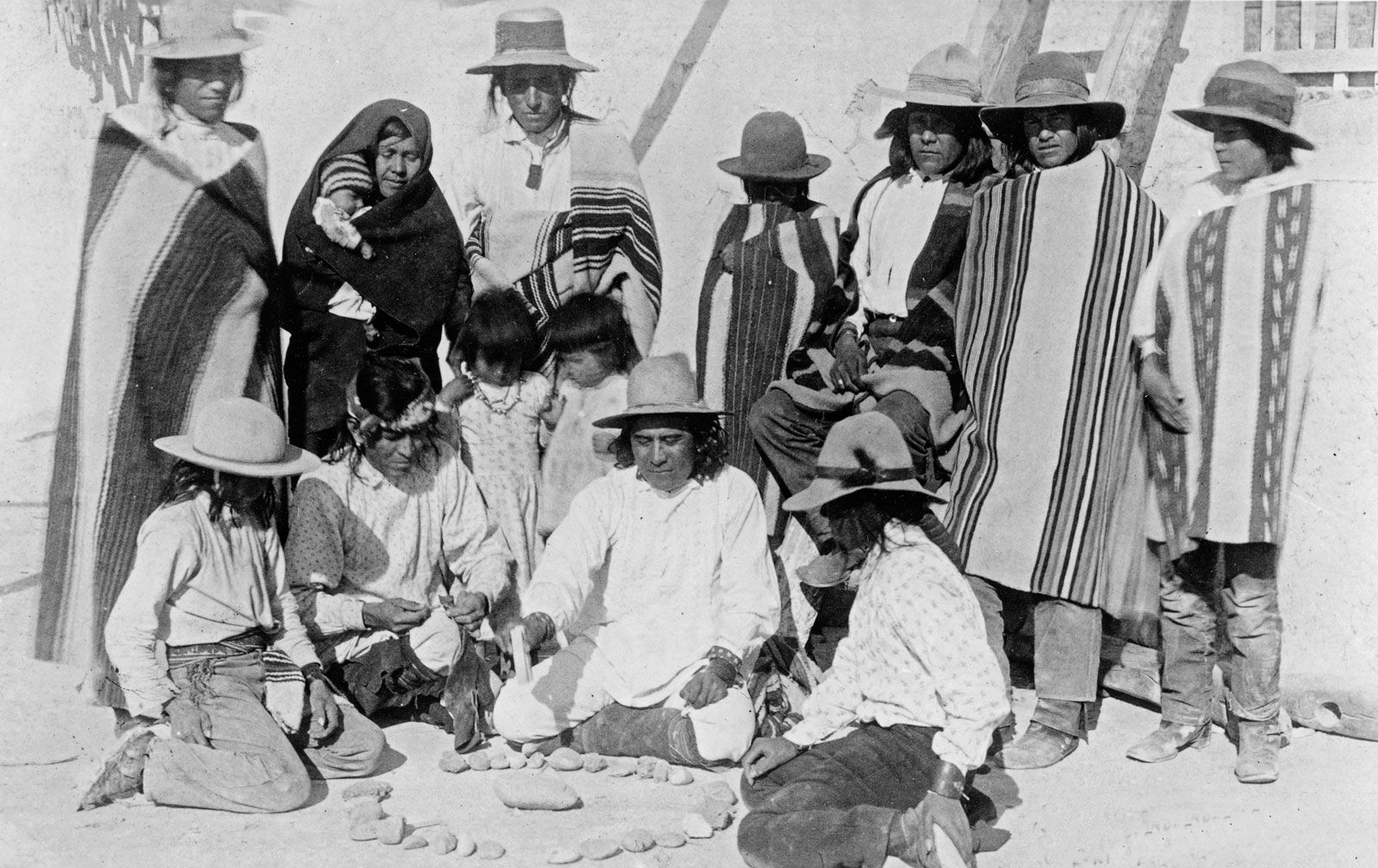
Pueblo peoples
PeopleWikipedia
104
MENTIONS
51
EPISODES
33
PODCASTS
Search complete. 104 mentions across 51 episodes found for "Pueblo peoples".
Sep 11, 2026

speaker_5NARRATOR
We can sound out the syllables, but we don't know what language they represent.
speaker_5NARRATOR
The ancestral Puebloans in the American Southwest built massive cliff dwellings and complex multi-story pueblos, then largely abandoned them in the 13th century.
speaker_5NARRATOR
Chaco Canyon was a massive cultural center with great houses containing hundreds of rooms.
speaker_5NARRATOR
Then the people dispersed.

Luke MehallHOST
So if you're curious about those two articles, check them out.
Luke MehallHOST
Josh's article was called Finding Protection in Bears Ears and Len's was called Yucca Rope, the DIY Ancestral Puebloan Static Line.
Luke MehallHOST
You know, there's so many things to say about Bears Ears National Monument.
Luke MehallHOST
Climbers love it, but it's, you know, the ancestral homeland for many different Native American indigenous tribes and tribes.
24 MINS LATER
Luke MehallHOST
Even if the work was grueling and the challenges to remain safe were often overwhelming.
Luke MehallHOST
The wall was located next to a giant forming arches, giving the zone a feeling of protection.
Luke MehallHOST
Perhaps the ancestral Puebloans once stood here as well and gathered water when there was more moisture here.
Luke MehallHOST
The first day of developing, we established two 510s right next to each other, and then immediately, I desired to go look at the line that initially attracted me to the wall.

Daniel ChacónHOST
But why did this suggestion trigger such an emotionally charged reaction from New Mexicans? Whether
Rob MartinezGUEST
you're native Puebloan or Apache, Navajo, Comanche, or Spanish, Mexican, French, African American.
Rob MartinezGUEST
We have been here for generations, immigrating here, establishing families, mixing bloodlines and cultures, fighting, dying, living and dying here.
Rob MartinezGUEST
Our Bones are in this earth.
9 MINS LATER
Rob MartinezGUEST
They are timelines that help us organize history.
Rob MartinezGUEST
But the fact is, there's a lot of movement in there.
Rob MartinezGUEST
The Puebloan people are here first.
Rob MartinezGUEST
We're learning for maybe over 20,000 years.

Shawn SpainhourHOST
Split twig figurines, small animal effigies woven from willow branches, tucked into caves deep within the canyon, have been found dating back roughly four thousand years, left by people whose purpose for them we can only partially reconstruct, likely ritual objects tied to hunting success.
Shawn SpainhourHOST
Ancestral Puebloan peoples built structures throughout the canyon between roughly one thousand five hundred and eight hundred years ago, granaries, dwellings, and- And ceremonial spaces tucked into alcoves and perched on ledges, some of which are still visible today along popular trails, including a well-preserved granary visible from the South Kaibab Trail that thousands of hikers walk past every year.
Shawn SpainhourHOST
The Hopi and other Pueblo peoples trace direct ancestry to these builders, and Hopi oral tradition includes detailed knowledge of specific migration routes and settlement sites throughout the canyon that predates and, in many cases, has since been confirmed by archaeological survey.
Shawn SpainhourHOST
The relationship between oral tradition and the archaeological record here is one of the more interesting ongoing collaborations in American archaeology tribal knowledge, held for a thousand years, guiding where scientists look and how they interpret what they find.

speaker_10SOUNDBITE_SPEAKER
Some of these, including portions of the skull, were charred, and the majority of the long bones had been cracked open.
speaker_10SOUNDBITE_SPEAKER
It would therefore seem that these Pueblo Indians, either through stress of hunger or for religious reasons, had occasionally resorted to the eating of human flesh.
speaker_2NARRATOR
Many of Wetherill's findings were later dismissed or ignored.
speaker_2NARRATOR
Wetherill himself was ambushed and murdered.

Derek DeStefanGUEST
So he just knew to be careful and, and Nancy was one of-- was a Native American, and he does have small Native American ancestry as well.
Derek DeStefanGUEST
And so he kinda held onto that part of his blood as he got older and going to Taos and talking to the Pueblo Indians.
Derek DeStefanGUEST
And that's why Nancy became very helpful to create the book and get it going.
Derek DeStefanGUEST
So I thought it's worth mentioning.

R.B. LembergGUEST
In all these respects, I think it isn't amiss to think of this time as sacred.
R.B. LembergGUEST
The sacred and the comic are not that far apart, something the Pueblo Indians seem to know better than most of us do.
R.B. LembergGUEST
Charles and Dennis came panting down the driveway with a big galvanized garbage can and a piece of semi-grid white plastic tubing about 15 feet long Dennis had the tube.
R.B. LembergGUEST
He knew what to do because he'd done it before.

NathanHOST
Which, well, that's south.
MattHOST
A lot of Native American and... ancestral Puebloan history in this region, especially.
MattHOST
And much like Mesa Verde, this area had, I mean, Puebloan dwellings dating back a thousand plus years up on steep mountainsides.
MattHOST
Yeah.
MattHOST
And so a lot of that is preserved.
Derek DeStefanGUEST
And, and Nancy was one of, was a native American and he does have small native American ancestry as well.
Derek DeStefanGUEST
And so he kind of held onto that part of his, blood as he got older and going to Taos and talking to the Pueblo Indians.
Derek DeStefanGUEST
And that's why Nancy became very helpful to create the book and get it going.
Derek DeStefanGUEST
So I thought it's worth mentioning.
Derek DeStefanGUEST
And Nancy was one of, was a Native American and he does have small Native American ancestry as well.
Derek DeStefanGUEST
And so he kind of held onto that part of his blood as he got older and going to Taos and talking to the Pueblo Indians.
Derek DeStefanGUEST
And that's why Nancy became very helpful to create the book and get it going.
Derek DeStefanGUEST
So I thought it's worth mentioning.
41 more episodes mention Pueblo peoples.
Create an account to see the whole feed, search across every transcript, and follow the entities you care about.