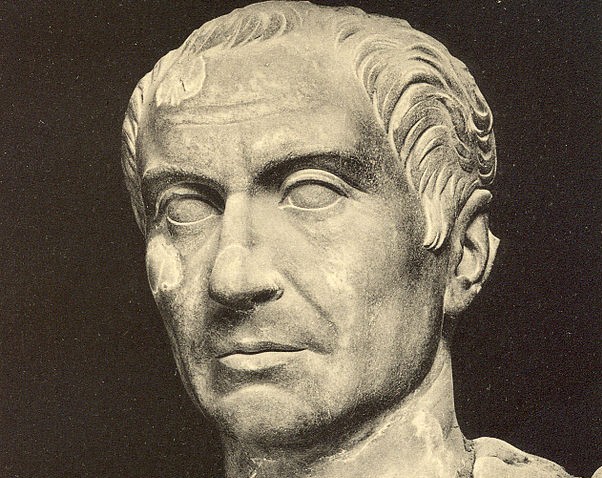
Publius Clodius Pulcher
PoliticianWikipedia
147
MENTIONS
26
EPISODES
20
PODCASTS
Search complete. 147 mentions across 26 episodes found for "Publius Clodius Pulcher".
Oct 16, 2026

Rachel CunliffePANELIST
But, you know, already this idea that the masses can be distracted if you bribe them and distract them and entertain them is, uh, deep in, in, in Roman thought and, and, uh, being disparaged by the elite Roman writers.
Rachel CunliffePANELIST
Um, but the one that I quite like who you might not have heard as much about is Clodius, who's a political figure at the same time as Cicero, who has this political career that is based on standing up for the people in a way.
Rachel CunliffePANELIST
He, um, massively expands the, uh, grain allowance that, uh, the grain subsidy that, um, s- poor citizens are entitled to.
Rachel CunliffePANELIST
Um, he's got a, a, a kind of weird sexual scandal in his past in that he dresses up as a woman and tries to get into an all-female festival.

speaker_0NARRATOR
Roman citizens had been executed without trial, a breach of the rights of the Roman people.
speaker_0NARRATOR
In 58 BCE, following the maneuverings of his political enemy Clodius, Cicero was unceremoniously exiled.
speaker_0NARRATOR
He languished far from Rome for sixteen months, often fearing for his life, separated from family and friends, but also from access to the public arena where he'd held his own for so long.
speaker_0NARRATOR
His letters home are full of lamentation.
10 MINS LATER
speaker_0NARRATOR
Such sexual passivity in an elite male, taking what was seen as a feminine, receptive sexual role, was deeply shocking for Romans.
speaker_0NARRATOR
It is notable that in his swansong, Cicero does his utmost to paint Antony as a man of unmanly sexual habits, addicted to pleasure, and with no sense of masculine moderation.
speaker_0NARRATOR
Cicero, ever the rhetorician out to win the argument, was quite prepared to exploit his audience's masculinist prejudices to demean an enemy.
speaker_0NARRATOR
With these speeches, Cicero managed to rally his fellow senators, at least for a time.

speaker_2NARRATOR
This LibriVox recording is in the public domain.
speaker_2NARRATOR
While tossed hither and thither by Catiline and Clodius, Pompeius and Crassus, by some open enemies and some doubtful friends, while he struggled with the struggling republic and kept it from going to ruin, when at last he was banished, being neither able to keep silence in prosperity nor to endure adversity with patience, how often must Marcus Cicero have cursed that consulship of his, which he never ceased to praise, and which nevertheless deserved it! What piteous expressions he uses in a letter to Atticus when Pompeius the father had been defeated and his son was recruiting his shattered forces in Spain.
speaker_2NARRATOR
"Do you ask," writes he, "what I am doing here? I am living in my Tusculan villa almost as a prisoner." He adds more afterwards, wherein he laments his former life, complains of the present, and despairs of the future.
speaker_2NARRATOR
Cicero called himself half a prisoner; but, by Hercules, the wise man never would have come under so lowly a title.

Alex GoughGUEST
So, um- Uh, yeah, so that, that's kind- that's his, um, that's his father and his stepfather.
Alex GoughGUEST
Um, and uh, at this point, he was, um, uh, just a kind of a wayward youth, um, uh, partying on the streets of Rome with his, uh, with his mate's, um, Clodius Pulcher, who we'll, we'll probably get onto as well, uh, and his best friend Curio.
Alex GoughGUEST
Um, and um, at some point, someone said, "You really need to sort yourself out." So as most, um, noble Roman youths do, he went to Greece, um, to study philosophy.
Alex GoughGUEST
Um, and there's this brilliant scene I love w- based on apparently what happened, which is when they turn up, um, in the docks at, uh, um, in Greece.
22 MINS LATER
Peta GreenfieldHOST
So if we're thinking about the series as a whole, and aside from Antony, was there any particular characters that you really enjoyed writing as well?
Alex GoughGUEST
Um, yeah.
Alex GoughGUEST
I mean, he's, he's not the best-known, known character, and he's, he, he dies relatively early in the series, but, um, Clodius Pulcher is one of my favorites.
Peta GreenfieldHOST
Ah, yes.

Jeremy Ryan SlateHOST
In 62 BC, Caesar was praetor, one step below the consulship, and that year's scandal landed in his own household.
Jeremy Ryan SlateHOST
It centered on a women's religious rite called the Bona Dea, and a young aristocrat named Clodius, who's going to matter a great deal in a later episode.
Jeremy Ryan SlateHOST
Caesar divorced his second wife, Pompeia, over it, and Plutarch has him explaining that Caesar's wife must be above suspicion.
Jeremy Ryan SlateHOST
Just so nobody gets tangled up later, Pompeia was no close relation to Pompey, despite the names, and that one trips up a lot of people reading these sources for the first time.
Jeremy Ryan SlateHOST
In 62 BC, Caesar was praetor, one step below the consulship, and that year's scandal landed in his own household.
Jeremy Ryan SlateHOST
It centered on a women's religious rite called the Bona Dea, and a young aristocrat named Clodius, who's going to matter a great deal in a later episode.
Jeremy Ryan SlateHOST
Caesar divorced his second wife Pompeia over it, and Plutarch has him explaining that Caesar's wife must be above suspicion.
Jeremy Ryan SlateHOST
Just so nobody gets tangled up later, Pompeia was no close relation to Pompey, despite the names, and that one trips up a lot of people reading these sources for the first time.

David CerfHOST
Rome had long sold subsidized grain in the capital.
David CerfHOST
In 58 BC, the tribune Clodius wiped out the price and made the distribution free.
David CerfHOST
Feeding the poor did not destroy the republic.
David CerfHOST
What changed was who got thanked.
6 MINS LATER
David CerfHOST
That is not a bribe on the public record.
David CerfHOST
It is a public rebate with an election date and a signature on it.
David CerfHOST
The parallel with Clodius is the credit, not the institution.
David CerfHOST
His grain was permanent.

Alexandra SillsHOST
We have such a second series coming up for you.
Alexandra SillsHOST
Much of it is already recorded and in the can, so I can exclusively reveal that in the coming months you can look forward to episodes, in no particular order, on Clodius, the Battle of Marathon, food and dining in ancient Greece, the Emperor Tiberius, the Athenian Empire, Arminius, the Catiline Conspiracy, the Emperor Julian, Mark Antony, the building blocks of epic poetry, Augustan monuments of the city of Rome, the Battle of Actium.
Alexandra SillsHOST
There'll be an episode on Hadrian and another one on Antinous.
Alexandra SillsHOST
We will learn how exactly Athenian democracy functioned.
Jeremy Ryan SlateHOST
Pompey aligned himself with the optimates, with Cato and the traditionalists, the same men who blocked him for years, and who now needed him against Caesar.
Jeremy Ryan SlateHOST
In 52 BC, after the street gangs of Clodius and Milo had left Rome burning and in chaos, they made Pompey sole consul alone, with no colleague at all.
Jeremy Ryan SlateHOST
Even Cato backed it, and it was extra-constitutional.
Jeremy Ryan SlateHOST
The man who'd once refused kingship now accepted an office that was kingship in all but name.

Jeremy Ryan SlateHOST
Pompey aligned himself with the optimates, with Cato and the traditionalists, the same men who blocked him for years and who now needed him against Caesar.
Jeremy Ryan SlateHOST
In 52 BC, after the street gangs of Clodius and Milo had left Rome burning and in chaos, they made Pompey's sole consul alone, with no colleague at all.
Jeremy Ryan SlateHOST
Even Cato backed it, and it was extra constitutional.
Jeremy Ryan SlateHOST
The man who'd once refused kingship now accepted an office that was kingship in all but name.
16 more episodes mention Publius Clodius Pulcher.
Create an account to see the whole feed, search across every transcript, and follow the entities you care about.