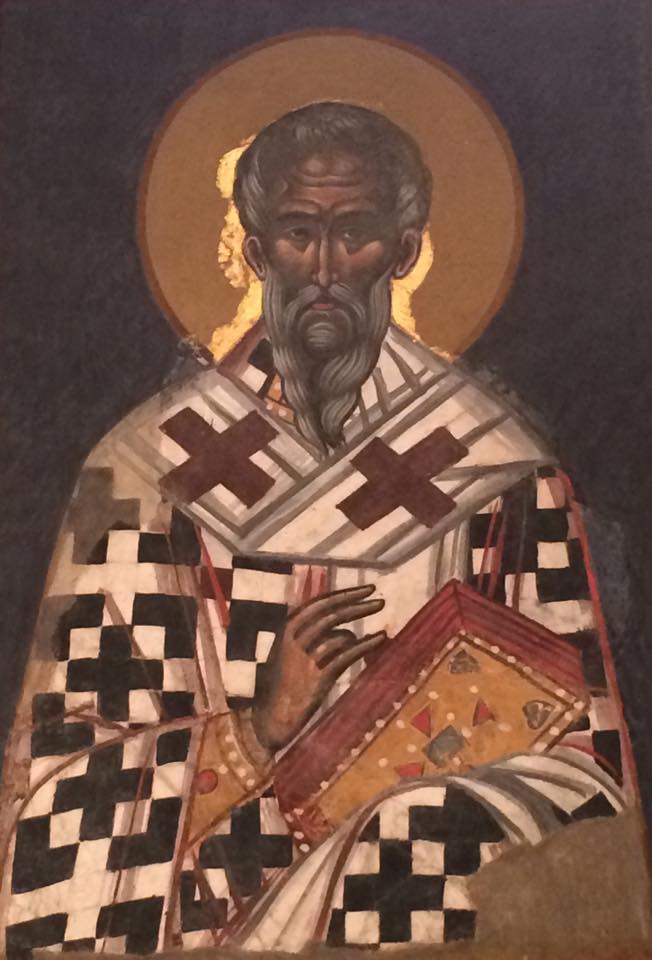
Pseudo-Dionysius the Areopagite
AuthorWikipedia
118
MENTIONS
22
EPISODES
21
PODCASTS
Search complete. 118 mentions across 22 episodes found for "Pseudo-Dionysius the Areopagite".
Sep 18, 2026

David AndersHOST
Yeah, they're our guys, too.
David AndersHOST
I mean, our big number one dude, Thomas Aquinas, I mean, his whole thought is absolutely saturated with the thought of Dionysius the Areopagite and John of Damascus.
David AndersHOST
I mean, the Eastern patrimony deeply enriches and fructifies the Latin tradition.
David AndersHOST
And I think it would go well for the Orthodox to acknowledge that when they talk to Catholics or write about Catholics.

Jason BaxterGUEST
At the same time, Thomas Gallus was deeply beholden to the effective spirituality that had grown up around the medieval commentaries on the Song of Songs.
Jason BaxterGUEST
And like Hugh of St. Victor, Thomas Gallus was also a great student of the mystical treatises of Dionysius the Areopagite, the father of medieval mysticism.
Jason BaxterGUEST
In particular, he hoped to show that these two sets of writings were not only mutually compatible, but were really two sides of the same coin.
Jason BaxterGUEST
Or as Thomas Gallus put it, quote, there are two forms of knowledge of God.
Jason BaxterGUEST
The one is intellectual and works through consideration of creatures.
Jason BaxterGUEST
That's facts, right? The other knowledge of God is incomparably better.
Jason BaxterGUEST
It is described by Dionysus, it is the superior wisdom by way of the human heart, end quote.
Jason BaxterGUEST
According to Thomas Gallus, to know God fully and wholly, you have to ascend to what he calls the apex of the soul.

Dylan SchraderHOST
Is there anything else that either of you wants to get in before we just wrap it up with a conclusion here?
Joey BellezaGUEST
Yeah, maybe just a brief mention of someone that Father had mentioned earlier is the figure of Pseudo-Dionysius, or as Urban and I like to say it, just Dionysius.
Joey BellezaGUEST
Yeah, so because this purportedly apostolic figure figure was not known to be a fifth or sixth century pseudonymous writer in the 13th century.
Joey BellezaGUEST
You know, he was treated with basically apostolic authority and the way in which Bonaventure, having learned Dionysus at this point, and actually I think that Bonaventure and Thomas are the first of their orders to study in Paris with the entire corpus of Dionysus' the manner in which the figure of St. Francis is interpreted in a very, very clear Dionysian lens that wasn't done before.
Joey BellezaGUEST
has made a great impact on the shape of Franciscan theology after that.
Joey BellezaGUEST
And maybe as a closing mention, the episode of the Stigmata, which I do not believe is legendary.
Joey BellezaGUEST
Dozens of people swore to seeing and adoring and kissing the exact same thing.
Joey BellezaGUEST
Um, but you know, he, he receives this, um, as part of a retreat during St. Michael's Lent in, uh, on top of this mountain called Mount Alverna, which was given to him by Count Orlando of Cusi as, uh, as a hermitage.
David AndersHOST
I'm sure there's some influence there.
David AndersHOST
But the Catholic doctrine of angels owes more, I think, to Hellenistic philosophy, in particular Neoplatonism, and to the works of Dionysius the Areopagite, and are developed in St. Thomas' Summa Theologica in deeply abstract and philosophical ways.
David AndersHOST
I mean, Thomas' conception of the angel is of an immaterial being, And he spends an awful lot of time unpacking what immaterial consciousness would look like in an angelic being without a body.
David AndersHOST
And I don't think those kinds of speculations owe anything to Zoroastrianism.

Brendan Graham DempseyGUEST
So it doesn't make any sense to put a bunch of people together and learn a core curriculum where half the people aren't getting any of it.
Brendan Graham DempseyGUEST
a quarter of the people are totally bored and maybe some subset are like actually kind of on par with whatever so actually recognizing that learning happens at these different levels and using those as the guidance rather than just age groupings would also be really huge because then you're in your cohort of people that's actually at your zone of proximal development you're actually learning from people and i think there's a whole model here that we could begin to develop around um A kind of almost kind of, you know, I'm thinking of like pseudo Dionysius, who's the guy who coined the idea of hierarchy, which I know is a kind of nasty term for some people.
Brendan Graham DempseyGUEST
But the basic idea that he's getting at there is that if you read his works in his kind of religious order, there are people that are kind of your mentors.
Brendan Graham DempseyGUEST
And then there are people that are sort of below you that you're mentoring and just taking the term in that sense.

Jonathan LangeNARRATOR
For He keeps all being in His own embrace, like a sea of essence infinite and unseen.
Jonathan LangeNARRATOR
Or, as the holy Dionysius says, He that is good, for one cannot say of God that He has being in the first place and goodness in the second.
Jonathan LangeNARRATOR
The second name of God is Othos, derived from thein, to run, because He courses through all things.
Jonathan LangeNARRATOR
Or from ithain, to burn, for God is a fire consuming all evil.
6 MINS LATER
Jonathan LangeNARRATOR
And to put it shortly, all the statements made about God that imply body have some hidden meaning and teach us what is above us by means of something familiar to ourselves, with the exception of any statement concerning the bodily sojourn of the God-Word.
Jonathan LangeNARRATOR
For he for our safety took upon himself the whole nature of man, the thinking spirit, the body, and all the properties of human nature, even the natural and blameless passions.
Jonathan LangeNARRATOR
Chapter 12 Concerning the Same The following then are the mysteries which we have learned from the holy oracles, as the divine Dionysius the Areopagite said, that God is the cause and beginning of all, the essence of all that have essence, the life of the living, the reason of all rational beings, the intellect of all intelligent beings, the recalling and restoring of those who fall away from him.
Jonathan LangeNARRATOR
The renovation and transformation of those that corrupt that which is natural, the holy foundation of those who are tossed in unholiness, the steadfastness of those who have stood firm, the way of those whose course is directed to him, and the hand stretched forth to guide them upwards.

AcerabelNARRATOR
Another work of this school deserves particular notice.
AcerabelNARRATOR
I mean the writings falsely attributed to Dionysius the Areopagite, the convert of St. Paul.
AcerabelNARRATOR
The pseudo-Dionysius, he may have been a Syrian monk, names as his teacher a certain Hierotheus, whom Frothingham has identified with Stephen Bar Sudali, a prominent Syrian Gnostic and a contemporary of Jacob of Saruge, 451-521 AD.
AcerabelNARRATOR
Dionysius quotes some fragments of erotic hymns by this Stephen, and a complete work, the Book of Hierotheus, on the hidden mysteries of the divinity, has come down to us in a unique manuscript which is now in the British Museum.

Brent SiddleHOST
Now, you've introduced me to somebody I had never read before, Plotinus.
Brent SiddleHOST
Now, and you also write about, people call him pseudo-Dionysius, but there are other people who think there's nothing pseudo about him.
Brent SiddleHOST
Anyway, let's not get into that debate.
Brent SiddleHOST
What, why, what, and what did Plotinus and what did pseudo-Dionysius or Dionysius believe about beauty?
Dennis BrayGUEST
Yeah, so Plotinus was not a Christian.
Dennis BrayGUEST
He rubbed shoulders with Christians.
Dennis BrayGUEST
And this is where, and we'll probably get here later, I hope we do, I think it's the beauty of our gospel, but this is where Christians differ so much about God's beauty and our beauty.
Brent SiddleHOST
Yeah, let's carry on.

Justin SledgeHOST
So this is an idea that's core.
Justin SledgeHOST
It will obviously live on in Pseudo-Dionysius, and it lives on in the Christian tradition, and it will live on in Kabbalah and all kinds of other things.
Justin SledgeHOST
So this idea also develops.
Justin SledgeHOST
But again, at the core of it, it's an ascent theory.

Ed HumpalNARRATOR
Therefore we cannot assign any definite number to the effects of government.
Ed HumpalNARRATOR
On the contrary, Dionysius says, Divine Names 12, God contains all and fills all by his providence and perfect goodness.
Ed HumpalNARRATOR
But government belongs to providence.
Ed HumpalNARRATOR
Therefore there are certain definite effects of the divine government.
16 MINS LATER
Ed HumpalNARRATOR
Considered in the first way, nothing can resist the order of the divine government.
Ed HumpalNARRATOR
This can be proved in two ways.
Ed HumpalNARRATOR
Firstly, from the fact that the order of the divine government is wholly directed to good, and everything by its own operation and effort tends to good only, for no one acts intending evil, as Dionysius says, Divine Names 4.
Ed HumpalNARRATOR
Secondly, from the fact that, as we've said above, answer 1, add 3, answer 5, add 2, every inclination of anything, whether natural or voluntary, is nothing but a kind of impression from the first mover, as the inclination of the arrow toward a fixed point is nothing but an impulse received from the archer.
12 more episodes mention Pseudo-Dionysius the Areopagite.
Create an account to see the whole feed, search across every transcript, and follow the entities you care about.