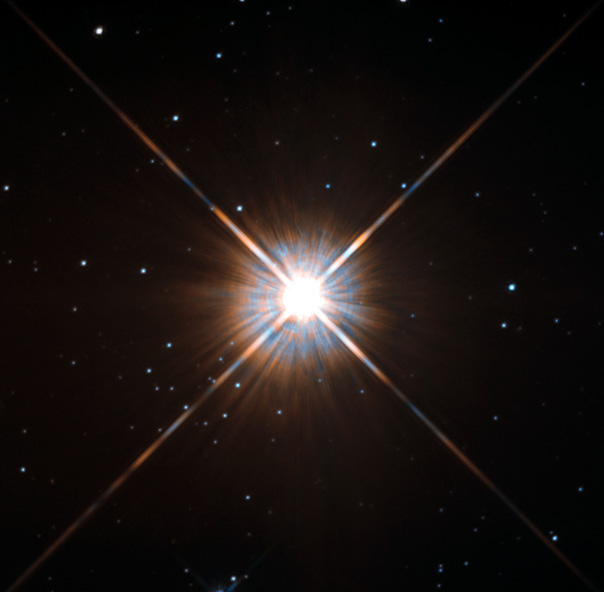
Proxima Centauri
StarWikipedia
1.1k
MENTIONS
133
EPISODES
60
PODCASTS
Search complete. 1089 mentions across 133 episodes found for "Proxima Centauri".
Sep 13, 2026

Phil ChenevertNARRATOR
That meant his ship was outbound on the Aldebaran run.
Phil ChenevertNARRATOR
Proxima Centauri, Sirius, Pollux, Procyon, Capella and Aldebaran.
Phil ChenevertNARRATOR
The line of passengers was disappearing through the doorway.
Phil ChenevertNARRATOR
A woman of head of bard turned and said nervously, We won't be put in cold sleep right away, will we? He reassured her, remembering his unbound trip five years ago.

PaulHOST
Yeah.
KatHOST
He misses Alpha Centauri B, which in orbit with his close binary Alpha Centauri A alternates between the second and third closest stars after Proxima Centauri.
KatHOST
He realizes he missed something and he had to go up and start all over again.
PaulHOST
Yeah.

Ana Sofia SimãoNARRATOR
That meant his ship was outbound on the Aldbaran Run.
Ana Sofia SimãoNARRATOR
Proxima Centauri, Sirius, Pollux, Procyon, Capella, and Aldbaran.
Ana Sofia SimãoNARRATOR
The line of passengers was disappearing through a doorway.
Ana Sofia SimãoNARRATOR
A woman ahead of Bart turned and said nervously, We won't be put into cold sleep right away, will we? He reassured her, remembering his unbound trip five years ago.

Beth JohnsonHOST
They are about the size and age of our own sun.
Beth JohnsonHOST
A third star, commonly known as Proxima Centauri, orbits the binary pair, but much farther out.
Beth JohnsonHOST
These new observations focused on the inner binary, and here's how the method works as explained by the press release.
Beth JohnsonHOST
By moving one star on the coronagraph and one star off the coronagraph every tenth of a second, this technique has allowed researchers to observe each star for half the time, and more importantly, it has allowed them to subtract one image from the next, which removes all but the noise of the camera and telescope.

Dean RegasHOST
It's our closest star by far.
Dean RegasHOST
At only ninety-three million miles away, or a hundred and fifty million kilometers, only I say, it's definitely easier to study than the next nearest star, Proxima Centauri, which is a whopping twenty-five trillion miles away, or forty trillion kilometers.
Dean RegasHOST
From Earth, places like the National Solar Observatory in Sunspot, New Mexico, can document fluctuating activity and monitor changes over time at our superstar.
Dean RegasHOST
But where can you watch the sun all day and all night? Let's go to space.

Richard GaitskellGUEST
We call them weakly interacting massive particles, and that term weakly interacting is, is, is no small exaggeration.
Richard GaitskellGUEST
These particles are so weakly interacting that if we took a single particle and set it off on a journey through a stack of lead, just continuously passing through lead, it could actually travel all the way from here to our closest star, well, after the sun, you know, Proxima Centauri, which is over four light-years.
Richard GaitskellGUEST
And four light-years of lead, the particle still wouldn't, on a 50/50 basis, have interacted.
Richard GaitskellGUEST
It, it, it-- This is crazy small probabilities of interacting, and the only reason it is even remotely feasible for us to say we- we're gonna try and measure such weakly interacting particles with a experiment here on Earth, or if you like, under the Earth, is that we have a very large detector, it's, it's nearly 10 tons in scale, and, uh, that we watch it for a very long period of time.

PeterHOST
Yeah, the average distance between stars is about 5 light years, or 47 trillion kilometers.
PeterHOST
For instance, the nearest star to us in our celestial neighborhood is Proxima Centauri, which is 4.24 light-years away, or 40 trillion kilometers.
PeterHOST
So there's a lot of room for the star systems that make up these galaxies to just quietly slide past one another.
PeterHOST
To visualize it, if you scaled Earth down to the size of a couple nanometers, about the size of a virus, our solar system would be about the size of a golf ball.

David KippingHOST
This star, 40 light-years away, is called TRAPPIST-1, and two of the planets might even be close to the so-called habitable zone of that star.
David KippingHOST
So huge congratulations to the TRAPPIST team on this amazing discovery, and I thought this would be a good time to update everyone about a search we are running here at the Cool Worlds Laboratory at Columbia for transiting planets around the nearest star, which is also a red dwarf, Proxima Centauri.
David KippingHOST
So the inspiration behind our campaign actually goes all the way back to 2012, when I remember sitting in a conference and hearing the announcement of a new planetary system around a red dwarf star in the Kepler data.
David KippingHOST
And I remember at the time, the author of this study, Phil Muirhead, pointed out that this star, Kepler-42, which has three planets around it, all rocky planets, looks very similar to our nearest red dwarf stars, Barnard's Star and Proxima Centauri.
David KippingHOST
In particular, the planets found around Kepler-42 were on very short orbital periods, of order of a day.
David KippingHOST
That means that because they were so close to the star, the probability of seeing a transit is actually really good.
David KippingHOST
So this discovery inspired me, and I realized that if we took the planetary system around Kepler-42 and plonked it around Proxima Centauri, it would be surprisingly detectable.
David KippingHOST
So I asked for time on MOST.

QuinnHOST
It would last approximately 500 years, and during that time, approximately half of Asia's mountains would be consumed by the Earth's engines as fuel.
QuinnHOST
Course was set for the star Proxima Centauri, approximately 4.3 light-years away.
QuinnHOST
During this point in time, civil unrest begins to build.
QuinnHOST
The populace begins to greatly mistrust the Coalition.
QuinnHOST
The explosion lasted for a short moment.
QuinnHOST
It was the last time its heat and light would ever reach the Earth.
QuinnHOST
Following the Sun's expansion, humanity continues its journey towards Proxima Centauri.
QuinnHOST
The fourth stage was called Wandering Earth 2.
David KippingHOST
For example, Deneb in the constellation Cygnus is easily visible by eye despite being roughly 2,000 light years away.
David KippingHOST
But the nearest star, Proxima Centauri, just four light years away, isn't visible by eye at all.
David KippingHOST
And to cap this argument off, my favorite example of a dissection bias would have to be supernovae.
David KippingHOST
The most common type of supernova is a core collapse event.
123 more episodes mention Proxima Centauri.
Create an account to see the whole feed, search across every transcript, and follow the entities you care about.