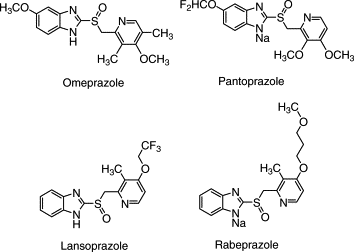
Proton-pump inhibitor
Class of drugsWikipedia
230
MENTIONS
92
EPISODES
89
PODCASTS
Search complete. 230 mentions across 92 episodes found for "Proton-pump inhibitor".
Sep 12, 2026

Rick LawrenceNARRATOR
They help digest food, defend your health by blocking bad germs, and teach your body how to fight off real illness, in addition to producing essential nutrients and active neurotransmitters, a tiny chemical messenger that carries important signals from one nerve cell to the next across your nervous system, including the brain.
Rick LawrenceNARRATOR
What can destroy your gut health? poor nutrition, poor sleep, and medical interventions like antibiotics, PPIs, surgery, and hospitalization.
Rick LawrenceNARRATOR
You can find out more about these microbiome-oriented activities by contacting 754-9039 to receive further information on self-care.
Rick LawrenceNARRATOR
And finally today from the river region portion of the September 4th edition, please join us for the 25th anniversary commemoration of 9-11 by Terry Dell, Interim Executive Director of the Chapter of the Chamber of Commerce.

AndrewHOST
AIN is an inflammation involving the renal interstitium and tubules, which is classically caused by drug-induced hypersensitivity reaction.
AndrewHOST
High-yield medications for this include beta-lactam antibiotics like cephalexin, sulfa drugs, rifampin, NSAIDs, PPIs, and certain diuretics.
AndrewHOST
The classic teaching triad is fever, rash, and eosinophilia.
AndrewHOST
But an important clinical point is that patients do not always have this entire triad.

David JockersHOST
In fact, just about every medication depletes magnesium.
David JockersHOST
We're talking about things like statin drugs, antidepressants, PPIs, which are your acid-blocking medications, blood pressure medications, ADHD medications, antibiotics, chemotherapy.
David JockersHOST
All those deplete magnesium.
David JockersHOST
And that's why most functional nutritionists recommend 500 to 1,000 milligrams daily from food and supplements.

Ahmed MalikHOST
They should know that.
Ahmed MalikHOST
I mean, they're meant to be teaching teachers, teachers and health, but then they're recommending Ozempic and SSRIs and antidepressants and statins and PPIs and vaccines.
Ahmed MalikHOST
And I just feel like the very thing that they're meant to be promoting true health, wellness, health, they do the exact opposite.
Ahmed MalikHOST
They just feed big pharma.

Shahryar KhanGUEST
So you would have to ask about, um, a history of, uh, like drugs.
Shahryar KhanGUEST
Uh, have they, have they had any NSAIDs, omeprazole, PPIs, any new drug, and then there is a temporal association between that new drug and AKI.
Shahryar KhanGUEST
Uh, so that actually gives you a telltale sign that it could just be an acute interstitial nephritis.
Shahryar KhanGUEST
In chemotherapy patients, specifically, you know, people on immunotherapy, like the pembrolizumabs and all of these zumabs, they can cause acute interstitial nephritis, which we call as immunotherapy related nephritis.

Richard RockerHOST
Let's face it, it's a big moneymaker and I don't think they're going to let go of that narrative anytime soon.
Richard RockerHOST
The second thing I also see, Widely prescribed is PPIs, protein pump inhibitors.
Richard RockerHOST
Yes, yes.
Richard RockerHOST
And again, when I look at that and going, well, if people ate a species appropriate diet, they probably wouldn't need to take that in the first place.

Molly PelletierHOST
So let's start kind of with the foundation.
Molly PelletierHOST
So roughly 80% of LPR patients and 40% of GERD patients don't respond to PPIs, which is a crazy statistic.
Molly PelletierHOST
Why does acid suppression work for some people and not others?
Nikki JohnstonGUEST
Yes, as you said, approximately 40% of GERD patients have persistent symptoms despite proton pump inhibitor, PPI acid suppression therapy, and the majority of LPR patients don't respond to PPIs with some studies, as you said, reporting up to 86%.
Nikki JohnstonGUEST
And it really for a long time, LPR was thought to be simply an extension of GERD, so that stomach acid moving higher up, irritating the throat.
Nikki JohnstonGUEST
But I think what we've learned over the past two decades is that this explanation is too simplistic.
Nikki JohnstonGUEST
So our understanding has shifted towards a more nuanced model, thankfully, that now includes non-acid reflux, pepsin exposure, neural hypersensitivity, and impaired mucosal defenses.
Nikki JohnstonGUEST
And so I think we now recognize LPRD as a more heterogeneous disease with multiple phenotypes rather than just that acid-centered entity.

Jamie BelzHOST
The failure occurs when symptom management becomes the overarching just accepted solution.
Jamie BelzHOST
It becomes so profitable and familiar, everybody has heartburn, everybody's on a PPI, right, that they quit looking for the cause.
Jamie BelzHOST
It's professionally inconvenient.
Jamie BelzHOST
They don't want to find help.

Eric BergHOST
Certain medications also deplete B1.
Eric BergHOST
Antacids like PPIs or metformin, certain antibiotics.
Eric BergHOST
People that are under chronic stress need tremendous amounts of B1.
Eric BergHOST
And also, there's a virus that can go in and out of remission.

LilaHOST
So somebody has stomach acid coming back up their throat.
LilaHOST
What do we do? We suppress it, right? With some of the medications we're going to talk about with, you know, PPIs and things like that.
LilaHOST
But what we don't take the time to understand and fix is how these mechanisms actually work.
LilaHOST
So we have to have a certain level of stomach acid in our stomachs for the lower esophageal sphincter to close.
82 more episodes mention Proton-pump inhibitor.
Create an account to see the whole feed, search across every transcript, and follow the entities you care about.