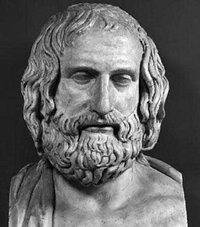
Protagoras
Philosopher and sophistWikipedia
221
MENTIONS
43
EPISODES
35
PODCASTS
Search complete. 221 mentions across 43 episodes found for "Protagoras".
Oct 18, 2026

Bob FosterNARRATOR
Whether the poet knows these things or not, his art as a poet is never seriously criticized on that account.
Bob FosterNARRATOR
What fault can one see in Homer's Sing of the Wrath, Goddess, which Protagoras has criticized as being a command where a prayer was meant, since the bid one do or not do he tells us is a command.
Bob FosterNARRATOR
Let us pass over this, then, as appertaining to another art and not to that of poetry.
Bob FosterNARRATOR
This is a LibriVox recording.

Geoffrey EdwardsNARRATOR
Stranger: In all and every art, what the craftsman ought to say in answer to any question is written down in a popular form, and he who likes may learn.
Geoffrey EdwardsNARRATOR
Theaetetus: I suppose that you are referring to the precepts of Protagoras about wrestling and the other arts? Stranger: Yes, my friend, and about a good many other things.
Geoffrey EdwardsNARRATOR
In a word, is not the art of disputation a power of disputing about all things? Theaetetus: Certainly there does not seem to be much which is left out.
Geoffrey EdwardsNARRATOR
Stranger: But, oh, my dear youth, do you suppose this possible? For perhaps your young eyes may see things which to our duller sight do not appear.

speaker_1NARRATOR
The form and institutions of the state are more clearly drawn out in the laws.
speaker_1NARRATOR
As works of art, the Symposium and the Protagoras are of higher excellence.
speaker_1NARRATOR
But no other dialogue of Plato has the same largeness of view and the same perfection of style.
speaker_1NARRATOR
No other shows an equal knowledge of the world, or contains more of those thoughts which are new as well as old, and not of one age only, but of all.

Artificially AwareHOST
Man is the measure of all things.
Artificially AwareHOST
This proverb, attributed to the ancient Greek philosopher Protagoras, suggests that human beings, in all their complexity, are the standard by which everything is judged.
Artificially AwareHOST
But is this just a self-centered view of the universe? Or does it hold a deeper truth? In the realm of science, this idea resonates with the anthropic principle, which posits that the universe must be compatible with the conscious beings that observe it.
Artificially AwareHOST
Your human experience, after all, is how the universe perceives itself.

Gio PennacchiettiHOST
An analogy I could find in history would be, was it in the Credo or was it the Menno? I forget.
Gio PennacchiettiHOST
Was it in the Protagoras? I was right, actually.
Gio PennacchiettiHOST
It was the Menno.
Gio PennacchiettiHOST
It was the Menno.

Pamela NagamiNARRATOR
4.
Pamela NagamiNARRATOR
Protagoras The first and most famous of the sophists was Protagoras of Abdera.
Pamela NagamiNARRATOR
Born in the year 480 BC, he became a paid teacher at 30, and pursued that calling for a period of 40 years with brilliant success, traversing the whole breadth of the Hellenic world, and if we may judge from what seems to be the typical instance of Athens, exciting immense enthusiasm among the more enlightened classes of Greek society.
Pamela NagamiNARRATOR
Pericles debated moral problems with him, and he was employed to make laws for the Athenian colony of Thurii.
Pamela NagamiNARRATOR
On the occasion of a later visit to the imperial city, public attention was drawn to the fact that Protagoras was a declared agnostic.
Pamela NagamiNARRATOR
A book of his began with the words, As to the gods, I do not know whether they exist or not.
Pamela NagamiNARRATOR
Life is too short for such difficult inquiries.
Pamela NagamiNARRATOR
The author was expelled from Athens, a herald was sent round demanding the surrender of the book from all private individuals who possessed it, and the copies collected were burnt in the marketplace.

Mark LinsenmayerHOST
At some point, he quotes Homer, but in this case, both the people prompting Hippias and Ion, respectively, have some knowledge, have said something with regard to Homer that gets this discussion going, and I'm really glad that this morning I actually...
Mark LinsenmayerHOST
I was reviewing the Protagoras and some other, the Gorgias, and other things in this area because these two dialogues, like, if you introduce somebody to Plato with these, this would not be good.
Mark LinsenmayerHOST
[laughs] They would not know what Plato's, Socrates's view is on anything.
Mark LinsenmayerHOST
They're both very short, and they kind of establish, I don't know, they're very easy to summarize, I feel.
Wes AlwanHOST
It's Seth's turn, and I didn't really give a real intro [laughs] anyway.
Mark LinsenmayerHOST
Well, since Seth didn't jump in, I'll say one more thing.
Mark LinsenmayerHOST
So I'm glad that this morning I thought about this, you know, unifying knowledge and virtue thing, which is very central to all of, you know, the, if we're gonna analyze what Plato has to say about ethics, this is really key, and we talked about it a lot in our discussion of the Protagoras, which was another, you know, mid-period dialogue around the same time or earlier, a little earlier than The Republic, we think, where, you know, where The Republic we sort of get the, the clearest idea of, you know, what this ruler class, how they would be the best, how they would be in touch with virtue.
Mark LinsenmayerHOST
But I was being very literal before that, and, like, you know, we're gonna consider the perennial questions of, is it better to knowingly do evil than to unknowingly do evil? And are the poets knowledgeable about the things they talk about, or are they just divinely inspired? Those questions do, which are the literal things that are discussed in these two dialogues, do not sound like they would reverberate through the ages.

Pamela NagamiNARRATOR
4.
Pamela NagamiNARRATOR
Protagoras The first and most famous of the Sophists was Protagoras of Abdera.
Pamela NagamiNARRATOR
Born in the year 480 BC, he became a paid teacher at 30, and pursued that calling for a period of 40 years with brilliant success, traversing the whole breadth of the Hellenic world.
Pamela NagamiNARRATOR
And if we may judge from what seems to be the typical instance of Athens, exciting immense enthusiasm among the more enlightened classes of Greek society.
Pamela NagamiNARRATOR
Pericles debated moral problems with him, and he was employed to make laws for the Athenian colony of Thurii.
Pamela NagamiNARRATOR
On the occasion of a later visit to the imperial city, public attention was drawn to the fact that Protagoras was a declared agnostic.
Pamela NagamiNARRATOR
A book of his began with the words, As to the gods, I do not know whether they exist or not.
Pamela NagamiNARRATOR
Life is too short for such difficult inquiries.

Mark LinsenmayerHOST
At some point he quotes Homer, but in this case, both the people prompting Hippias and Ion respectively are, have some knowledge, have said something with regard to Homer that gets this discussion going.
Mark LinsenmayerHOST
And I'm really glad that this morning I actually, I was reviewing the Protagoras and some other, the Gorgias and other things in this area, because these two dialogues, like if you introduce somebody to Plato with these, this would not be good.
Mark LinsenmayerHOST
They would not know what Plato's, Socrates' view is on anything.
Mark LinsenmayerHOST
They're both very short and they kind of establish, I don't know, they're very easy to summarize, I feel.
Mark LinsenmayerHOST
Well, since Seth didn't jump in, I'll say one more thing.
Mark LinsenmayerHOST
So I'm glad that this morning I thought about this, you know, unifying knowledge and virtue thing, which is very central to all of, you know, if we're going to analyze what Plato has to say about ethics, this is really key.
Mark LinsenmayerHOST
And we talked about a lot in our discussion of Protagoras, which was another mid-period dialogue around the same time or earlier, a little earlier than the Republic era.
Mark LinsenmayerHOST
We think where we're a republic, we sort of get the clearest idea of what this ruler class, how they would be the best, how they would be in touch with virtue.
33 more episodes mention Protagoras.
Create an account to see the whole feed, search across every transcript, and follow the entities you care about.