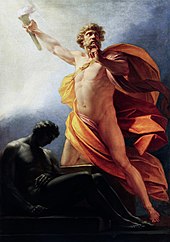
Prometheus
GodWikipedia
716
MENTIONS
92
EPISODES
79
PODCASTS
Search complete. 716 mentions across 92 episodes found for "Prometheus".
Sep 21, 2026

speaker_4NARRATOR
This tale, which is by far the best authenticated fact in Hesiod's life, does not give us a very pleasant impression as to the poet's capacity for passing judgement on women, and probably the details of the Pandora myth are his own invention.
speaker_4NARRATOR
The story itself is very old, but as told by Hesiod it has all the sham epic machinery, while it is linked on to the ancient fable of Prometheus.
speaker_4NARRATOR
To revenge the gift of fire to men, Zeus resolves to make a woman.
speaker_4NARRATOR
I will give them an evil thing, he says.
1 HR 6 MINS LATER
April6090NARRATOR
With such like dreams the kingly dark for me was ever fraught, me miserable, till ridden I gat me heart to open to my father the visions and the dreams of night and he to Plytho, yeah, and even to Dodona sent embossage on embossage inquiring what thing he had need to do or what word speak to pleasure them that rule us and they came bringing still back burdenous wavering lips sentences blind dark syllables at last a word cleared visaged came to Machus enjoying plainly saying he should thrust me forth of the house forth of the land to wander at large a separate thing even to the last confines of earth The story is the same, but the treatment is different.
April6090NARRATOR
The two passages illustrate the difference between romantic idealism and realistic depreciation.
April6090NARRATOR
But Io, in the Prometheus, is only one of the gallery of Acelus heroines.
April6090NARRATOR
For in his art, women take the foremost place.

Betty B.NARRATOR
Recording by Betty B.
speaker_7NARRATOR
The Problem of Types in Poetry Carl Spittler's Prometheus and Epimetheus By Carl Gustav Jung, 1875-1961 From Psychological Types or the Psychology of Individuation This is a LibriVox recording.
speaker_7NARRATOR
All LibriVox recordings are in the public domain.
speaker_7NARRATOR
For more information or to volunteer, please visit LibriVox.org.
speaker_7NARRATOR
But we have already seen how in Schiller this problem stirred the poet in him as deeply as the thinker.
speaker_7NARRATOR
In this chapter we shall turn our attention to a poetic work which is almost exclusively based on the motif of the type problem.
speaker_7NARRATOR
I refer to Carl Spittler's Prometheus and Epimetheus, which first appeared in 1881.
speaker_7NARRATOR
I have no wish to explain at the outset that Prometheus, the forethinker, stands for the introvert, while Epimetheus, the man of action and afterthinker, signifies the extrovert.

speaker_7ADVERTISER
Midas, the best around.
ExpatriateNARRATOR
Chorus, here's thou the address of the cow horned virgin, Prometheus.
ExpatriateNARRATOR
and how not here the fly world virgin daughter of inachus whose zeus's heart warmed with love and now the courses overlonged by herei hated forcedly performs io whence utterest thou my father's name tell me miserable who thou art that to me o suffering one me born to suffer thus true things dost address the god-sent ale thou namest which wastes me stinging with maddening goads alas alas with foodless and unseemly leaps rushing headlong i came by wrathful plots subdued who of the wretched who alas alas suffers like me but to me clearly show what me awaits to suffer what not necessary what remedy of ill teach if indeed thou know'st speak out tell the ill wandering virgin prometheus how clearly tell thee all you wish to learn not weaving in enigmas but in simple speech as it is just to open the mouth to friends thou seest the giver of fire to men prometheus io o thou who didst appear a common help to mortals wretched prometheus to atone for what do you endure this prometheus i have scarce ceased my sufferings lamenting io would you not grant this favour to me prometheus say what you ask for you learn all from me io say who has bound thee to the cliff prometheus the will indeed of zeus hephaestus hand io and penalty for what crimes dost thou pay pr thus much only can i show thee io but beside this declare what time will be to me unfortunate the limit of my wandering pr not to learn is better for thee than to learn these things io conceal not from me what i am to suffer pr indeed i grudge thee not this favour io why then dost thou delay to tell the whole prometheus there's no unwillingness but i hesitate to vex thy mind io care not for me more than is pleasant to me prometheus since you are earnest it behoves to speak hear then chorus not yet indeed but a share of pleasure also give to me first will learn the malady of this one herself relating her destructive fortunes and the remainder of her trials let her learn from thee prometheus tis thy part io to do these a favour as well for every other reason and as they are sisters of thy father since to weep and to lament misfortunes there where one will get a tear from those attending is worthy the delay io i know not that i need distrust you but in plain speech you shall learn all that you ask for and yet e'en telling i lament the god-sent tempest and dissolution of my form whence to me miserable it came for always visions in the night moving about my virgin chambers enticed me with smooth words o greatly happy virgin why be a virgin long is permitted to obtain the greatest marriage for zeus with love's dart has been warmed by thee and wishes to unite in love but do thou o child spurn not the couch of zeus but go out to lerna's deep morass and stables of thy father's herds that the divine eye may cease from desire with such dreams every night was i unfortunate distressed till i dared tell my father of the night wandering visions and he to pytho and dodona frequent prophets sent that he might learn what it was necessary he should say or do to do agreeably to the gods and they came bringing ambiguous oracles darkly and indistinctly uttered but finally a plain report came to enochus clearly enjoining him and telling out of my home and country to expel me discharged to wander to the earth's last bounds and if he was not willing from zeus would come a fiery thunderbolt which would annihilate all his race induced by such predictions of the loxian against his will he drove me out and shut me from the houses but zeus's reign compelled him by force to do these things immediately my form and mind were changed and horned as you behold stung by a sharp-mouthed fly with frantic leaping rushed i to cancria's palatable stream and lerna's source but a herdsman born of earth of violent temper argus accompanied with numerous eyes my steps observing but unexpectedly a sudden fate robbed him of life and i fly stung by lash divine am driven from land to land you hear what has been done and if you have to say aught what's left of labour speak nor pitying me comfort with false words for an ill the worst of all i say are made-up words chorus ah ah enough alas ne'er ne'er did i presume such cruel words would reach my ears nor thus unsightly and intolerable hurts sufferings fears with a two-edged goad would chill my soul alas fate fate i shudder seeing the state of io prometheus beforehand sigh'st thou and art full of fears hold till the rest also thou chorus tell teach for to the sick tis sweet to know the remaining pain beforehand clearly prometheus your former wish ye got from me with ease for first ye asked to learn from her relating her own trials the rest now here what sufferings tis necessary this young woman should endure from here but do thou offspring of enochus my words cast in thy mind that thou mayst learn the boundaries of the way first indeed hence towards the rising of the sun turning thyself travel uncultivated lands and to the scythian nomads thou wilt come who woven roofs on high inhabit on well-wheeled carts with far casting bows equipped whom go not near but to the sea resounding cliffs bending thy feet pass from the region on the left hand the iron-working calabes inhabit whom thou must needs beware for they are rude and inaccessible to strangers and thou wilt come to the hybristes river not ill-named which pass not for not easy is it to pass before ye get to caucasus itself highest of mountains where the stream spurts out its tide from the very temples in passing over the star-neighbored summits tis necessary to go the southern way where thou wilt come to the man-hating army of the amazons who themiscyra one day will inhabit by the thermidon where psalmidesia rough jaw of the sea inhospitable to sailors stepmother of ships they will conduct thee on thy way and very cheerfully and to the cimmerian isthmus thou wilt come just on the narrow portals of a lake which leaving it behoves thee with stout heart to pass the meiotic straits and there will be to mortals ever a great fame of thy passage and bosphorus from thy name twill be called and leaving europe's plain the continent of asia thou wilt reach seemeth to thee forsooth the tyrant of the gods in everything to be thus violent for he a god with this mortal wishing to unite drove her to these wanderings a bitter wooer didst thou find o virgin for thy marriage for the words you now have heard think not yet to be the prelude eo ah me me alas alas prometheus again dost shriek and heave a sigh what wilt thou do when the remaining ills thou learn'st chorus and hast thou any further suffering to tell her prometheus ay a tempestuous sea of baleful woe io what profit then for me to live and not in haste to cast myself from this rough rock that rushing down upon the plain i may be released from every trouble for better once for all to die than all my days to suffer evilly End of part two, recording by expatriate in Bangor, Maine.
ExpatriateNARRATOR
Part three of Prometheus Bound by Aeschylus, translated by Henry David Thoreau, 1817-1862.
ExpatriateNARRATOR
This LibriVox recording is in the public domain.
ExpatriateNARRATOR
Recording by expatriate in Bangor, Maine.
ExpatriateNARRATOR
Part three.
ExpatriateNARRATOR
prometheus unhappily my trials wouldst thou hear to whom to die has not been fated for this would be released from sufferings but now there is no end of ills lying before me until zeus falls from sovereignty io and is zeus ever to fall from power prometheus thou wouldst be pleased i think to see this accident io how should i not who suffer ill from zeus prometheus that these things then are so be thou assured io by what one will the tyrant's power be robbed prometheus himself by his own senseless counsels io in what way show if there's no harm prometheus he will make such a marriage as one day he'll repent io of god or mortal if to be spoken tell prometheus what matters which for these things are not to be told io by a wife will he be driven from the throne prometheus aye she will bring forth a son superior to his father io is there no refuge for him from this fate prometheus none surely till i may be released from bonds io who then is to release thee zeus unwilling prometheus he must be some one of thy descendants io how sayest thou that my child would deliver thee from ills prometheus third of thy race after ten other births io this oracle is not yet easy to be guessed prometheus but do not seek to understand thy sufferings Io, first proffering gain to me, do not then withhold it.

ElroyNARRATOR
The end of Satuli or the King of the Birds.
Ollie A. GeeNARRATOR
The Story of Prometheus in Myths and Legends Around the World.
Ollie A. GeeNARRATOR
Collection 10.
Ollie A. GeeNARRATOR
This is a LibriVox recording.
Ollie A. GeeNARRATOR
All LibriVox recordings are in the public domain.
Ollie A. GeeNARRATOR
For more information, or to volunteer, please visit LibriVox.org. Read by Ollie A. Gee.
Ollie A. GeeNARRATOR
The Story of Prometheus by James Baldwin.
Ollie A. GeeNARRATOR
Chapter 1 How Fire Was Given To Men in those old old times there lived two brothers who were not like other men nor yet like those mighty ones who lived upon the mountain top they were the sons of one of those titans who had fought against jupiter and been sent in chains to the strong prison-house of the lower world the name of the elder of these brothers was prometheus or forethought for he was always thinking of the future and making things ready for what might happen to-morrow or

Denny SayersNARRATOR
Section three.
Denny SayersNARRATOR
The story of Prometheus.
Denny SayersNARRATOR
One.
Denny SayersNARRATOR
How fire was given to men.
Denny SayersNARRATOR
In those old, old times, there lived two brothers who were not like other men, nor yet like those mighty ones who lived upon the mountaintop.
Denny SayersNARRATOR
They were the sons of one of those titans who had fought against Jupiter and been sent in chains to the strong prison house of the lower world.
Denny SayersNARRATOR
The name of the elder of these brothers was Prometheus, or forethought, for he was always thinking of the future and making things ready for what might happen tomorrow, or next week, or next year, or it may be in a hundred years to come.
Denny SayersNARRATOR
The younger was called Epimetheus, or afterthought, for he was always thinking of the future and making things ready for what might happen tomorrow, or next week, or next year, or it may be in a hundred years to come.

speaker_0NARRATOR
Pseudo-Apollodorus, a much later mythographic compiler whose library may preserve older material, gives a direct alternative.
speaker_0NARRATOR
When the time comes for Athena's birth, Prometheus or Hephaestus strikes Zeus' head with an axe.
speaker_0NARRATOR
The source does not make them partners in a single scene.
speaker_0NARRATOR
It preserves two possibilities.
13 MINS LATER
speaker_0NARRATOR
In Pindar, it is the bronze instrument associated with Athena's leap and cry.
speaker_0NARRATOR
In some vase paintings, it identifies the scene at a glance.
speaker_0NARRATOR
In Apollodorus, it belongs either to Prometheus or to Hephaestus.
speaker_0NARRATOR
The tool is stable enough to become iconic, yet even its bearer is unsettled by the sources.

Heather GrzychHOST
We've seen pieces of this before.
Heather GrzychHOST
There's an ancient Greek story about a man named Prometheus that might ring a bell.
Heather GrzychHOST
Prometheus steals fire from the gods and he gives it to human beings.
Heather GrzychHOST
And the fire changes everything.
Heather GrzychHOST
It gives us human beings power.
Heather GrzychHOST
It allows us to transform our environment, to make tools, to cook food, to build things.
Heather GrzychHOST
And in some versions of the story, Prometheus is essentially giving humanity a piece of power that had belonged to the gods.
Heather GrzychHOST
And there is a reason that this story has lasted for thousands of years because it captures something fundamental about human beings.

Betty B.NARRATOR
Recording by Betty B.
speaker_1NARRATOR
The Problem of Types in Poetry Carl Spittler's Prometheus and Epimetheus by Carl Gustav Jung, 1875 to 1961, from Psychological Types or the Psychology of Individuation.
speaker_1NARRATOR
This is a LibriVox recording.
speaker_1NARRATOR
All LibriVox recordings are in the public domain.
speaker_1NARRATOR
But we have already seen how in Schiller this problem stirred the poet in him as deeply as the thinker.
speaker_1NARRATOR
In this chapter we shall turn our attention to a poetic work which is almost exclusively based on the motif of the type problem.
speaker_1NARRATOR
I refer to Carl Spittler's Prometheus and Epimetheus, which first appeared in 1881.
speaker_1NARRATOR
I have no wish to explain at the outset that Prometheus, the forethinker, stands for the introvert, while Epimetheus, the man of action and afterthinker, signifies the extrovert.

Shirley AndersonNARRATOR
And I cannot learn the names of those who divided the world or where they got the names which they used.
Shirley AndersonNARRATOR
For Libya is said by most Greeks to be named after a native woman of that name, and Asia after the wife of Prometheus.
Shirley AndersonNARRATOR
Yet the Lydians claim a share in the latter name, saying that Asia was not named after Prometheus' wife Asia, but after Asias, the son of Cotys, who was the son of Manes, and that from him the Asiad clan at Sardis also takes its name.
Shirley AndersonNARRATOR
But as for Europe, no men have any knowledge whether it is bounded by seas or not or where it got its name, nor is it clear who gave the name, unless we say that the land took its name from the Tyrian Europa, having been, it would seem, before then nameless like the rest.
Shirley AndersonNARRATOR
But it is plain that this woman was of Asiatic birth and never came to this land which the Greeks now call Europe, but only from Phoenicia to Crete and from Crete to Lycia.

speaker_2NARRATOR
Not every titan met the same fate as Cronus and his defeated brothers, though.
speaker_2NARRATOR
Among the children of Iapetus, one of the original twelve titans was Prometheus, whose name meant forethought, and it was he in the earliest tellings who shaped the very first men out of clay and water, giving them their form before any god had yet decided what, if anything, they truly deserved from the new order above them.
speaker_2NARRATOR
Whether or not that particular detail belongs to the oldest layer of the story or was added by later storytellers, every source agrees on what came next.
speaker_2NARRATOR
Prometheus loved the fragile creatures he had helped bring into being, and when Zeus, newly established as king of the gods, chose to withhold the gift of fire from mankind entirely, keeping them cold, weak, and permanently dependent on the gods above.
speaker_2NARRATOR
Prometheus defied him outright.
speaker_2NARRATOR
He stole a single spark from the forge of the gods, hid it carefully inside a hollow fennel stalk, and carried it down to earth for men to keep as their own forever.
speaker_2NARRATOR
Zeus' fury at the theft was absolute and unforgiving.
speaker_2NARRATOR
He had Prometheus dragged to a remote mountain peak in the Caucasus and chained there permanently, and each day sent a great eagle to tear open his side and devour his liver, an organ the ancient Greeks believed would regenerate fully overnight, only for the same torment to begin again with the very next sunrise.
82 more episodes mention Prometheus.
Create an account to see the whole feed, search across every transcript, and follow the entities you care about.