Project Mercury
ProgramWikipedia
42
MENTIONS
10
EPISODES
10
PODCASTS
Search complete. 42 mentions across 10 episodes found for "Project Mercury".
Sep 10, 2026

Leroy ChiaoGUEST
You know, and it took the, the NACA, the National Advisory Committee on Aeronautics, and turned it into the National Aeronautics and Space Administration.
Leroy ChiaoGUEST
Then, um, the, uh, m- human program started going, uh, in full gear with von Braun proposing, uh, the space capsule that became Mercury and, uh, you know, we would- they'd select, uh, astronaut candidates.
Leroy ChiaoGUEST
They decided to recruit from the military, the f- the military pilots, test pilots, and, uh, and the rest, as they say, is, is kinda history, you know? That's, so that's how NASA began, and that's how we got into the Space Race.
Leroy ChiaoGUEST
The whole idea was, well, the Russians are, you know, launching, um, dogs into space.
11 MINS LATER
speaker_8SOUNDBITE_SPEAKER
Full go.
Alan ShepardSOUNDBITE_SPEAKER
Cabin pressure is holding at 5.5. Cabin holding at 5.5.
speaker_8SOUNDBITE_SPEAKER
Freedom 7 in voice communication with the Mercury Control Center.
Alan ShepardSOUNDBITE_SPEAKER
Fuel is go.

speaker_0NARRATOR
The command pilot, Gus Grissom, had had a close shave before.
speaker_0NARRATOR
He was chosen as one of the seven Project Mercury astronauts in 1959 after extensive testing, promoted to the rank of Lieutenant Colonel while involved in the space program.
speaker_0NARRATOR
As the pilot of the Mercury Redstone IV, or Liberty Bell 7, He nearly drowned during the splashdown when the explosive bolts blew off the hatch prematurely.
speaker_0NARRATOR
The spacecraft sank, but Grissom was saved by a helicopter, insisting he had done nothing to detonate the explosives.

John DevGUEST
These didn't just come out of nowhere either.
John DevGUEST
These were preceded by Project Mercury, which spanned between 1958 and 1963. which was essentially to just get a man into space.
John DevGUEST
That is a launch, orbit, reentry, recovery.
John DevGUEST
There was no fatalities in Project Mercury.
John DevGUEST
And again, these rockets that were used in Project Mercury, these didn't just come out of a vacuum either.
John DevGUEST
These were the product of a decades-long exploration into rocket technology, led beginning in 1950.
John DevGUEST
That's almost 20 years before Apollo 11 mission, led by Wernher von Braun, who the Allies captured in Nazi Germany.

JohnHOST
Number two, before the Apollo program was Project Gemini.
JohnHOST
And before Project Gemini, we had Project Mercury.
JohnHOST
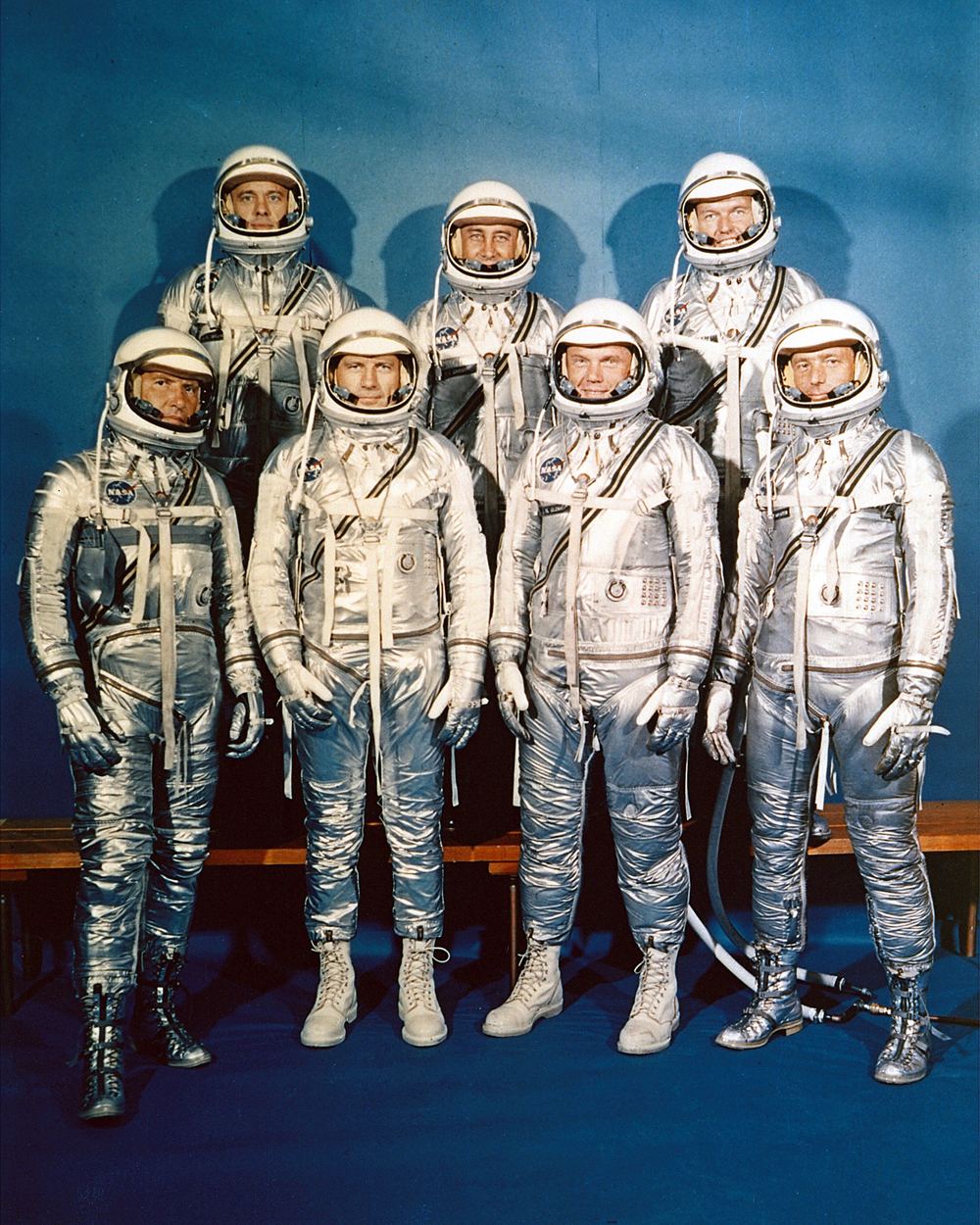
Project Mercury's astronauts became known as the Mercury 7.
JohnHOST
They were America's first group of astronauts, selected in 1959 from an initial pool of 508 military test pilots.
JohnHOST
3.

TowerHOST
The space program followed the same logic.
TowerHOST
Mercury, Gemini, Apollo.
TowerHOST
And at the individual mission level, the astronauts named their own vehicles.
TowerHOST
Gus Grissom called his Mercury capsule Liberty Bell Seven.
TowerHOST
Alan Shepard named his Freedom Seven.
TowerHOST
John Glenn flew Friendship Seven.

Simon WhistlerHOST
Today, we're gonna take a look at all the most mysterious and strange events that astronauts have reported seeing during space missions, and then explore what possible explanations could account for them, if any at all.
Simon WhistlerHOST
The Mercury fireflies.
Simon WhistlerHOST
To start with, we have to go further back than NASA's famous Apollo missions that put a man on the moon.
Simon WhistlerHOST
Before Apollo, there was Gemini.
Simon WhistlerHOST
There's also that, uh [laughs], thing that replaced my Google search.
Simon WhistlerHOST
And before Gemini, there was Mercury.
Simon WhistlerHOST
It happened during the early years of the space race between the United States and the Soviet Union, and its main goal was to send a man into space.
Simon WhistlerHOST
Six crewed missions took place between 1961 and 1963, and we're interested in the third one, Mercury-Atlas 6.

WyattHOST
Hence, Gemini is known as the twin constellation.
WyattHOST
And in December of 1961, in the midst of the Mercury program, the Gemini program was announced by NASA.
WyattHOST
It spanned 12 missions, 10 of which were crewed and lasted about five years total.
WyattHOST
Gemini was essentially the bridge between Mercury and Apollo.
WyattHOST
I'm Wyatt and welcome back to the 10 Minute Universe.
WyattHOST
Your Center for Space Phenomena and History Simplified.

Annie LarnerHOST
Oh.
Brady SteffelHOST
"His name was Gordon Cooper, and his mission, the final flight of Project Mercury, would last longer, fly, fly further, and test human endurance more than any solo space flight in history." Well, if that's a shout-out to that, that's a deep cut and also pretty darn cool.
Annie LarnerHOST
[laughs] Totally.
Brady SteffelHOST
If you know who has that plate, uh, sidedishlongmont@gmail.com. That's cool.

Daven HiskeyHOST
For in August of 1958, the government of President Dwight D. Eisenhower decided to consolidate all manned spaceflight efforts under the auspices of the newly formed National Aeronautics and Space Administration, or NASA.
Daven HiskeyHOST
A new civilian space program, Project Mercury, was soon announced and a nationwide search began for America's first group of astronauts.
Daven HiskeyHOST
Less than a year later, on April 9, 1959, the seven finalists were revealed at a press conference in Washington, D.C. As per NASA requirements, all were married military test pilots aged less than 40 measuring less than 5 feet 11 inches tall, and possessing a science or engineering degree.
Daven HiskeyHOST
The final group selected was Malcolm Scott Carpenter, Leroy Gordon Cooper, John Glenn, Virgil Gus Grissom, Walter Shearer, Alan Shepard, and Donald Deke Slayton.

Aidan MattisHOST
happened and not why it might you know not how it worked necessarily but why it happened and what needs to be said about how it worked to get there so beginning with the uh you know joe could you walk me through like the apollo the stages of the apollo mission
JoeGUEST
um yeah so i'm I guess if you want to get like a full insight of what happened there, you would actually probably start with the Mercury and Gemini programs, which kind of were the stepping stones to get to the Apollo program.
JoeGUEST
So you had, you know, Project Mercury, first person in space.
JoeGUEST
You had Gemini where we were getting into orbit.
JoeGUEST
And then you had the Apollo program.
Aidan MattisHOST
It's just aeronautics, for some reason, probably because of its military usefulness, just accelerates so fast compared to everything else.
Aidan MattisHOST
If you look at the difference between cars 100 years ago and cars now, I think planes are a much bigger change.
Aidan MattisHOST
So as we get to the point of preparing to launch a moon mission, Mercury is about getting into space.